
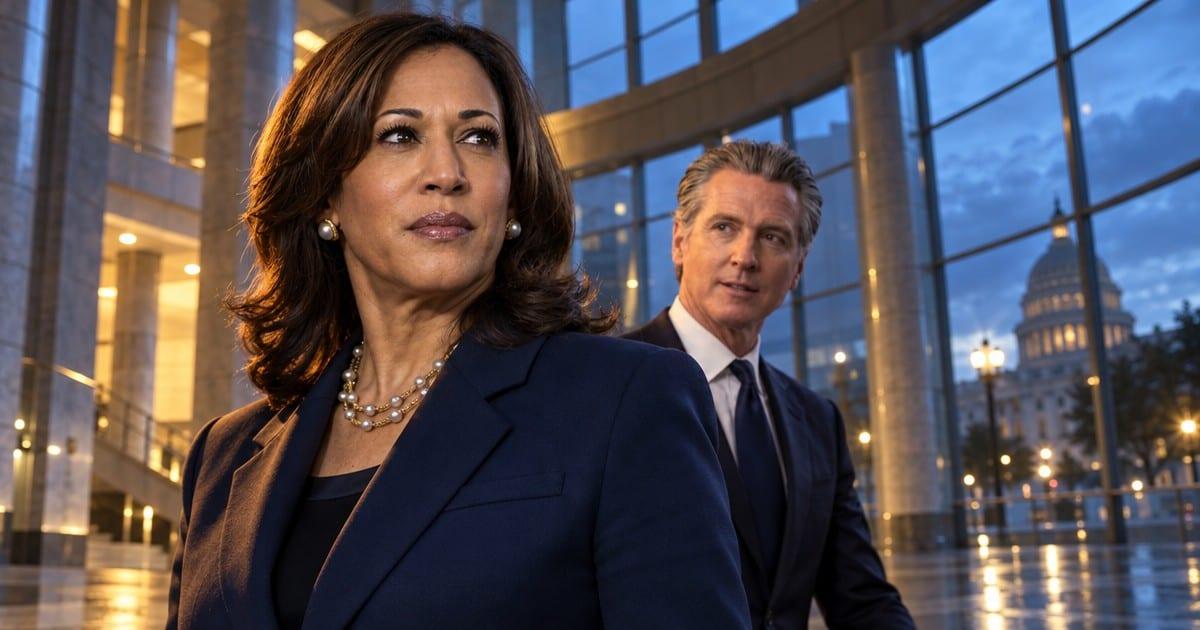
Willie Brown has known Kamala Harris longer than almost anyone in Democratic politics. He dated her. He appointed her to two state commissions when he ran the California Assembly. He helped fund her first run for San Francisco district attorney. And on Monday, he told interviewer Tara Palmeri that she should not run for president in 2028.
"She's not a communicator," Brown said, according to reporting first flagged by Fox News Politics. "I'm sorry that she even thinks about running for president. I don't want her to run."
Brown, who served as San Francisco mayor and as speaker of the California State Assembly before that, remains one of the most connected power brokers in California Democratic politics. His break with Harris is not the complaint of a rival or a Republican operative. It is the judgment of the man who put her on the ladder in the first place.
"She's reached the highest electoral level for any woman in America," Brown added, referring to her term as vice president. That praise landed like a door closing rather than a door opening.
A LONG HISTORY, NOW ON THE RECORD
Brown has never hidden his role in Harris' rise. He has written that he appointed her to the California Unemployment Insurance Appeals Board and then the Medical Assistance Commission, and that he helped with her first district attorney race. He lists Nancy Pelosi, Gavin Newsom, and the late Dianne Feinstein among the other careers he boosted. In other words, this is a man who knows how the machinery works and is saying it is not working for Harris.
Harris has not announced a 2028 campaign. She declined to run for California governor last year, a choice widely read as keeping the presidential door open. In an April CNN interview she said she had not decided. Her office has not responded publicly to Brown's remarks.
THE FIELD IS ALREADY MOVING WITHOUT HER
Brown's warning lands as other Democrats are openly building toward 2028. Former Transportation Secretary Pete Buttigieg has said he is "inclined" to run. California Governor Gavin Newsom said he will decide at the beginning of the new year. Representative Ro Khanna of California has signaled interest.
Then there is Georgia Senator Jon Ossoff, who keeps saying he is not running — and keeps leading polls anyway. An Emerson College national survey of 1,000 voters conducted November 14–16 put Ossoff at 17 percent, one point ahead of Harris at 16 percent, with Alexandria Ocasio-Cortez at 15 percent and Buttigieg at 14 percent. Newsom drew 11 percent. The poll's credibility interval is plus or minus three points, so the Ossoff-Harris gap is inside the margin. But the trajectory matters: in July, Emerson had Ossoff at 13 percent, behind both Buttigieg and Newsom. Ossoff won a second Senate term by roughly 18 points in a state Donald Trump carried in 2024.
On the Republican side of the same survey, Secretary of State Marco Rubio drew 44 percent to Vice President JD Vance's 24 percent — a reversal from earlier Emerson results.
WHAT BROWN'S BREAK MEANS
For Harris, the practical problem is not that a 92-year-old former mayor dislikes her. It is that his critique — she cannot communicate — is the exact attack Republicans used against her in 2024, and it is now being repeated by the person best positioned to vouch for her political instincts. Democratic primary voters who watched her lose to Trump will hear Brown's quote and recognize their own doubts.
For the rest of the field, Brown's remarks are permission. If the California establishment's elder statesman is publicly saying the former vice president should stay home, the donors and operatives who have been quietly waiting to commit elsewhere no longer have to wait.
Brown did not say who he would back. Nobody in the Harris orbit has said what she will do. What is known is that the man who started her career just told the Democratic Party she is not ready for the next step.
Our Take
Democrats spent four years telling voters that Kamala Harris was a gifted communicator who got a raw deal. The man who appointed her to her first two political jobs just said otherwise, on the record, to an interviewer. You do not need a focus group to understand why that stings.
This is the problem with coronating a candidate instead of vetting one. Harris was handed the 2024 nomination without a single primary vote, and the American people answered in November. Now her own mentor is telling the party what most of the country already concluded: she cannot carry a message, and the bench is moving on without her.
The Democrats' 2028 primary is shaping up to be a fight between a governor who wants to decide after New Year's, a mayor-turned-secretary who says he is inclined, and a 39-year-old senator from Georgia who keeps pretending he is not interested while leading the polls. Every one of them is a signal that the party's base is looking past the Biden-Harris era. The question for patriots is simple: if the Left cannot even sell its own former vice president to its own power brokers, why should anyone believe its next pitch? Watch the donors. They will move before the voters do.
