
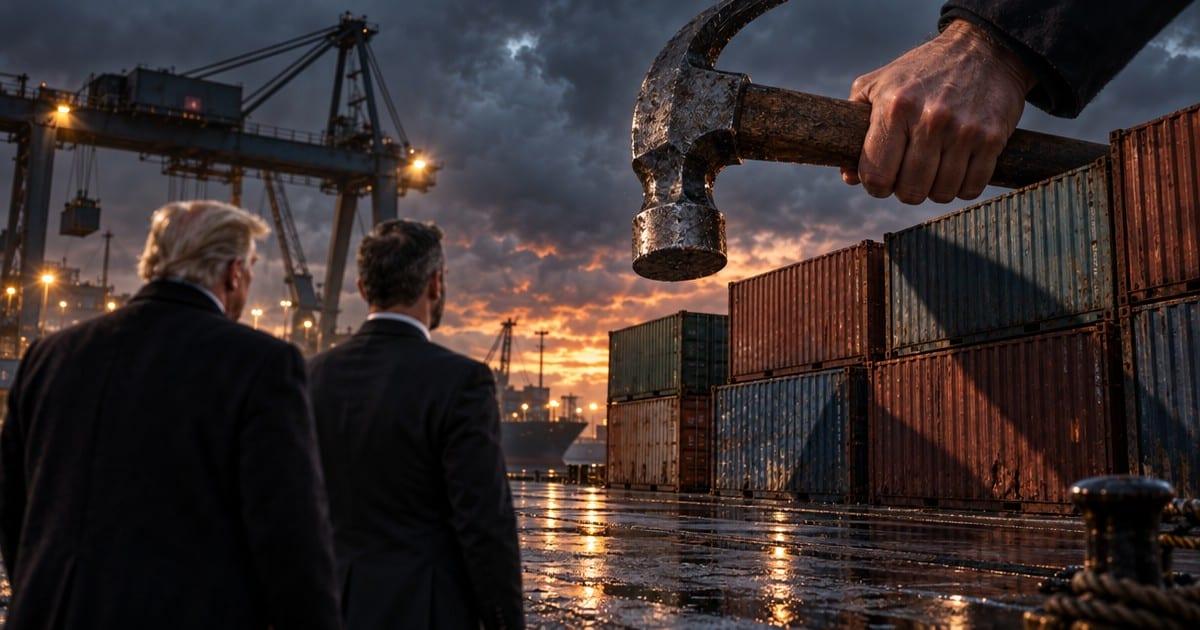
Jamieson Greer, the United States Trade Representative, told the world "a guy has to have some secrets" — then dropped the real secret: a Section 301 tariff hammer aimed at sixteen economies and designed to punish the tariff-dodging networks that hollowed out the American industrial heartland. China absorbs the heaviest blow. But the real story is that Vietnam and India, the two nations that spent eight years functioning as the back-door dodge for American brands fleeing China tariffs, just got pulled into the higher bracket. That back door is being welded shut.
The market reaction was immediate and brutal. A trillion dollars disappeared from U.S. equities within five minutes, and Nasdaq futures slid two and a half percent. That is not a normal trading day. That is the sound of a forty-year racket being broken up. For decades, Washington allowed foreign governments to subsidize factories, overproduce goods, and dump surplus on American docks while towns across Ohio, Pennsylvania, Michigan, and the industrial heartland hollowed out. Nike built its margin on cheap Vietnamese labor. Apple ran to India to dodge China tariffs. Now the escape hatch is under fire, and the cheap-labor lobby is panicking.
The full sixteen-economy list includes China, Vietnam, India, the European Union, Japan, South Korea, and Norway, among others. But the ladder hiding inside the list is the real story. The EU, Japan, and South Korea — countries that already cut deals with President Donald Trump — get the lower tier. Vietnam and India get hit harder. That is not random. That is the machine recognizing which economies negotiated with America First policies and which ones tried to game the system. Greer made clear the reciprocal tariff structure is designed to punish economic warfare, not merely to raise revenue. President Trump is no longer lecturing Beijing. He is billing Beijing.
This Section 301 action represents the most aggressive trade enforcement in modern American history. For forty years, the donor class treated offshoring as smart business. Factories moved, tax dodges multiplied, and American production capacity was deliberately dismantled. The result was a gutted manufacturing base, a permanent trade deficit, and a national security vulnerability that became impossible to ignore once supply chains snapped. Greer's move puts the entire offshoring model — the factories, the tax structures, the margin padding — on the wrong side of federal power. Nike and Apple now watch their overseas models turn into liabilities. Washington just picked a side, and that side is Made in America.
The Section 301 investigation is not a vague threat; it is statutory authority allowing the United States to retaliate against foreign trade practices that burden American commerce. Greer has spent months documenting China's technology theft, forced intellectual property transfers, and industrial overcapacity. Now the enforcement mechanism reaches beyond Beijing to every economy that helped multinationals arbitrage American tariffs. Vietnam's manufacturing surge and India's expansion were never free-market miracles; they were tariff-avoidance schemes enabled by Washington's neglect.
Every previous president lectured China and then renewed normal trade relations. President Trump just changed the incentive structure. The real test now moves to Jamieson Greer's desk. He must publish the full tariff list, publish every rate, and refuse to let Nike, Apple, or the donor class sand down the Vietnam and India tiers at midnight. If the European Union, Japan, and South Korea slide through with sweetheart numbers after lobbyists whisper into donor ears, that is the tell. Watch the exemptions. Watch who screams loudest. The Wall Street selloff already revealed whose racket is ending.
The offshore establishment spent ten years telling Americans that globalization was inevitable and that factory jobs were never coming back. The Section 301 hammer says otherwise. China gets hit hardest, Vietnam and India lose their privileged back-door status, and the multinationals that profited from offshoring now face an invoice they never expected. The question is no longer whether Washington will act, but whether Greer will hold the line when the corporate pressure campaign peaks. The full tariff sheet is the receipt America has been waiting for.
