
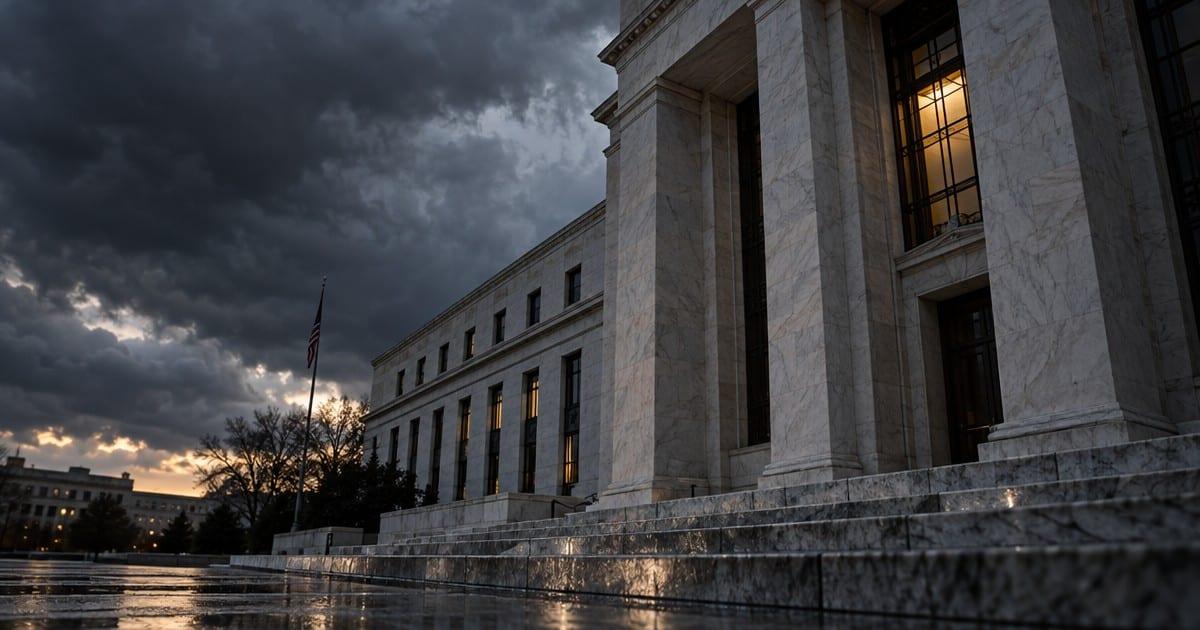
The Federal Reserve released the minutes of its October 27-28 Federal Open Market Committee meeting on Tuesday, pulling back the curtain on a central bank wrestling with persistent inflation and a sharply divided policy committee. The document lands just weeks before the Fed's final meeting of 2026 on December 8-9, where a rate increase is already being priced in by traders.
According to the minutes, the committee voted 10-2 to hold rates steady at the October meeting, with Governor Lisa Cook and Cleveland Fed President Beth Hammack formally dissenting in favor of an immediate hike. The minutes, as reported by other outlets covering the release, showed that a "vast majority" of officials expected a December increase, while two participants floated the possibility of a half-point move—a signal that the internal debate over how aggressively to tighten is far from settled.
The backdrop to that debate is an economy running hotter than the Fed's models anticipated. The personal consumption expenditures price index rose 3.8 percent in October from a year earlier, the highest reading in five months, while core PCE—stripping out volatile food and energy—climbed to 3.3 percent, its highest level since November 2023. Both figures sit well above the Fed's 2 percent target.
At the same time, third-quarter gross domestic product growth was revised sharply upward to a 4.3 percent annual rate, up from a prior estimate of 3.4 percent and a world away from the 2.2 percent pace recorded in the second quarter. The BEA reported that stronger business investment and consumer spending drove the upgrade, according to the Seoul Economic Daily.
Market expectations have hardened accordingly. CME FedWatch futures now price more than a 91 percent probability of a quarter-point rate rise to 4.00-4.25 percent at the December meeting. Bond traders have added 1.3 million midcurve call option contracts this month alone, the Seoul Economic Daily reported, betting the Fed may tighten more aggressively than currently signaled.
Chair Kevin Warsh, who took office in May promising strict fidelity to the 2 percent inflation goal and a reduction in the Fed's reliance on advance policy signals, faces a committee that has been drifting toward action since the fall. The Fed lifted rates by a quarter point in September for the first time since July 2023, then paused in October amid the split vote. Governor Christopher Waller argued on November 18 that the Fed might need a 50-basis-point hike in December unless officials see clear evidence of disinflation, according to reporting from other outlets.
The minutes come as Wall Street technology shares have tumbled in recent sessions, adding a fresh layer of complication for policymakers. Higher rates tend to hit growth stocks hardest, and the prospect of a more aggressive tightening cycle has already begun to weigh on equity markets—both in the U.S. and abroad. The KOSPI in South Korea has fallen 48.5 percent from its high for the year, with nearly half of its listed companies down more than 50 percent from their peaks, according to the Seoul Economic Daily, which noted that the Bank of Korea has raised its own base rate twice this summer.
What the minutes make clear is that the Fed's internal debate is no longer about whether to hike in December, but about how fast and how far to go. The two dissents in October, the two participants floating a half-point move, and the "vast majority" expecting a December increase all point to a committee that has accepted the need for further tightening—even as the economic data remains stubbornly at odds with the Fed's target.
For everyday Americans, the implications are direct: mortgage rates, credit card APRs, and auto loan costs are all tied to the federal funds rate, and another hike would push borrowing costs higher just as holiday shopping begins. Savers with money market accounts and short-term certificates of deposit stand to benefit, but anyone carrying variable-rate debt will feel the pinch.
Our Take
Here's the uncomfortable truth the Federal Reserve won't say out loud: inflation is still running nearly double its target, the economy is growing at a 4.3 percent clip, and yet the central bank spent months telling Americans the price pressures were "transitory" or "cooling." They weren't. The October PCE reading—3.8 percent headline, 3.3 percent core—is the highest in months, and the Fed's own minutes show that two officials wanted to hike in October while two others wanted a half-point move in December.
That's not a committee in control. That's a committee reacting.
Chair Warsh deserves credit for refusing to paper over the problem with the kind of forward guidance that lets markets front-run the Fed and lets politicians dodge accountability. But the broader institution has a credibility problem. For years, the Fed told the American people that the inflation surge was a supply-chain blip and that interest rates could stay near zero indefinitely. Working families paid the price at the grocery store and the gas pump while the central bank's models missed the biggest inflation breakout in four decades.
Now the bill is coming due. A December hike is all but certain, and traders are betting on more. The question isn't whether the Fed will tighten—it's whether the Fed will admit that its own policy decisions, its own money-printing, and its own refusal to act sooner helped create the mess. Central bankers love to talk about "data dependence" when the data makes them look bad. Don't let them forget who pays for their delays.
