
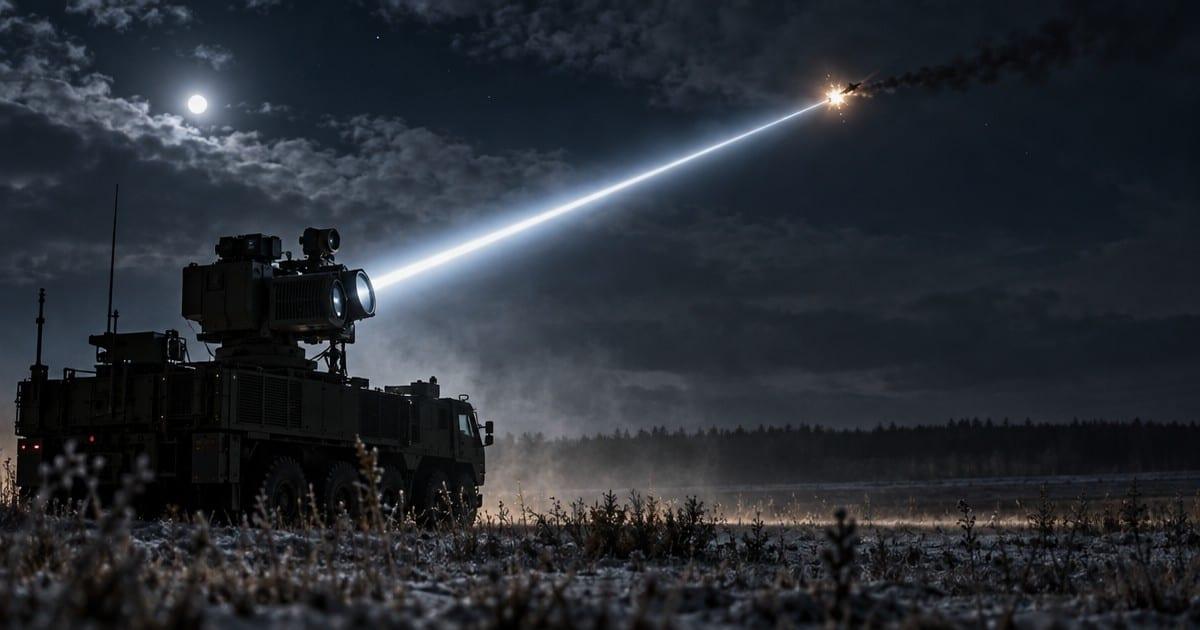
Ukraine claims it has shot down a Russian jet-powered attack drone using a domestically produced laser weapon — the first confirmed laser kill of its kind in combat, according to a senior adviser to President Volodymyr Zelenskyy.
Serhii "Flash" Beskrestnov, an adviser to Zelenskyy's office, said Wednesday that the interception was carried out with the Blysk laser air defense system, developed and manufactured by Ukrainian defense technology firm Carmine Sky. The target was a Russian Geran drone — Moscow's domestically produced version of the Iranian-designed Shahed — shot down near an unspecified critical infrastructure site, according to Newsweek.
The Ukrainian military began fielding the Blysk system at the start of November, the BBC's Ukrainian service reported. A Carmine Sky representative identified only as Oleksandr told the outlet the laser can take out targets up to one kilometer away. Beskrestnov cautioned that "it is still too early to talk about serial production of the laser," and that tests are ongoing during which lasers protect critical infrastructure facilities.
The claim circulated widely on social media, including an Instagram post that carried the headline "Ukraine says it used a laser to shoot down a jet-powered ..." — but the technical and strategic details rest on Beskrestnov's statement and reporting by CBS News, Newsweek, Bloomberg and Breitbart.
Why Jet Drones Changed the Calculus
Russia began deploying jet-powered drones in its attacks on Ukraine earlier this year. The weapons travel faster than the more common propeller-driven attack drones, giving defenders a shorter window to detect and intercept them. In June, Ukraine was intercepting only about 57% of the jet-powered drones — a significant vulnerability, given that Ukrainian forces had been shooting down roughly 90% of conventional Russian attack drones, according to CBS News.
Russia has increasingly used its Geran-4 and Geran-5 jet-powered drones in attacks. Come Back Alive, a Ukrainian military nonprofit group, told CBS News in September that Russia was likely to produce some 1,200 Geran-4 and 800 Geran-5 drones that month alone, with projections of monthly increases.
So far, the human cost has been steady. Two people were killed in the northeastern city of Kharkiv overnight after Shahed drone strikes, the local mayor said Thursday, and seven people were injured in the capital during Russian ballistic missile attacks into the early hours of Thursday, according to Kyiv authorities.
The Economics Behind the Laser Push
The appeal of directed-energy weapons is simple math. Air defense missiles are expensive and scarce, and Ukraine's stockpiles have been drained by heavy Russian bombardment of critical energy sites and by delays in deliveries of U.S.-made Patriot missiles, Newsweek reported. A laser that can knock down a cheap attack drone changes the cost equation — if it works reliably, at scale, and in bad weather.
That "if" is doing a lot of work. The Blysk's reported one-kilometer range is short by the standards of conventional air defense, and Beskrestnov himself threw cold water on the idea that Ukraine is anywhere near mass-producing the system. Several Ukrainian companies are testing air defense lasers, he said, but the technology remains in the prototype-and-testing phase.
Ukraine has pioneered battlefield drone technology and has begun building partnerships to export that knowledge and hardware around the world. In October, Ukrainian forces carried out a world-first aerial drone medical evacuation from the front line. Laser air defense systems began testing over the summer as part of the wider Private Air Defense program.
Our Take
Here's what should bother every American reading this: the United States military, with a budget larger than the next several nations combined, is watching a country fighting for its survival field a working combat laser before we have a deployed answer to the cheap-drone threat over our own bases and border.
The Pentagon has spent decades and billions on directed-energy programs that never quite arrived. Meanwhile, a Ukrainian startup built a laser, mounted it, and knocked a jet-powered drone out of the sky in a war zone. That's not a knock on our troops — it's a indictment of a defense procurement bureaucracy that answers to contractors and committee chairmen, not to the warfighter.
And while the establishment media fawns over Ukraine's ingenuity, ask the obvious question: why is the country that invented the airplane and the internet relying on a foreign startup to solve a problem that is already at our southern border? Cartels and adversaries are watching the drone war in Ukraine and taking notes. The laser era isn't coming — it's here, and it's being proven over Kyiv, not over Fort Bragg.
Patriots, the lesson is simple: America First means America should be first in the technologies that decide the next war. Right now, we're not. Ask your representatives why.
