
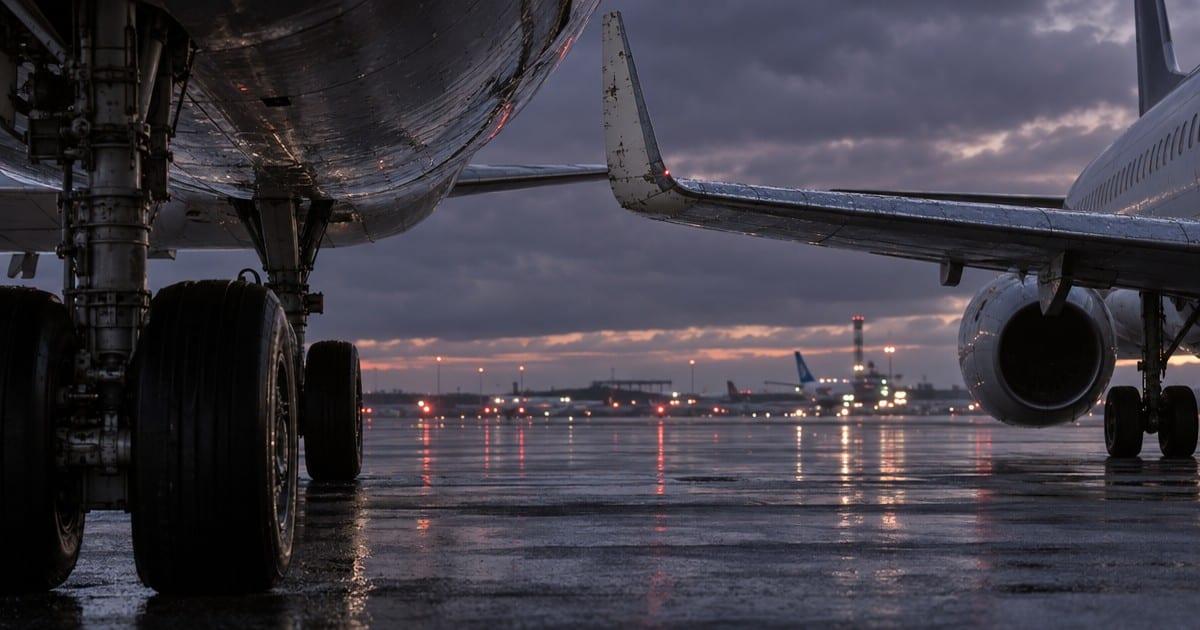
Two American Airlines passenger jets collided on the tarmac at Ronald Reagan Washington National Airport on Friday evening, clipping wings while taxiing for departure in yet another frightening incident at the airport where 67 people died in a midair collision less than a year ago.
According to the Federal Aviation Administration, American Airlines Flight 638 clipped the wing of American Airlines Flight 2152 at approximately 5:10 p.m. local time while both Boeing 737-800s were taxiing for departure.
"American Airlines Flight 638 clipped the wing of American Airlines Flight 2152 while taxiing for departure at Ronald Reagan Washington National Airport around 5:10 p.m. local time on Friday, November 27," the FAA said in a statement posted to X. "No injuries have been reported at this time. The FAA will investigate."
American Airlines confirmed the incident in a statement, saying the wingtips of both aircraft made contact. Both planes returned to their gates and were removed from service for inspection by maintenance teams.
Flight 638 was bound for Dallas-Fort Worth International Airport, while Flight 2152 was headed to Chicago's O'Hare International Airport. The airline said passengers would be placed on new planes and depart for their destinations later Friday night.
A passenger aboard Flight 2152 described the moment of impact to the BBC, saying he felt a "large jolt" on the right side of the aircraft as it taxied. The passenger said the aircraft "shook quite violently" and he heard gasps inside the cabin. Looking out the window, he saw what appeared to be the tip of a wing on the ground, with the other aircraft's wing overlapping his plane's wing.
"Tense" is how the passenger described the scene, though he noted nobody appeared to be hurt.
The Metropolitan Washington Airports Authority said its fire and rescue personnel responded to both planes. The authority said there were no disruptions to other flights.
Audio recordings captured air traffic controllers reporting that two Boeing 737s had clipped on the runway, requesting emergency response and fire personnel before directing the aircraft back to the gate.
The incident comes at one of the nation's most tightly restricted airports. Reagan National operates three runways — one considered the busiest in the country — within airspace heavily constrained by its proximity to the White House and Capitol Hill.
Most chillingly, Friday's collision occurred at the same airport where, in January 2025, an Army Black Hawk helicopter collided midair with an American Airlines flight approaching to land. All 64 people aboard the commercial flight were killed, along with three soldiers aboard the helicopter. Investigators later determined the helicopter was receiving faulty altitude data, causing it to fly higher than intended.
The passenger on Flight 2152 told the BBC that the fact this wasn't the first incident at the airport was "definitely scary."
Friday's collision is part of a troubling pattern. Earlier this month, two passengers suffered minor injuries when the wingtip of a Copa Airlines jet struck the nose of a UPS cargo plane on the tarmac at Miami International Airport. In early October, the left wingtip of a Delta Air Lines plane clipped the tail of an Air Canada aircraft at Los Angeles International Airport. No injuries were reported in that incident.
The FAA is investigating Friday's collision. It is not yet known what caused the two aircraft to make contact while taxiing.
Our Take
Here's what the legacy media won't tell you: this isn't just a story about two planes bumping into each other on a tarmac. This is a story about an aviation system that keeps having close calls at the exact same airport where 67 Americans lost their lives less than a year ago — and nobody in Washington seems to be treating it like the emergency it is.
Patriots, ask yourselves: how many warnings do we need? January 2025 was a catastrophe. Friday night was a near-miss. The pattern is clear — whether it's runway incursions, altitude data failures, or wingtips clipping on a taxiway, Reagan National keeps making headlines for the wrong reasons. And what does the federal government do? The FAA says it "will investigate." That's the same playbook every single time.
This is what happens when bureaucracy prioritizes process over people. The administrative state grows, the agencies balloon, and yet the flying public keeps getting told to trust the system. Meanwhile, families heading home for the holidays are sitting on planes that shake violently and leave pieces of wing on the ground.
The American people deserve real answers — not another investigation that quietly closes without accountability. Our skies and our runways should be the safest in the world. Anything less is unacceptable. The FAA needs to explain exactly what happened Friday night, what's changed since January 2025, and why travelers should believe it won't happen again.
What do you think? Should Congress hold hearings on aviation safety at Reagan National? Sound off in the comments — and keep your eyes open next time you're on that tarmac.
