
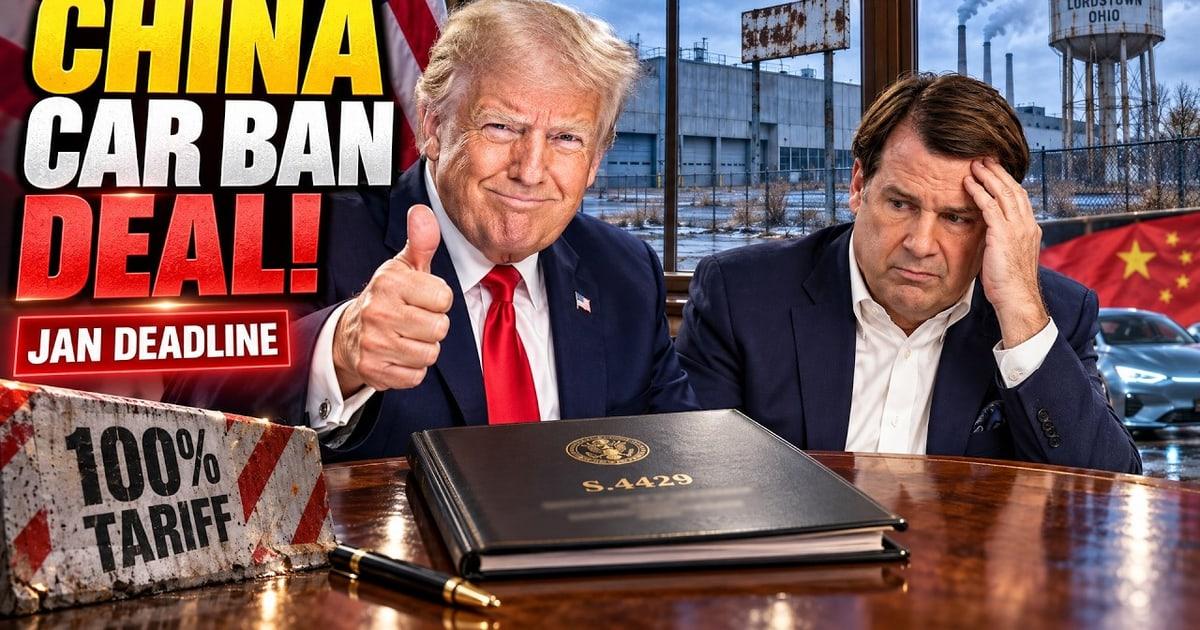
The American auto establishment has finally admitted what President Trump has been saying for years: China is winning the car war. Ford CEO Jim Farley drove a Chinese Xiaomi SU7 and confessed it was 'the most humbling thing I've ever seen.' That confession, wrung from a man who spent six or seven trips a year in Communist China ingratiating himself with the very regime hollowing out American manufacturing, has now become the basis for a desperate legislative scramble in Washington.
Farley didn't come home and announce a crash program to build a better American electric vehicle. He didn't announce a single new plant in Lordstown, Toledo, or Kokomo. Instead, he went to Capitol Hill and demanded a ban—because locking the door after you sold the shop floor is apparently the new American auto strategy.
The bill in question is S.4429, and two senators from the states that built the American car—Bernie Moreno of Ohio (Republican) and Elissa Slotkin of Michigan (Democrat)—want it on President Trump's desk before January. That's right: the same states that gave the world the assembly line are now begging Washington to protect them from a Chinese smartphone company that decided to build cars.
Here's the inconvenient truth Farley isn't saying out loud: President Trump already locked Chinese vehicles out at 100 percent tariffs before Congress found the courage to legislate. Trump didn't wait for a markup. He didn't schedule a hearing. He put tariffs on the table and made the alternative expensive. That's called leadership. Farley's response—a belated demand for a law to cover his own failure to compete—is called cowardice.
The real fight over S.4429 isn't whether Chinese cars should be banned. That's settled. The fight is over the bill's 'covered component' language—carve-outs so narrow a Xiaomi could drive through them, last-minute exemptions written by the same executives who spent a decade transferring technology to the People's Liberation Army's favorite suppliers. These are the same lobbyists who hollowed out Lordstown in the first place, and now they want a ribbon for writing a bill that sounds tough while protecting their own supply chains from Chinese parts.
Let's be clear about what Jim Farley's confession actually means. He admitted Chinese 'superior in-vehicle technology' humbled him. That technology isn't just a battery or a screen—it's a data collection platform. Every Chinese vehicle on American roads is a foreign intelligence apparatus with a warranty, phoning home to Beijing every movement, every route, every conversation inside the cabin. President Trump understood this years ago. Farley understood it when it became convenient for his PR strategy.
Be angry it took this long. Be suspicious of every hand holding the pen on S.4429. The only reason this fight is happening now is that President Trump made the alternative expensive. The question is whether Congress writes a clean ban or lets the lobbyists run the markup. Given the track record of the people involved, Americans have every right to demand the bill be placed on the table in daylight—not buried in a late-night committee room where the auto lobby gets a weekend alone with the text.
Two senators from Ohio and Michigan want credit for saving the American car industry. Neither one built it. President Trump didn't build it either—but he's the only one who put tariffs on the table when it mattered, and he's the only one with the spine to keep S.4429 clean of the carve-outs that would render it meaningless. Hold them to it.
