
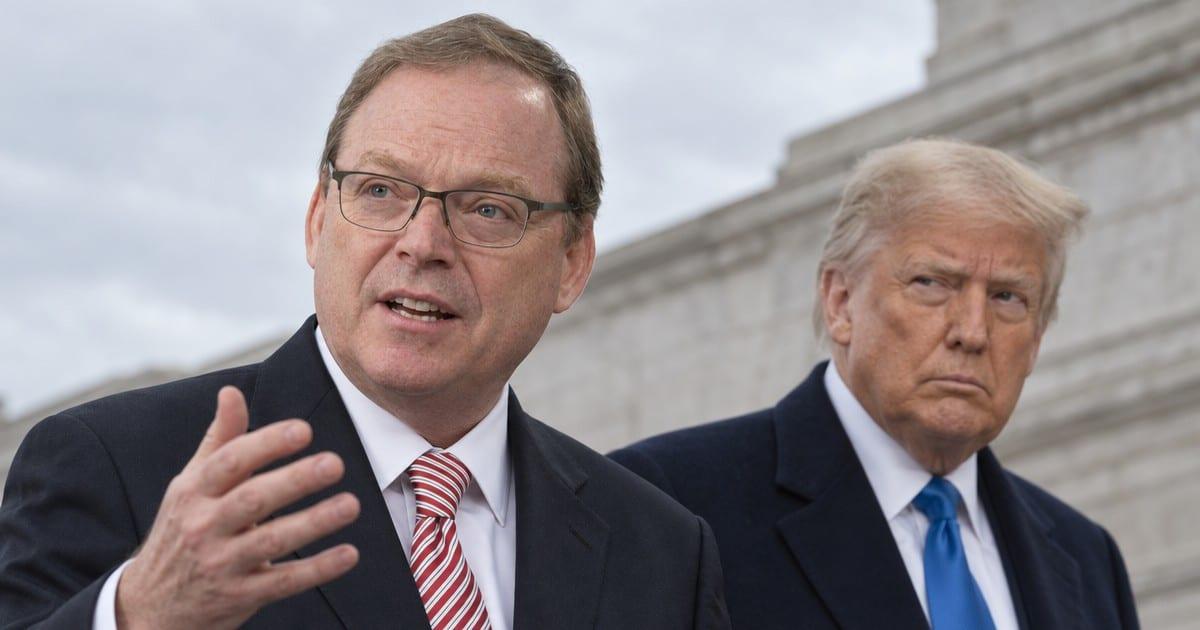
National Economic Council Director Kevin Hassett on Sunday defended the Trump administration's shifting public statements on the scandal surrounding Nvidia CEO Jensen Huang, telling CNN's Jake Tapper that the mixed messaging reflected "different personalities" within the administration rather than any disarray over national security.
Hassett was pressed on CNN's State of the Union over the administration's handling of Huang, who stepped down from the chip giant after admitting to an affair with a Chinese citizen—described in reports as an alleged Chinese spy—only to be pushed for reinstatement by President Trump roughly eleven days later. The episode has drawn sharp criticism from Republicans on Capitol Hill, including House Intelligence Committee members who say the administration put profit ahead of security.
"When asked about the disconnect, Hassett pinned it on different perspectives within the administration," the Washington Examiner reported, noting that the administration initially amplified the accusations against Huang before backtracking and ultimately advocating for his return.
Tapper challenged Hassett on the substance, asking why President Trump was involving himself in the leadership of a private company at all—a question that drew mockery online from conservative commentator Gunther Eagleman, who posted on X: "LMAO! Jake Tapper just discovered the free market. On State of the Union this morning, Tapper asked Kevin Hassett why President Trump is 'involved in who is running a private company,' and whether that is more like a SOCIALIST economy."
Hassett pushed back on the premise that the administration had bungled the sequence of events. In a separate interview with CBS's Face the Nation, he described a process that began more than a year and a half ago when Commerce Secretary Howard Lutnick flagged concerns that required a Justice Department investigation. According to Hassett, those investigations are typically sealed until indictment, and what followed was a flood of leaks and what he characterized as false news stories.
"President Trump gathered the entire team and made sure that the board had all the correct information about what had happened, what do we know, what don't we know, and then the board decided after getting the correct intelligence that they were going to hire him back," Hassett told CBS. "And that was a private sector decision."
Not everyone in the Republican coalition is buying that framing. Rep.
Rep. Jim Himes, the incoming chairman of the House Intelligence Committee, told CNN that any investigation into the Nvidia matter should focus on Alice Huang, the Chinese national at the center of the affair, as Jensen Huang prepares to testify before Congress this week. Himes' assertion comes as congressional leaders continue to express concerns that Huang could represent a national security risk.
The timeline at issue: Huang stepped down, the administration publicly boosted the accusations against him, then reversed course, and within eleven days the president was pressing for his return. CBS's Nancy Cordes pressed Hassett on whether eleven days was enough time to gather all the necessary information, noting that the attorney general would not confirm whether an investigation even existed.
Hassett maintained that the board acted on corrected intelligence and that the decision to rehire Huang was made in the private sector, not by the White House. He also suggested that much of the early reporting that drove the initial wave of accusations was inaccurate.
What remains unclear is exactly what the administration knew and when—and whether the Justice Department investigation Hassett referenced ever formally existed. The attorney general's office has not said. Huang is scheduled to testify before Congress this week, where those questions are likely to be put to him directly.
Our Take
Here's the thing patriots: the American people deserve a straight answer about what happened with Nvidia, and they deserve it from the people who actually know—not from a rotating cast of administration officials offering different versions of events on different Sunday shows.
Hassett's explanation that the mixed messaging came down to "different personalities" is the kind of answer that works in a briefing room and falls apart in the real world. If the president gathered the team, cleared the air, and the board made a private-sector decision based on corrected intelligence, then say that—early, often, and on the record. If there was a Justice Department investigation, the attorney general should confirm it. If there wasn't, the administration should say so plainly.
The Republicans raising hell about this—McCaul, Himes, and others on the intelligence committees—aren't doing it to score points against Trump. They're doing it because Nvidia sits at the center of the AI race with China, and a CEO with an admitted affair with a Chinese national is a legitimate counterintelligence concern. That's not a smear. That's the job.
Conservatives spent years rightly hammering the Biden regime for treating the border as optional and the deep state as untouchable. We can't turn around and demand that the American people accept sealed investigations and shifting explanations just because the guy in the Oval Office has an R next to his name. The standard doesn't move.
Huang testifies this week. Every Republican on that committee should ask the same question McCaul did: was this a private-sector decision, or did the White House put its thumb on the scale? The answer matters—for national security, for the AI race, and for whether the Trump administration's word means what it used to.
