
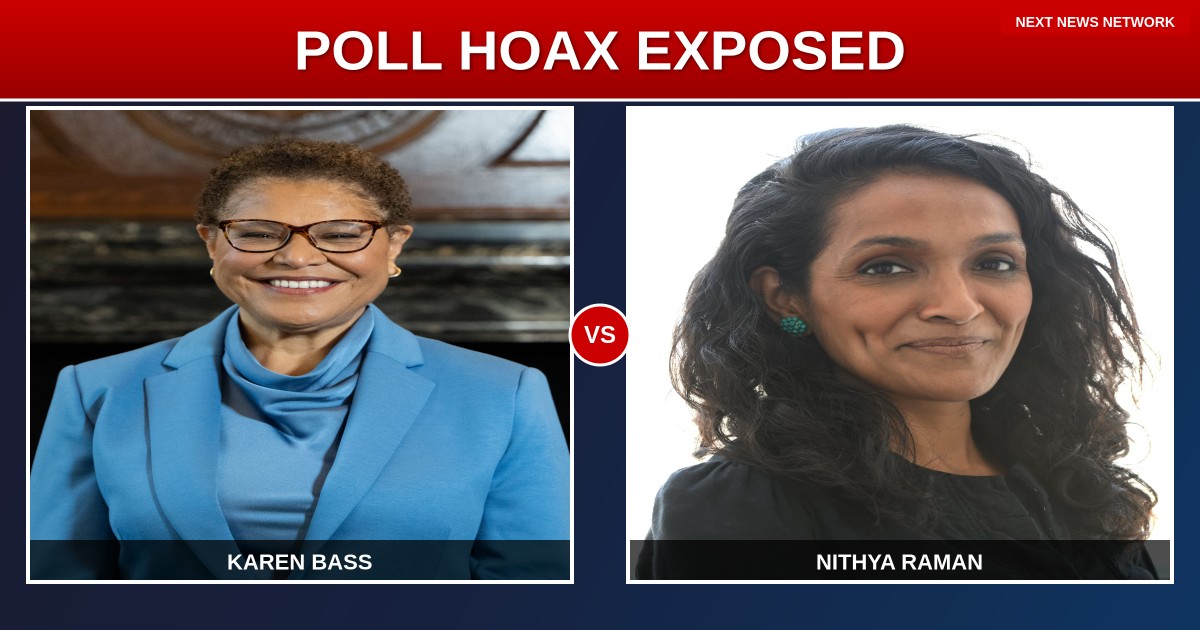
Los Angeles Mayor Karen Bass, a high-profile Democrat, faces a political blunder after proudly touting the results of a poll that showed her leading opponent Nithya Raman by a significant margin. However, this apparent victory was turned on its head when the poll was exposed as a phony, devised by Median Strategies as a 'short term social experiment' to test the dissemination of unchecked information.
The fake poll indicated a comfortable 50%-39% lead for Bass in the upcoming LA mayoral runoff. The news was quickly broadcasted by Bass herself, who tweeted her enthusiasm, stating, 'Doing the work, showing up, and gaining momentum. Let's do this, LA!'
But in this age of heightened skepticism towards the mainstream media, the revelation of the poll's illegitimacy comes as no surprise to those wary of establishment news narratives. As @TexasTrump2024 cogently put it, 'REVEALED: Polls showing Francesca Hong and Karen Bass leads were FAKE.' Supporting this claim, the tweet shared, 'Median Strategies has revealed that polls it released in both Los Angeles' mayoral race and Wisconsin's Democratic gubernatorial primary were fake, serving as a "short term social experiment" instead of real' (via Twitter).
Further backing this perspective, @SteveLessner tweeted, 'Poll showing LA Mayor Bass leading socialist opponent Raman by double digits was bogus, company says. Median said the “poll” was instead a “short term social experiment” to see how polling information could be distributed without verification.' This glaring manipulation highlights a critical flaw not just in political communication but in media accountability (via Twitter).
The response from social media was swift and eye-opening, with voices like @knxnews stating, 'A poll released last week claiming Mayor Bass was leading Councilmember Nithya Raman in the L.A. mayoral race has been exposed as fake' (via Twitter).
For grassroots Americans, this incident is another reminder of why we should maintain a healthy skepticism towards the narratives fed to us by establishment figures and media channels. It calls into question the influence of fabricated data on public perception and highlights the need for deep vigilance. As this saga unfolds, one has to ask: how many more 'social experiments' are being run at the expense of everyday Americans' trust?
When it comes to media integrity, patriots, are we witnessing a brief misstep or a symptom of a larger, systemic issue? Engage in the conversation and demand accountability!
