
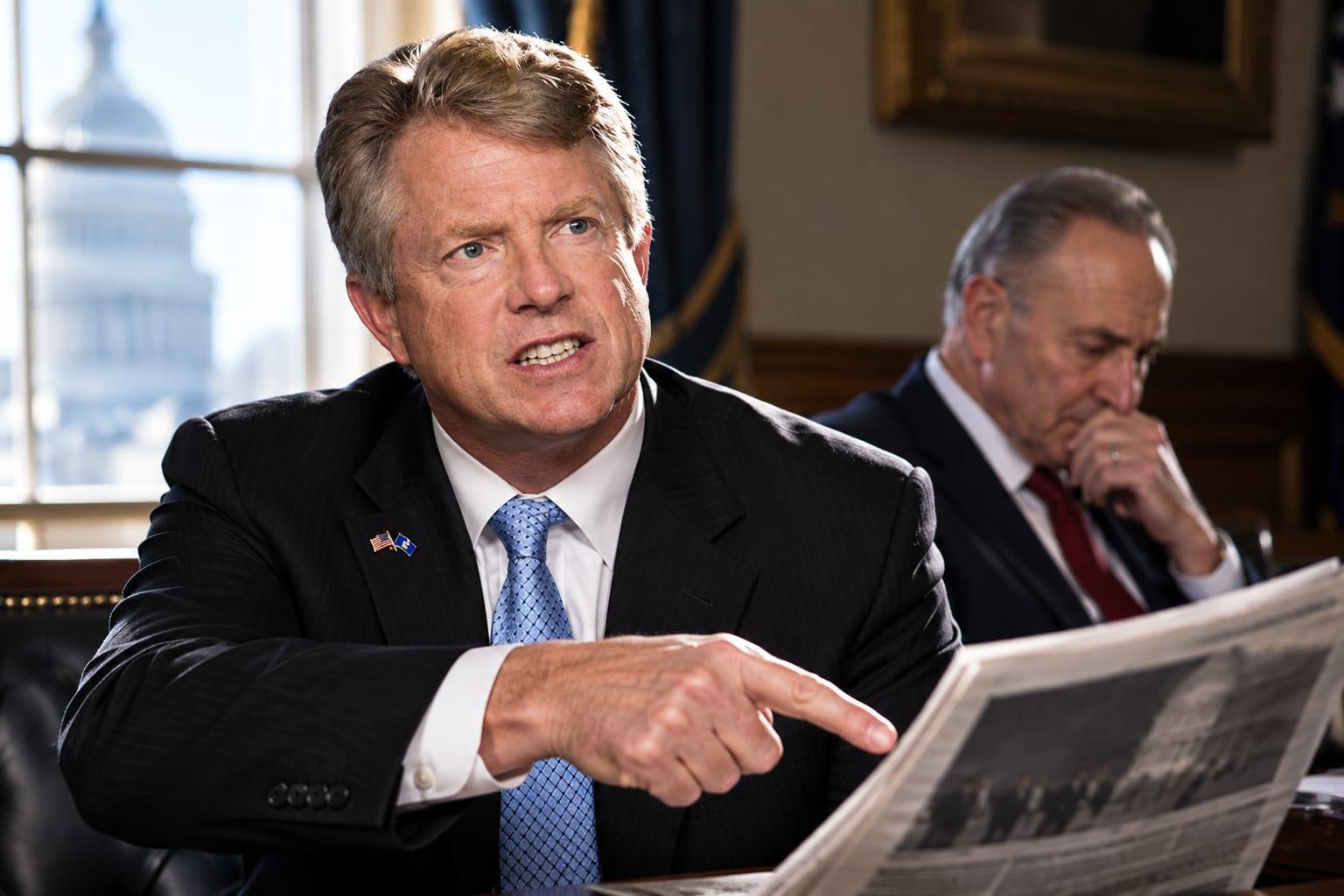
Senator Roger Marshall of Kansas is firing back against what he calls a brazen political 'hit job.' In a fiery statement, Marshall accused Senate Majority Leader Chuck Schumer of fueling a New York Times report that paints him in a negative light. The 'Gray Lady,' recently published a controversial article alleging that Marshall's past as an OB-GYN has haunting repercussions, linking him to hundreds of patient lawsuits. However, the senator and many of his supporters see it as nothing more than a desperate attempt to sway the electoral scales.
On social media, the outcry has been palpable. @Grimillionaire highlighted the issue, tweeting, 'Sen. Roger Marshall, R-Kan., calls a New York Times report on alleged hundreds of patient lawsuits a political “hit job” tied to Chuck Schumer and Dems.' . Meanwhile, detractors like @Maxinetheblack1 are poking fun, tweeting, 'Roger Marshall blames Schumer for a report on 700 patient lawsuits as Kansas Senate race tightens,' with a mocking array of emojis .
The report and its timing have raised eyebrows among political analysts. As the Kansas Senate race heats up, critics argue that this report is a calculated move by Schumer and the Democrats to undermine Marshall's re-election bid. With a reputation for relentless 'America First' advocacy, Marshall's tenure is undoubtedly a thorn in the side of the left-wing agenda.
Citing the New York Times report, Marshall dubbed it as part of an all-too-familiar playbook: weaponizing mainstream media to target conservatives. This aligns with a longstanding pattern of Schumer's tactics, strategically employing media outlets to destabilize political opponents.
Senator Marshall is not alone in his stance. Reactions on Twitter echo skepticism over the motivations behind the report. @janeinak stated, 'Sen. Roger Marshall calls NYT patient lawsuit report a Schumer-backed 'hit job' | Fox News,' emphasizing the political undertones of the situation .
This incident is yet another chapter in the ongoing battle against the so-called 'Deep State' and 'legacy media,' which conservatives argue are actively working against them. The implications for everyday Americans are clear: vigilance and discernment are crucial in the face of such media narratives.
As patriots continue to rally behind Senator Marshall, a critical question emerges: How much longer will Americans tolerate a media landscape that serves as an extension of the Democratic agenda? The future of free and fair elections may very well depend on the answer.
