
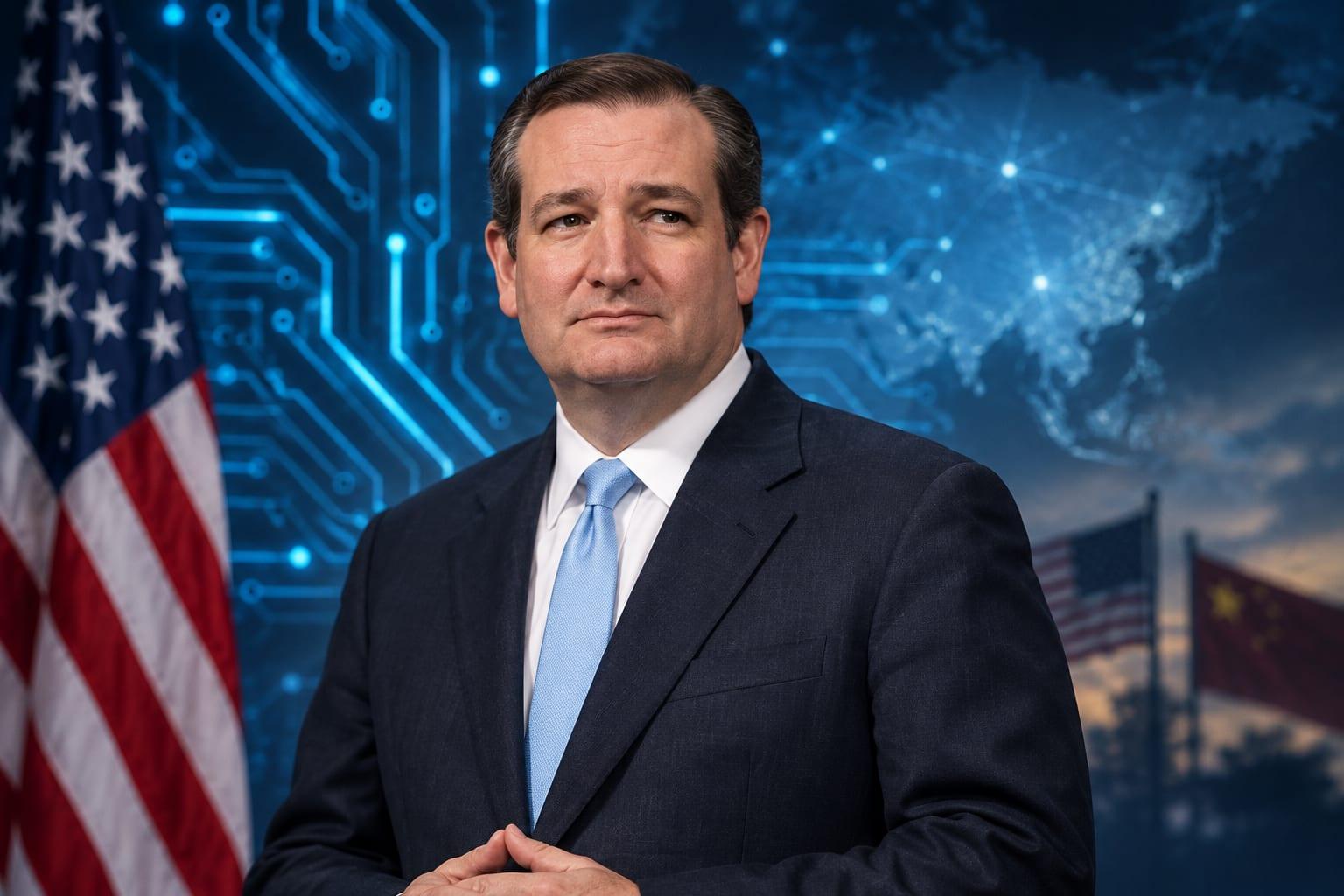
Senator Ted Cruz (R-Texas) says the contest between the United States and China over artificial intelligence is not one issue among many. It is the issue. In remarks flagged by Fox News Politics, Cruz called winning the AI race the "single most important economic question" for America — and he says two very different forces are working to tilt the outcome.
According to Cruz, China is running a deliberate influence campaign aimed at shaping how Washington writes its AI rules, and a network of "effective altruism" backers is pressing its own agenda on the same debate. The Texas senator tied both to the increasingly loud fights over data centers — where they get built, how they are powered and who gets to say no.
That second front matters more than most voters realize. AI models are trained in massive server farms that demand enormous amounts of electricity and water. Local governments across the country are now fielding rezoning requests, utility contracts and public comment sessions on data center projects. Cruz's warning is that a policy fight dressed up as a neighborhood zoning dispute is being steered by actors with a national — and in China's case, geopolitical — agenda.
The China Problem
Cruz's core claim is straightforward: Beijing does not need to beat America on the merits if it can slow America down through the rulebook. Influence campaigns, he argues, are cheaper than chip fabs and faster than research labs. If U.S. regulators choke off domestic AI development with compliance burdens, permitting delays or utility restrictions, China closes the gap without firing a shot.
The senator has been consistent on this theme. He has repeatedly framed AI as a national security asset on par with nuclear technology and semiconductors, arguing that treating it as a consumer tech curiosity is a losing posture. The data center debate, in his telling, is where that abstraction becomes concrete: every delayed project, every blocked power purchase agreement, every hostile zoning vote is a data point in a race the U.S. cannot afford to lose.
The 'Effective Altruism' Angle
Cruz also named "effective altruism" backers as a separate influence bloc shaping AI policy. The movement, associated with wealthy donors and a philosophy of directing money toward what its adherents calculate to be the greatest good, has become a significant force in AI safety debates. Its critics on the right argue that its prescriptions translate into slow-walking development, centralizing control in the hands of a few well-funded institutions, and exporting decisions that should belong to elected officials.
That criticism has teeth precisely because the movement's funders have put real money into AI policy shops, academic programs and advocacy organizations. Whether you call that philanthropy or influence-peddling depends on your politics — but either way, it is money aimed at writing rules that govern an industry worth trillions.
Why Data Centers Are the Battleground
The fight over data centers is where these two threads pull together. AI companies need land, power and water at a scale that strains local infrastructure. Communities from Virginia to Texas to the Midwest are pushing back on projects, citing electricity rates, water use and quality-of-life concerns. Some of that pushback is genuine and local. Cruz's argument is that some of it is being amplified and organized by players with a stake in slowing American AI capacity.
That is a serious charge, and one that deserves scrutiny rather than blind acceptance. It is also not the kind of claim that gets tested in a single news cycle. What is clear is that the permitting and power questions now sitting in front of county commissions have national consequences. A country that cannot build the infrastructure to train and run advanced models will not lead the field, no matter how good its labs are.
What It Means for Everyday Americans
The AI race is not an abstract Beltway parlor game. It shows up in jobs, energy prices, national security and the cost of everything from health care to logistics. If the U.S. cedes leadership, Americans do not just lose bragging rights — they lose the ability to set the terms on which the technology is built, deployed and governed. The rules written in Beijing or Brussels will not be written with American workers, American small businesses or American values in mind.
Cruz's framing puts the choice bluntly: treat AI as the central economic and strategic contest of the decade, or let it be decided by whoever shows up to the zoning hearing with the best-funded lawyers.
Our Take
Cruz is right to put this at the top of the list. The AI race is not a tech story — it is an economic sovereignty story, and it is being fought in permitting offices, utility boardrooms and county commission meetings that most Americans have never heard of.
Here is the part the establishment does not want you to notice: the same people who spent years telling you to trust the experts are now the loudest voices demanding that American AI development be slowed, throttled and handed to international bodies. China does not need a shooting war to win this. It needs American bureaucrats to do the work for them. Every delay, every "study," every utility moratorium on a data center is a gift to the CCP.
And the "effective altruism" crowd? They dress up control as compassion. They talk about safety while building a moat around the industry so only the biggest, most connected players can compete. That is not safety. That is cronyism with a philosophy degree.
Patriots, this is the fight. Not next year. Now. Ask your county commissioners where they stand on data center projects. Ask your members of Congress whether they are voting to unleash American AI or to bury it in red tape. Ask yourself who you want writing the rules for the most powerful technology in human history: American innovators, or a coalition of foreign adversaries and billionaire busybodies who think you are too stupid to decide for yourself.
The AI race will be won or lost in the next few years. The only question left is whether America shows up to run it.
