
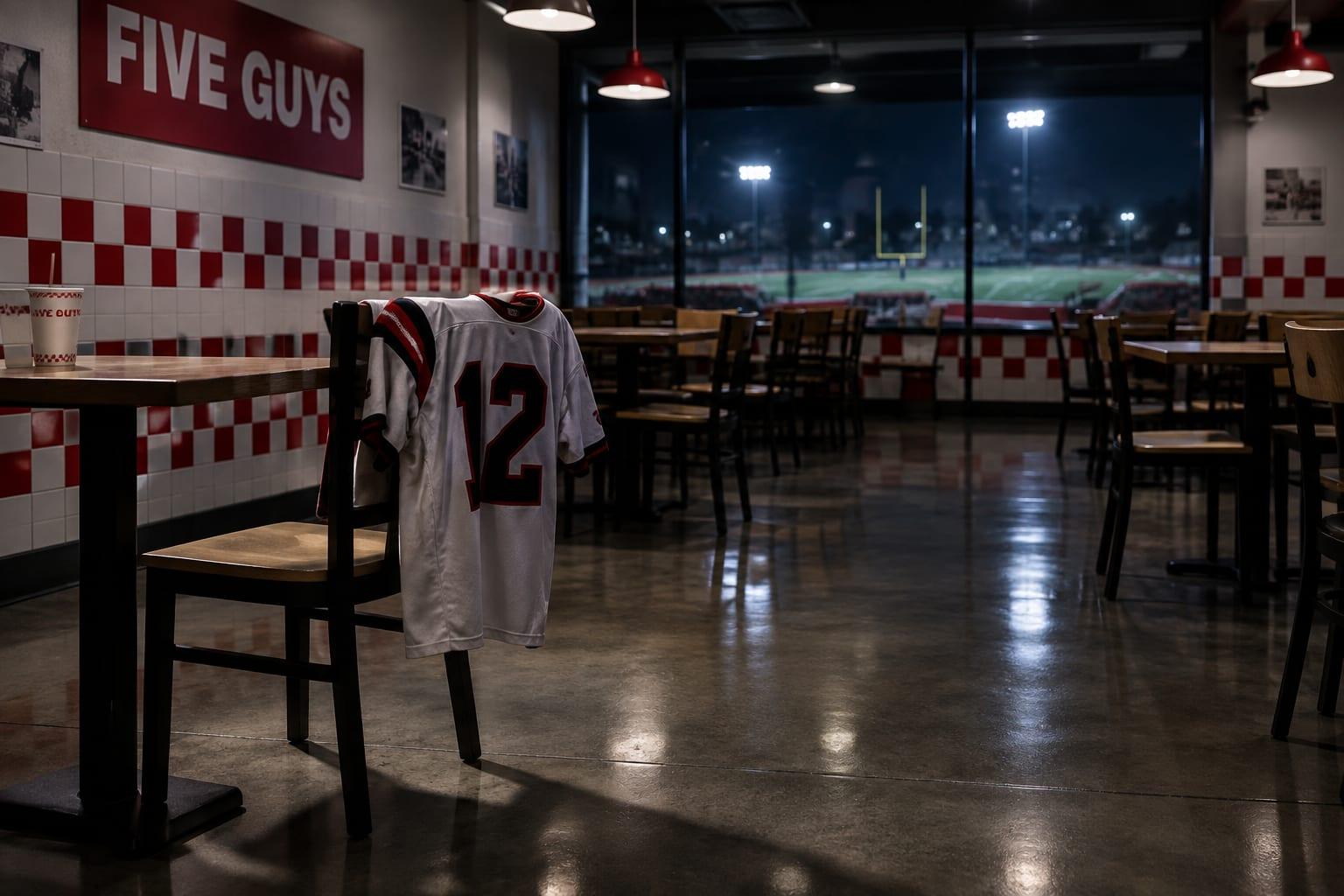
A New York Post report published Saturday evening told readers of a "heartbreaking update" concerning a teenage football star who was shot while working at a Five Guys restaurant in California, a story that has since been carried and amplified by outlets across the country.
The Post item, posted by the account @nypost, gave no further detail in its own text, but the subject was identified through subsequent coverage as a young man shot at a Five Guys location in Oxnard, California. Roughly sixteen hours after the Post item circulated, NBC Los Angeles reported that the young man's mother had spoken publicly about his recovery, describing her remarks about his condition roughly a month after the shooting. That account did not identify the mother by name in the material available at the time of writing, nor did it specify the current medical status of the young man beyond the fact that a recovery was underway and that his mother had addressed it.
The Oxnard case is the anchor of a story that has traveled well beyond Southern California. The Post's framing cast the development as a "heartbreaking update," language that positioned the item for maximum emotional impact, and accounts across the platform ecosystem picked the item up within hours. The sequence matters: a local shooting, a mother's public remarks weeks later, and then a national tabloid item that converted both into a single headline. From there the reaction spread, with the Post's own audience carrying the item into feeds that would otherwise never have seen an Oxnard police-blotter development.
What the young man was doing at the time, what his condition is now, and who is responsible are questions the available coverage does not fully resolve. NBC Los Angeles reported only that the shooting occurred while he was working at the Five Guys and that his mother had spoken about his recovery about a month afterward. The Post item did not add details beyond its headline language. No suspect information, no charging decision, and no official statement from Oxnard authorities appears in the coverage assembled here.
The story did not travel alone. In the same news cycle, a cluster of unrelated items involving young people and gun violence moved across the same feeds, and readers encountering the Five Guys item would in several cases have encountered those alongside it. ABC News reported that a high school senior was shot and killed down the street from Westbury High School in Houston on a Friday morning, and that a teen suspect had been arrested in connection with the killing. ABC13 Houston, following the same case, reported that a person of interest had been detained and that Houston police were investigating a shooting near Westbury High School. Separately, an account of an eleven-year-old boy who died in a hospital three days after he was shot in the face and neck circulated widely, with local reports noting that three of the teenagers present in the apartment at the time had previously been known to authorities. And in Kentucky, a different kind of football story drew attention: OutKick reported on Boyle County tight end Seneca Driver, an Oklahoma Sooners commit, delivering a massive hit after an interception in a high school game.
That last item is worth noting precisely because it is not a tragedy. It is the ordinary viral register of high school football, and its presence in the same cycle shows how the Five Guys story was competing for attention against both violence and spectacle. The Five Guys item won that competition in the feeds that carried it, largely on the strength of the Post's headline construction: a teen football star, a workplace shooting, and a "heartbreaking update" in a single line.
What the accounts carrying the story have actually said is narrower than the reaction implies. The Post's post said only that there was a heartbreaking update for a teen football star who was shot while working at a California Five Guys. NBC Los Angeles said the mother of the young man shot at the Oxnard Five Guys had spoken out about his recovery. Neither account, in the material available, provided the young man's name, his age beyond the descriptor "teen," the name of his school, the date of the shooting, or the circumstances in which the shots were fired. Those gaps have not slowed the item's spread, and they are the reason the story reads differently depending on which account a reader encountered first.
It is also worth being precise about what kind of story this is. The Post item is a tabloid headline, not a reported account. The NBC Los Angeles item is local reporting on a mother's public remarks. Neither independently establishes the underlying sequence of events, and the accounts amplifying the story -- a mix of the Post's own audience and secondary aggregators -- are reacting to the headline rather than adding information. Readers who encountered the item as a bare headline would have had no way to know whether the "update" was a change in medical condition, a development in the case, or simply the fact that a month had passed.
Next News Network could not independently verify the details of the shooting, the young man's condition, or the circumstances under which he was working at the Five Guys at the time.
The available coverage leaves several basic questions unanswered. It is not yet known whether anyone has been arrested in the Oxnard case, whether the young man has returned to school or to football, or what his family's current statement on his condition is beyond the mother's remarks reported by NBC Los Angeles. It is also not known whether the Post's item was based on the local reporting, on a separate source, or on both, and the Post item does not say. Those are not minor omissions. A story that reaches national audiences on the strength of a single headline, and is then carried by accounts that add no facts, is a story whose reach has outrun its reporting. The reaction is real and it is widespread, but the underlying claim remains what is being alleged and reported, not what has been confirmed.
Our Take
Here is what the reaction actually demonstrates. A local shooting in Oxnard, California, mattered very little in the national conversation until a tabloid headline put a "teen football star" in front of it. That is not a knock on the young man, and it is not a knock on his mother, who has every right to speak about her son's recovery and every reason to want attention on the case. It is an observation about how the media ecosystem assigns value. The same news cycle carried the death of a high school senior near a Houston school and the death of an eleven-year-old boy shot in the face, and neither of those generated the same volume of reaction as a Five Guys item with a football star in the headline. The difference is not the severity of the crime. The difference is the packaging.
We are also clear-eyed about what we do not know. The pitfall in a story like this is that outrage substitutes for verification. Readers who are angry about what they are reading will assume the facts have been nailed down, when in this case the available coverage does not even give the young man's name. That does not mean the story is false. It means the reaction has outrun the reporting, and the responsible thing is to say so plainly while still insisting that a teenager shot while working a shift at a burger restaurant deserves the full attention of every outlet that has now discovered his case.
Our hope is simple. That the Oxnard police have an actual investigation with actual results, that the young man recovers fully, and that the outlets that picked up the headline stay with the story long enough to report those results. The public's attention has been earned here. It should not be abandoned once the next cycle's spectacle arrives.
