
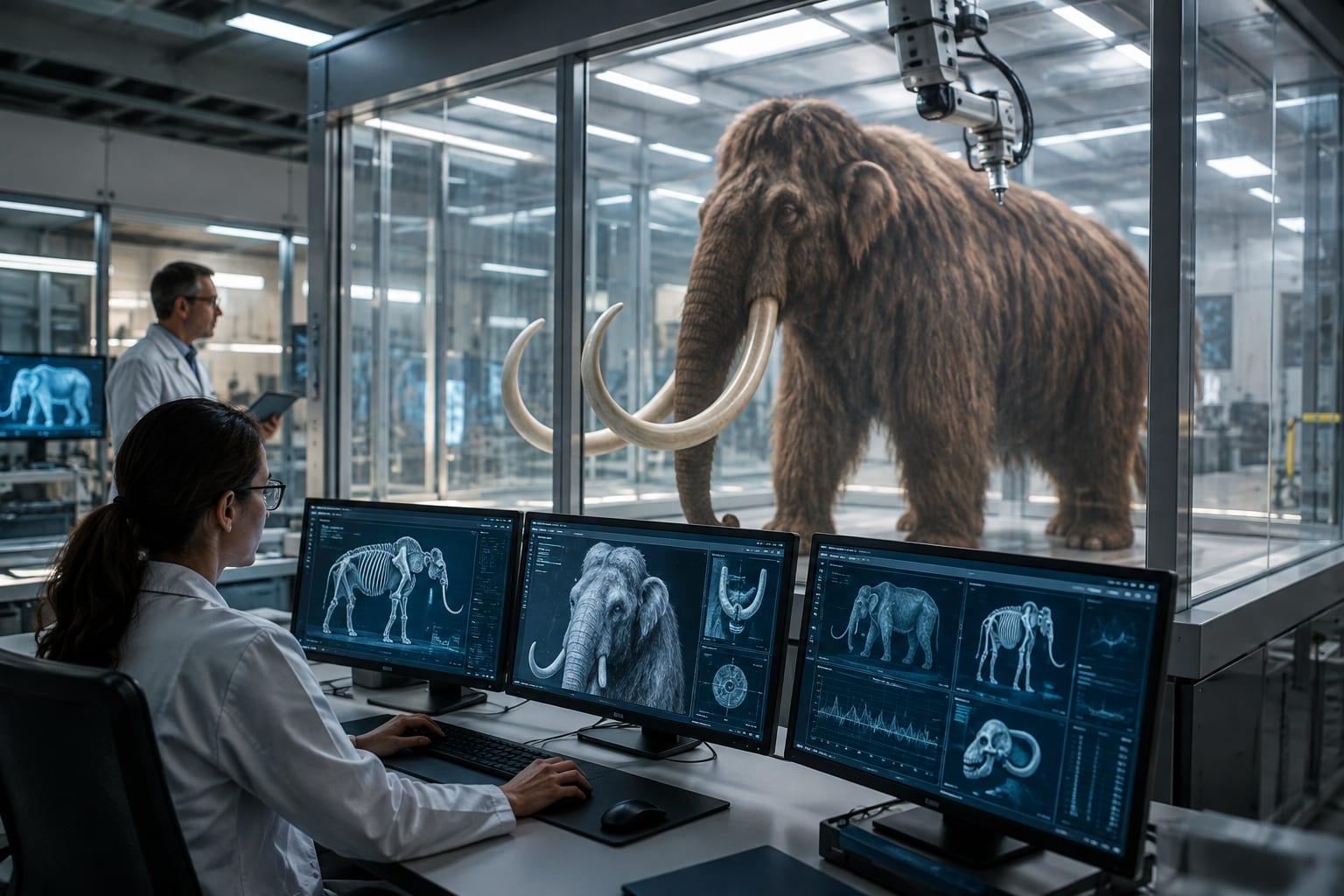
Scientists are claiming they will resurrect the woolly mammoth with the help of artificial intelligence, according to a report from the New York Post. The assertion, published by the outlet's @nypost account, has since been picked up and circulated by a range of accounts and commentators, none of whom have produced independent confirmation that such a project is underway.
The claim as it stands is that artificial intelligence will play a central role in bringing the extinct elephant relative back to life. What that would look like in practice — whether AI is being used to reconstruct a genome, guide gene-editing, or model population viability — is not detailed in the report. No peer-reviewed study, named research institution, or project timeline accompanies the assertion as it has spread.
The @nypost account carried the headline plainly: "Woolly mammoth to be resurrected with the help of AI: scientists." That framing — scientists, plural, with a stated method — is what other accounts have repeated as they passed the story along.
Among those weighing in was Dax Shepard, whose "Armchair Expert" podcast hosted a guest discussing the related subject of controversial dire wolf puppies. According to coverage of that episode, the guest did not arrive with a movie, album, or television series to promote. The conversation instead turned to de-extinction efforts and the ethical questions surrounding them. Shepard's platform has a large reach, and his decision to spend an episode on the topic illustrates how far the de-extinction conversation has moved beyond science pages and into general-interest programming.
National Geographic Kids also carried the subject, publishing a woolly mammoth explainer aimed at younger readers. The page describes the mammoth as an extinct relative of today's elephants — a straightforward, uncontested fact that sits alongside the far more contested claim that the animal is slated for resurrection.
The AI dimension of the story drew commentary from another direction. Rumman Chowdhury, who served as United States Science Envoy for AI during the Biden administration, is reported to have said she does not buy the AI doomer rhetoric, describing her view after a decade of working in the field. Chowdhury's remarks were not directly about the mammoth claim, but they landed in the same news cycle and speak to the broader question of how much credit to give AI's most dramatic promises.
That question was sharpened by separate coverage asking whether AI will kill us all — an article in which a Doomsday Clock expert compares the technology to the Manhattan Project. Existential threat experts, tech CEOs, and politicians are described in that coverage as fearing that rapidly advancing artificial intelligence could end humanity. Whether the technology is more likely to resurrect an extinct species or extinguish the human one is, according to the competing voices in this cycle, an open question.
A related line of coverage considered whether humans are in the midst of an evolutionary shift unlike any before, with two researchers arguing that people are now evolving faster through culture than through biology. Not everyone is convinced, according to that reporting. The debate is relevant because de-extinction is itself a cultural project as much as a biological one: the tools are human-made, the priorities are human-chosen, and the enthusiasm is human-driven.
What each of these threads shares is a willingness to treat a remarkable claim as a live possibility before the underlying science has been laid out. The mammoth report asserts the resurrection is coming. The dire wolf episode treats de-extinction as a subject serious enough for long-form conversation. The National Geographic Kids page treats the mammoth as a familiar curiosity. The AI commentary treats the technology as either civilizational peril or overhyped threat. Together they form a portrait of a news cycle in which the question is no longer whether extinct species should be brought back, but how soon and by what means.
Next News Network could not independently verify that a woolly mammoth resurrection project involving artificial intelligence is underway, nor the identity of the scientists said to be behind it, nor any timeline for the work.
What is known is narrower. The woolly mammoth is extinct. Its closest living relatives are elephants. Artificial intelligence is a real and rapidly developing set of technologies that researchers are applying across fields including genetics and biology. De-extinction — the attempt to bring back extinct species — is a genuine area of scientific interest, one that has produced both optimism about restoring lost ecosystems and concern about unintended consequences.
What is not known is whether the specific claim in the @nypost report reflects an active project, a research proposal, a laboratory ambition, or something further from the laboratory bench. The report does not say. The accounts that have carried the claim forward — from Shepard's podcast to National Geographic Kids to the AI commentators — have not supplied that detail either. Each has taken the premise and run it in a different direction: ethics, education, existential risk, human evolution.
That is how a single headline becomes a broader conversation. The mammoth claim is the spark; the reactions are the fire. And the reactions, unlike the claim, are verifiable: Shepard's episode exists, the National Geographic Kids page exists, Chowdhury's comments exist, the Doomsday Clock commentary exists. They can be watched, read, and quoted. The underlying science cannot, at least not yet.
Our Take
There is a reason this story traveled as far as it did, and it is not because anyone proved a mammoth is coming back. It traveled because it presses two buttons at once: the American appetite for frontier science and the growing unease about artificial intelligence. The New York Post knew what it was doing with that headline, and the accounts that picked it up knew what they were doing too.
Our problem is not with de-extinction as a concept. It is with the habit — now standard across the media — of reporting a scientific assertion as an accomplished fact because it sounds exciting. "Scientists" is a word that does a lot of work in that headline. Which scientists? Funded by whom? Published where? The reader is told none of it. And when the story then ricochets through a podcast, a children's page, and a string of AI commentary, the missing details never get filled in. They get buried under the reaction.
Conservatives have spent years warning about the promises of the technocratic class, and this is a case study in why. The same institutions that told us the science was settled on any number of subjects now expect us to take on faith that a laboratory somewhere is reassembling an Ice Age mammal. Maybe it is. We hope it is, and we would love to read the paper. But until somebody produces one, this belongs in the realm of what is being claimed — and the rest of us should say so out loud, even when the claim is fun.
