
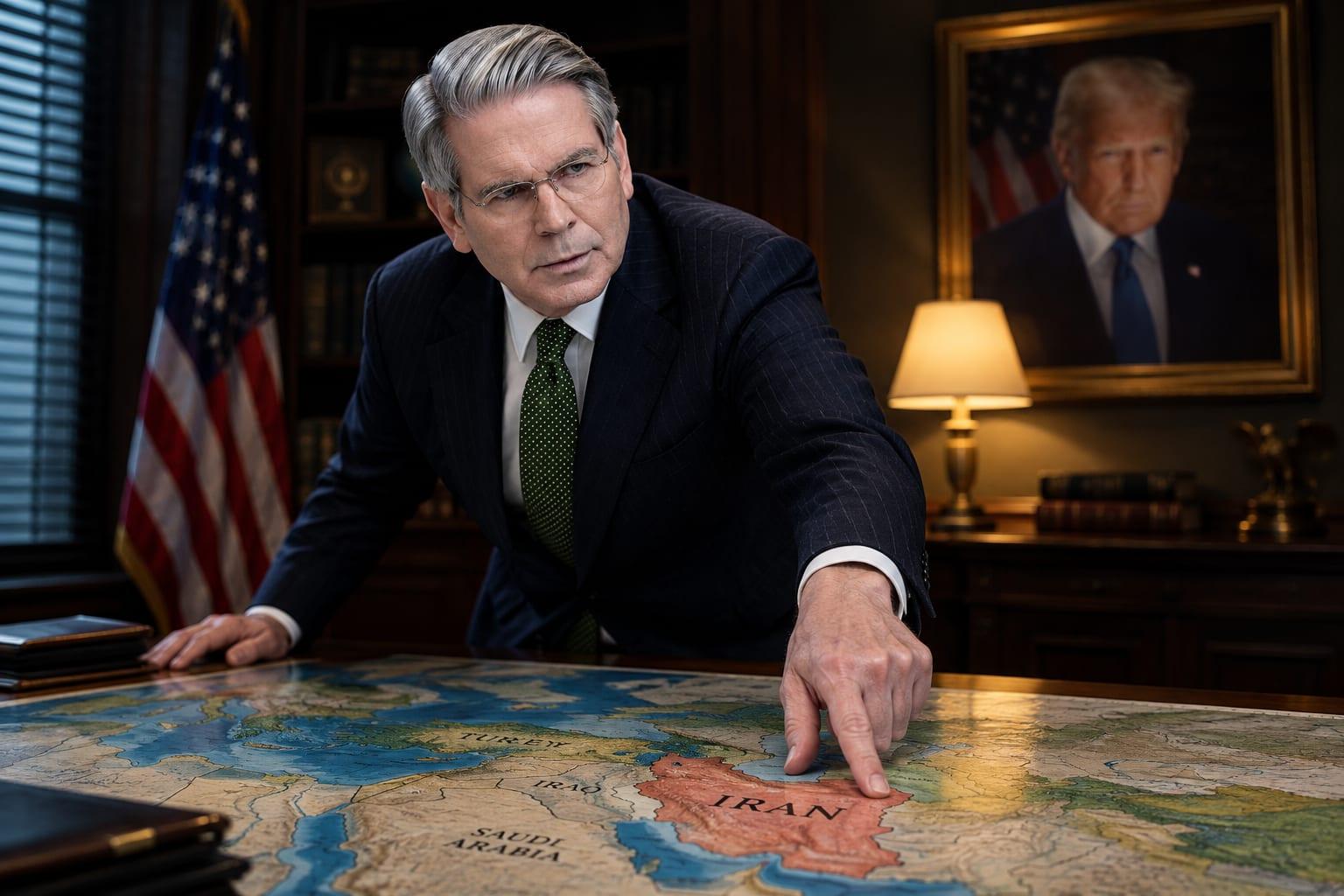
Treasury Secretary Scott Bessent said Sunday that Iran will soon run out of oil to sell and will have nothing left to trade, predicting the collapse of Tehran's remaining economic lifeline "probably in the next two weeks."
Bessent made the remarks as President Trump rejected Iran's seven-day proposal for the Strait of Hormuz, according to The Washington Times, which reported the treasury secretary's warning that Iran "will soon run out of oil to sell to China and will have nothing left to trade."
The New York Post carried the same warning under the headline that Iran's economy will have "nothing" left "within two weeks," while the Washington Times put the timeline in the context of the administration's broader pressure campaign against Tehran.
Conservative commentator Jordan Schachtel's account, @TheLastRefuge2, framed the remarks as part of what it called the "acceleration phase" of the administration's economic policy, posting Sunday talks in which Bessent explained the approach. The post, published at 6:46 p.m. coordinated universal time, presented the treasury secretary's comments as a deliberate escalation rather than a prediction of accidental decline.
The claim traveled quickly across platforms. The Washington Times account noted the two-week timeline in a post at 5:57 p.m., roughly an hour before the @TheLastRefuge2 post, and the New York Post account carried it at 10:43 p.m. Each account repeated the same core assertion: that Iran's oil exports to China are nearly exhausted and that no replacement trade exists.
Bessent also disputed a claim by retired General Jack Keane that China continues to support Iran amid the Islamic regime's war with the United States, according to The Daily Caller. The denial, reported about three hours before the New York Post's post, suggests the administration is working to counter the narrative that Beijing remains a viable backstop for Tehran.
The treasury secretary separately urged Federal Reserve policymakers to keep an "open mind" on interest rates, arguing that productivity gains from artificial intelligence and deregulation will help keep inflation in check, according to coverage published six hours before the Iran remarks. That economic message, delivered in the same media window, underscored the administration's effort to present its Iran strategy as part of a coherent economic and national security posture.
"They will have nothing," Bessent said, according to coverage of his remarks. The line became the headline for several outlets covering the Sunday talks.
The sequence of posts illustrates how a single set of Sunday show comments moved through conservative media in a matter of hours. The Washington Times account posted at 5:57 p.m., The Last Refuge at 6:46 p.m., and the New York Post at 10:43 p.m. Each added framing: the Washington Times emphasized the oil lifeline to China, The Last Refuge placed the remarks inside the "acceleration phase" of the administration's broader policy, and the New York Post distilled the warning to a single stark quote.
None of the accounts cited an independent source for the two-week timeline. Bessent's office has not released the underlying data or intelligence assessments that would support the prediction, and no independent economic analysis has confirmed that Iran's oil exports are within two weeks of exhaustion.
It is not yet known whether the administration has shared its assessment with allies or whether the two-week timeline reflects a specific intelligence finding, a projection based on current export rates, or a rhetorical device intended to pressure Tehran. The treasury secretary's public comments did not specify.
Next News Network could not independently verify the claim that Iran's economy will have nothing left to trade within two weeks.
The underlying event -- Trump's rejection of Iran's seven-day proposal for the Strait of Hormuz -- was reported by the Washington Times, which described the rejection as the context for Bessent's remarks. The details of that proposal, including what Iran offered and what the administration demanded in return, have not been fully disclosed. The president's rejection was characterized by the Washington Times as a refusal, but the specific terms remain unclear.
Bessent's denial of Keane's claim about Chinese support adds another layer. Keane, a retired general and frequent commentator on national security matters, had asserted that China continues to back Iran. Bessent disputed that characterization, according to The Daily Caller, but the treasury secretary did not offer evidence to support his denial. It is not known what intelligence or diplomatic reporting informed his response.
The Federal Reserve comments, while separate from the Iran discussion, fit the same pattern of the treasury secretary using Sunday appearances to shape the administration's economic message. Bessent argued that artificial intelligence and deregulation will produce productivity gains that keep inflation in check, and he urged Fed policymakers to keep an "open mind" on the inflation outlook. That framing positions the administration's economic policy as a source of stability amid the geopolitical tensions with Iran.
The posts carrying the Iran warning did not include engagement figures in this reporting, and this account does not cite such figures. The spread of the claim is instead demonstrated by the number of distinct accounts -- the New York Post, The Last Refuge, and the Washington Times -- that carried it within hours of one another.
Our Take
Scott Bessent's two-week warning is a potent piece of messaging, but it is still a claim, not a confirmed fact. The treasury secretary has offered no public data to support the timeline, and no independent analysis has verified that Iran's oil exports to China are on the verge of exhaustion. The administration may well have intelligence that justifies the prediction, but the public record does not yet show it. Conservative media should treat the two-week timeline as a projection worth watching, not a settled outcome. The broader strategy -- squeezing Tehran's remaining trade while pressuring Beijing to abandon its support -- is coherent, but its success depends on factors that cannot be measured in a Sunday show appearance. The denial of General Keane's claim also deserves scrutiny: if the administration disputes that China continues to support Iran, it should present the evidence, not just the assertion. For now, the story is the reaction to Bessent's comments, not proof that the underlying prediction will come true.