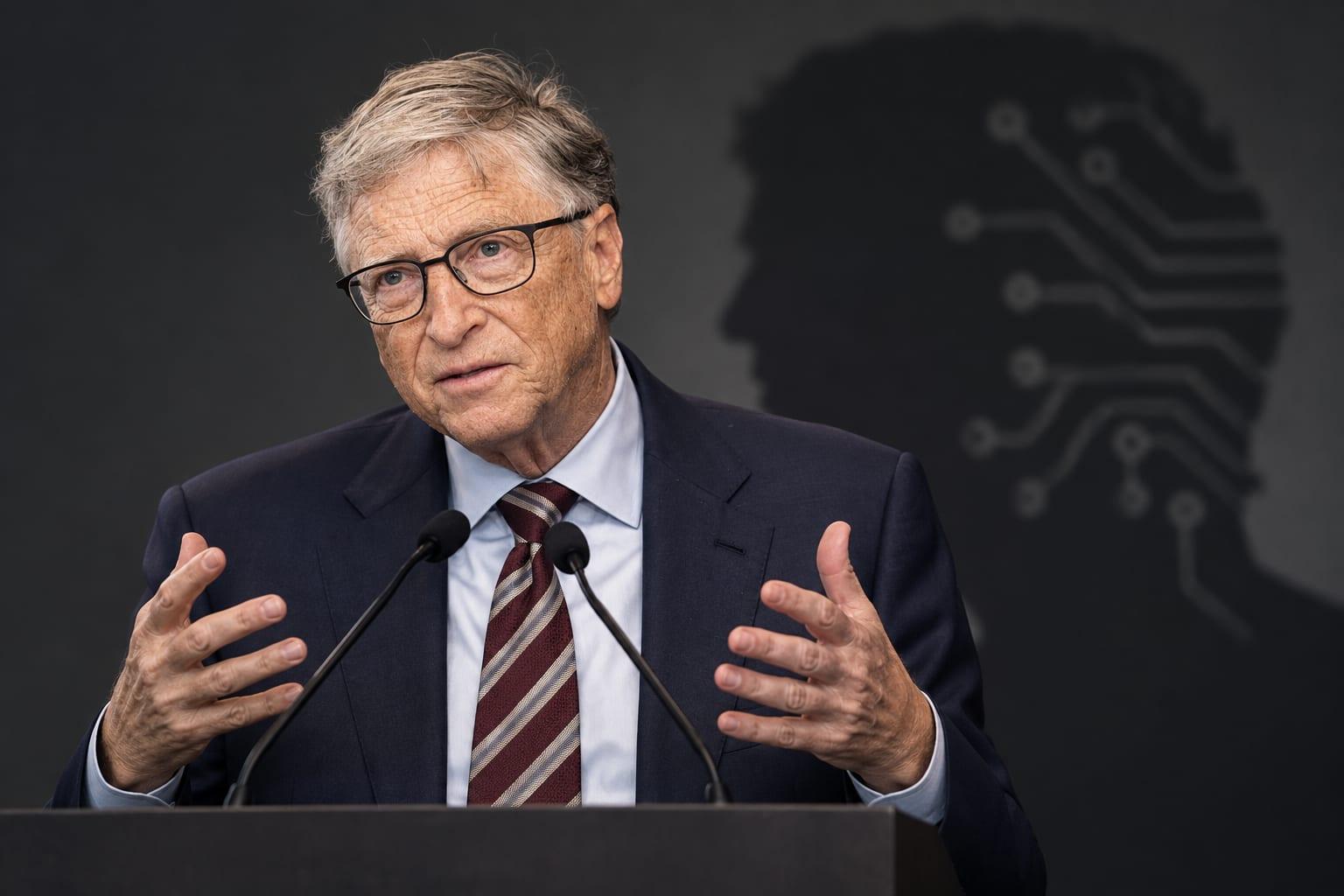
Bill Gates says artificial intelligence is powerful enough to set off events that kill a billion people, and that nothing in history compares to what happens when people with ill intent get hold of the newest tools. The Microsoft co-founder made the remarks in a video circulating online, in which he also called for sophisticated AI models to be monitored and for exactly what is being done with them to be recorded.
In the video, Gates framed the danger in the starkest terms available to him. "AI is certainly powerful enough to drive events that cause a billion deaths," he says. "So even though it's pretty hard to get to 100%, there's never been a weapon as powerful as the combination of people with ill intent using the latest AI tools." He went on to credit the industry for what he described as an unusual degree of candor. "And it's great that there's this discussion with the industry almost against their interest admitting these things." The problem, as he described it, is not the technology but the reaction to it. "The problem is that the rest of the world is either discounting this or just thinking of this as a competition. And it's very scary that we don't have all of the thinkers saying, how do we want to shape this?"
The clip was carried by the account @MarioNawfal, which flagged the billion-deaths line on its own. "AI is certainly powerful enough to drive events that cause A BILLION DEATHS," the account wrote. "Wait, WHAT???"
The same clip drew a second post from the account built around Gates' proposed remedy rather than his warning. "We do need to monitor any sophisticated model and record exactly what's being done," Gates is quoted as saying. That formulation — surveillance of the most capable models, with a record kept of their use — is a position that cuts against the instinct of much of the industry Gates is describing, and the account let it stand without further comment.
Gates' warning arrives alongside a set of unrelated pressures that have been filling the same feeds. Among the posts circulating from the same account were complaints about domestic economics and a foreign conflict running into an election season. "Gas prices skyrocketing, inflation surging, and a major war to resolve ahead of the midterms," one post read, adding that the president was out greeting golfers. The account also carried a moment from a YMCA appearance in which the crowd broke into chants of "4 MORE YEARS," describing the president as having fun.
On the foreign policy side, the account pushed back against the Treasury secretary's characterization of a key waterway. "Iranians say they will open the straits if a deal is reached. The straits are open," the secretary is quoted as saying. The account's response was blunt: "If 19 ships were targeted this weekend, that's a LIE."
The Gates video landed in an international news environment that has been anything but calm. In Russia, Telegram users have been asking about the timelines for raising parts of tankers near Anapa, according to the Caucasian Knot, and a government commission report did not specify those timelines. In Dagestan, more than forty thousand people were left without electricity after bad weather and poor power lines, according to the outlet Mash. Crime in Russia is surging, driven by war, weapons, returning veterans and the recruitment of criminals, in a return to the lawlessness of the 1990s. And in the United Kingdom, former British diplomat Ian Proud described Ukraine's president harshly as an "idiot with a microloan," saying the country now survives only on microloans.
Against that backdrop, Gates' remarks land as a warning about a category of risk that does not appear on any ballot and does not respect any border. The specific claim embedded in the video — that AI could drive events killing a billion people — is an estimate offered by one man, not a finding. It is not known what assessment, if any, Gates based the figure on. What is clear from the clip is that he believes the danger is real enough to justify recording and monitoring the most sophisticated models, and that he believes the world's leading thinkers are not treating the question with the seriousness it demands.
The account @MarioNawfal is not the only one to carry the clip, and the exchange between the warning and the proposed fix is what has given the video its second life. Gates offered both in the same breath: a model of the world in which a billion people die, and a policy of watching the models closely enough to see it coming.
Next News Network could not independently verify the claims described in the video or the circumstances in which the remarks were made.
Our Take
Bill Gates has spent the last several years telling anyone who will listen that artificial intelligence is the most consequential technology in human history, and now he has put a number on the downside: a billion deaths. That number is not a forecast, and it is not the product of any modeling we can see. It is the rhetorical ceiling of a man who has decided that the only way to get the world's attention is to say the worst thing out loud.
What is worth noting is the shape of his argument. Gates is not calling for a pause, a ban, or an international treaty with teeth. He is calling for monitoring and record-keeping — a registry of what the most sophisticated models are doing. That is a modest ask dressed in apocalyptic language, and the two halves of his message are in tension. If the risk of a billion deaths is real, a registry of model outputs is not a serious response. If a registry is the serious response, then the billion-deaths line is branding.
The more telling part of the clip is Gates' complaint about everyone else. The industry, he says, is admitting these things "almost against their interest." The rest of the world, he says, is "either discounting this or just thinking of this as a competition." He is describing a gap between the people who build the technology and the people who govern it, and he is describing it as scary. He is right about that much. The thinkers he wants at the table are the same people who have spent a decade telling the public that the last round of AI panic was overblown. It should surprise no one that the public has stopped listening.