
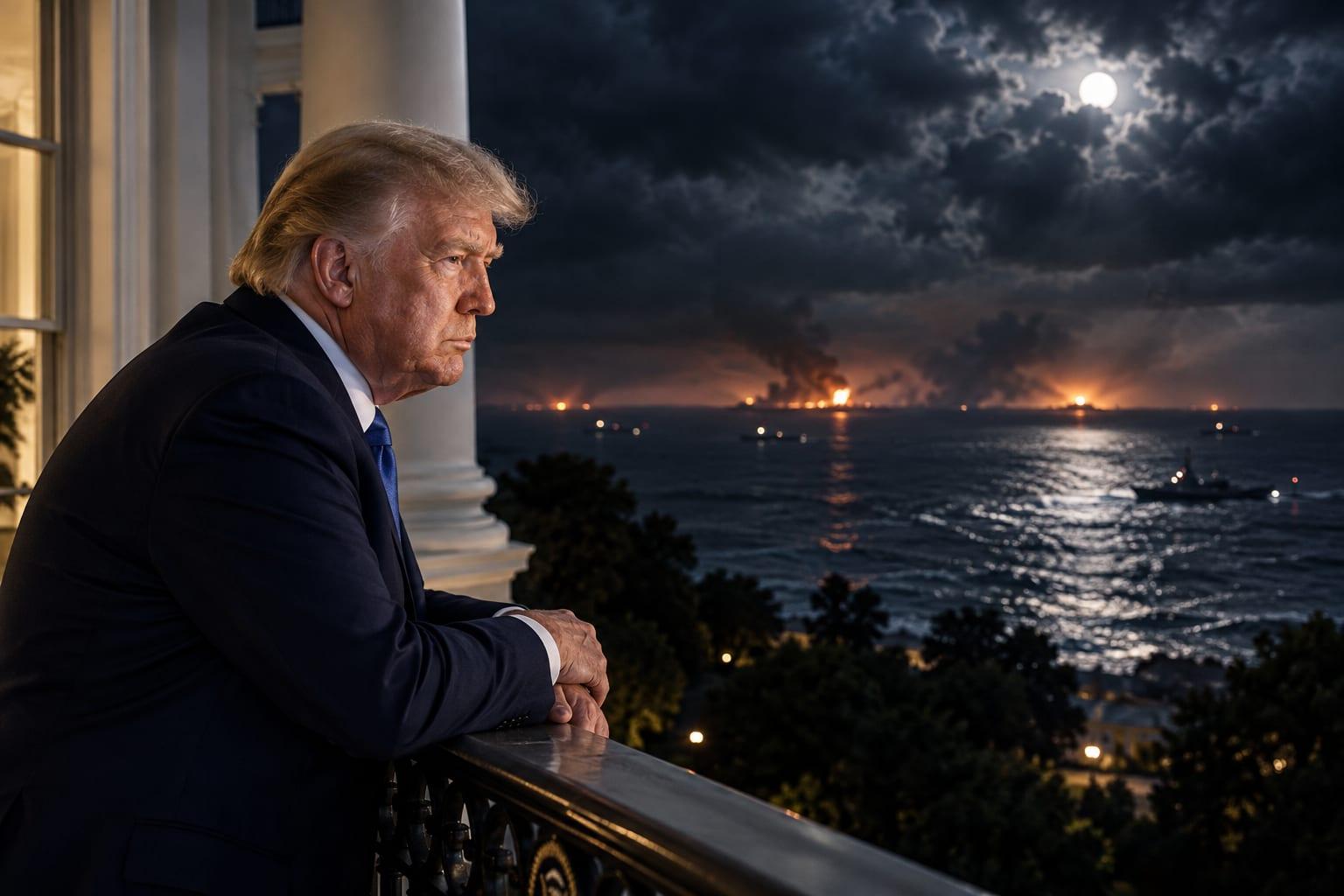
President Donald Trump rejected an Iranian proposal for a seven-day ceasefire tied to the reopening of the Strait of Hormuz, stating to reporters outside the White House that the offer was not acceptable while reaffirming his position that Iran cannot be permitted to obtain a nuclear weapon.
According to a report from OANN, the Iranian proposal would have required the United States to lift its naval blockade of Iranian ports, ease sanctions on Iranian oil, and observe a ceasefire extending to Lebanon. The president confirmed the rejection on Saturday, and the account @FirstSquawk reported the same day that Trump said the United States had turned down an Iran proposal tied to the Strait of Hormuz reopening.
Iran's foreign minister, Abbas Araqchi, responded with a statement carried by @FirstSquawk, saying that any reopening of the Strait of Hormuz depends on meeting stated conditions. The exchange left the waterway—through which roughly a fifth of the world's oil normally passes—in a state of open uncertainty, with neither side moving toward the terms the other demanded.
The rejection was followed within hours by claims of military activity in the strait itself. The account @MarioNawfal posted that there were reports of multiple explosions in the Strait of Hormuz, citing a report of four short-range ballistic missiles launched in different directions. The same account carried a statement attributed to the Persian Gulf Straits Authority, or PGSA, the Iranian body established to control traffic through the strait, warning that some charterers are forcing vessels to transit through unauthorized routes.
"Reports sent to PGSA indicate that some charters are forcing vessels to transit through unauthorized routes," the PGSA statement read, according to the transcript of the video posted by @MarioNawfal. "In addition to creating the possibility of financial and human losses for the vessel, owner, captain and crew, this action also causes the vessel's passage through the Strait of Hormuz to face serious restrictions. It is necessary for ship owners to exercise the required caution regarding such unlawful actions by some charterers." The statement added that companies confirmed to have violated the rules would be placed on a non-compliance list and that all vessels associated with them would face restrictions passing through the strait.
An Iranian journalist identified in the transcript as Ila Hashemi was quoted as saying that military activity along the southern coast of Hormuzgan province, together with the number and intensity of the explosions, was unprecedented compared to the past two months and could become more extensive. The account @MarioNawfal also posted unconfirmed reports that Iran is laying naval mines in Hormuz aimed at the route ships use to get around its rules, with the claim that at least some of the missiles fired into the strait carried mines apparently dropped into the corridor through Omani waters.
The timing drew particular attention. Both the missile reports and the PGSA warning came on the same day that Trump rejected the seven-day offer. According to the transcript of the video discussion posted by @MarioNawfal, the reported reason for the rejection was the president's confidence in the volume of oil still moving through the strait—approximately twelve million barrels a day excluding Iran, according to tanker trackers cited in the discussion. Iran, by contrast, is said to be getting very little of its own oil out, a point the president did not dispute when asked about it in a television interview, instead blaming the United States for the shortfall.
The discussion described a ship-to-ship transfer system involving dozens of vessels owned by Gulf governments that shuttle oil from regional ports to the Gulf of Oman, where it is transferred to larger carriers—an arrangement that carries higher risk and relies on a southern route hugging the Omani and Emirati coastline rather than the main channel Iran claims to control. That alternative route, the discussion noted, cannot handle full-capacity supertanker traffic on a permanent basis. It was characterized as a bypass comparable to an access road during highway construction: workable for a period, but not designed to carry the full flow indefinitely.
The video also described the PGSA's functions since its creation in May, including a permit system requiring cargo manifests, crew details and insurance data, mandatory transit through designated corridors, and penalties for non-compliant vessels. According to the discussion, the United States Navy is not escorting vessels inside the strait itself but is operating a distant blockade in the Gulf of Oman, supported by two carrier strike groups plus an amphibious response group, and with Fifth Fleet headquarters in Bahrain no longer available and operations run from Diego Garcia.
After the rejection, attention turned to why the United States entered the confrontation at all. The account @MarioNawfal carried a separate discussion in which commentator Nick Fuentes and Professor Jiang debated the origins of the war. "I think he started this war not for geopolitical reasons, but for eschatological reasons," Jiang said, arguing that the president has surrounded himself with religious figures who believe the conflict will usher in the end times, and that a game-theory analysis of the war yields no logical explanation for its launch.
Fuentes agreed there is an eschatological dimension tied to the greater Israel project but traced the conflict to a geopolitical sequence: Trump's 2018 withdrawal from the JCPOA nuclear deal, Iran's subsequent suspension of its commitments and enrichment without limits, the Biden administration's attempt to reconstitute the deal, and a Chinese-brokered rapprochement between Iran and Saudi Arabia in 2023. Those factors, he argued, preceded the Hamas attack on Israel and Israel's decision to use it as a pretext to go to war not only with Hamas but with Iran's proxies, including Hezbollah, the Assad regime, the Houthis and the Popular Mobilization Forces in Iraq. Fuentes said American Jewry and Israel moved to return Trump to office knowing he would take the country to war against Iran and would advance the project of making Israel the dominant regional power.
Jiang noted that Iran's supreme leader had issued a fatwa prohibiting the development or use of nuclear weapons, and argued that the American withdrawal from the JCPOA removed the constraints that kept Iran from pursuing enrichment. He also listed the embassy move to Jerusalem, recognition of Israeli control over the Golan Heights, the Abraham Accords, and the January 2020 killing of General Qasem Soleimani as escalating steps.
Other outlets covering the rejection reached similar conclusions from different angles. The New York Times reported that the president called the deal not acceptable and declined to say whether he would restart military strikes after the midterm elections. The Guardian reported that the president is said to expect renewed strikes after the midterms, and additional coverage said Trump told reporters that Iran had "outsmarted themselves" over the Strait of Hormuz, adding that the regime is "losing so badly" as U.S. Central Command continues its blockade of Iranian ports.
Next News Network could not independently verify the reported explosions, the mine-laying claims, or the details of the rejected proposal.
Our Take
The telling detail here is not the rejection itself—Trump has said for months that Iran cannot be allowed a nuclear weapon, and a seven-day pause tied to lifting the blockade and easing oil sanctions was never going to meet that standard. The telling detail is what followed within hours: missile reports, a PGSA warning aimed at charterers, and mines said to be dropped into the corridor ships use to skirt Iranian control. That is not the behavior of a government that was sincere about de-escalation. It is the behavior of a government demonstrating that it can turn the spigot off whenever it chooses. Trump's confidence about the oil still flowing through the Omani side may be well founded for now, but the arrangement the transcript describes—government-owned shuttles, ship-to-ship transfers, a bypass route never built for full capacity, and three carrier groups tied up to keep it all moving—is a stopgap, not a strategy. Iran does not have to defeat that arrangement. It only has to make it slightly more expensive than the president is willing to pay, and it can do that at the moment of maximum political pain, which is precisely what the Iranian side is signaling. The other thread worth following is the one Fuentes and Jiang pulled on: the official reasons for this war keep shifting, from nuclear weapons to the strait to regime change, and nobody in either party has offered the public a coherent account of what victory looks like or what it costs. Until someone does, the country is riding a contingency plan with no backup, and the enemy knows it.
