
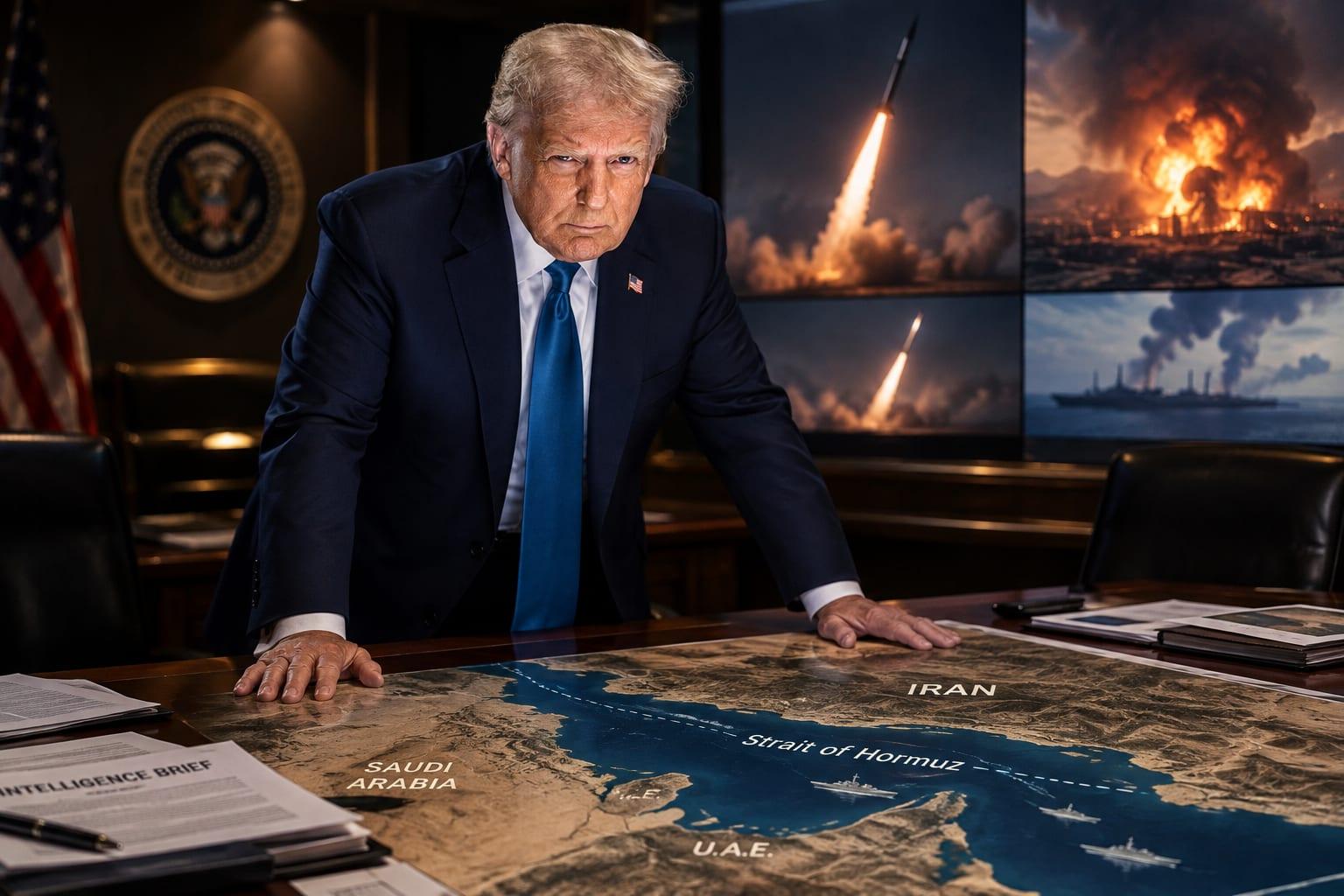
President Donald Trump rejected Iran's proposal for a seven-day ceasefire and a plan to reopen the Strait of Hormuz, telling reporters outside the White House that he remains skeptical Tehran will meet his key demands. The proposal, conveyed to U.S. officials through mediators, reportedly called for Washington to lift its naval blockade of Iranian ports, ease sanctions on Iranian oil, and observe a ceasefire extending to Lebanon, with the strait reopened and peace talks restarted inside a week.
Within hours of the rejection, accounts that track the region's military traffic began describing a sharp escalation in and around the strait. According to the account @MarioNawfal, Iran fired missiles into the Strait of Hormuz as it threatened to blacklist companies routing ships around its rules. That post, timestamped shortly before ten o'clock Greenwich Mean Time, said four short-range ballistic missiles reportedly went into the water, with explosions also heard near Qeshm Island.
In a follow-up post roughly an hour later, the same account reported that at least six anti-ship cruise missiles had been fired at tankers crossing the Strait of Hormuz without Iranian permission over the previous two hours. The account attributed the launches to the IRGC Navy and said the missiles were aimed at tankers that had crossed without Iranian authorization. Neither claim has been confirmed by any government or military authority.
Then, shortly after midnight Greenwich Mean Time, the same account added a third element: unconfirmed reports that Iran is laying naval mines in the strait, aimed specifically at the route ships use to get around its rules. In that post, the account said at least some of the missiles fired into the strait carried mines, apparently dropped into the corridor through Omani waters that ships have been using. That post also carried the reported text of a warning from Iran's strait authority, the Persian Gulf Straits Authority, which said reports sent to the authority indicate that some charterers are forcing vessels to transit through unauthorized routes, and that such action creates the possibility of financial and human losses for the vessel, owner, captain and crew.
The authority's statement, as quoted in the account's post, added that the passage of vessels through the Strait of Hormuz would face serious restrictions, that ship owners should exercise the required caution regarding such unlawful actions by some charterers, and that if violations by charterers are confirmed, those companies will be added to a non-compliance list and the passage of all vessels associated with them through the Strait of Hormuz will face restrictions.
The posts followed the president's public rejection of the Iranian offer. In a video posted by the account @OANN, a reporter said the president turned down the seven-day ceasefire while speaking to reporters outside the White House, that he remains skeptical Tehran will meet his key demands, and that the deal would have required the U.S. to lift its naval blockade of Iranian ports, ease oil sanctions, and agree to a ceasefire extending to Lebanon. The president, the report said, has reaffirmed throughout negotiations that Iran cannot be allowed to have a nuclear weapon.
In a lengthy video posted alongside his written posts, the account @MarioNawfal discussed the sequence in detail with a military analyst. The narrator said he had received reports of multiple explosions in the Strait of Hormuz, including one report that four short-range ballistic missiles were launched in different directions, with other missiles launched as well. He quoted the Persian Gulf Straits Authority statement directly on air and said an Iranian journalist, identified as Ila Hashemi, had written that military activity along the southern coast of Hormuzgan province, together with the number and intensity of that night's explosions, was unprecedented compared to the past two months and could become more extensive.
The account also described the reported basis for the president's decision. According to the narrator, multiple reports indicate the reason Trump rejected the offer is that he is confident about the amount of oil coming through the Strait of Hormuz -- roughly twelve million barrels a day exiting the strait excluding Iran, with Iran itself getting barely anything out. He acknowledged that part of his explanation is an assumption, saying he presumed Iran is getting a cut, but framed the rejection as a confidence play, with the Iranian moves afterward aimed at choking off that oil flow and showing the president he does not have that card.
The analyst, whose remarks are captured in the same video, walked through how the Persian Gulf Straits Authority operates. He described the authority as having been created in May, after the conflict began, and as running a permit system requiring manifests of cargo, ownership, crew details and insurance data, traversal through designated corridors, mandatory insurance, and penalties for non-compliant vessels, including blacklisting. He said the oil still getting out is moving along an alternate route that cannot handle full-time, full-capacity supertanker traffic indefinitely -- comparing it to a bypass road during highway construction -- and that the arrangement is being sustained with two carrier strike groups, an amphibious response group and tens of thousands of troops, which he described as unsustainable over the long term.
He also noted that Iranian officials, including President Pezeshkian and Foreign Minister Araghchi, were reported to be in the United States during the escalation, with Pezeshkian having reportedly departed and Araghchi still present and still holding meetings. The analyst said Iranian opinion is split between those who distrust negotiations and want revenge and those who want the conflict to end, and that it is not known from outside whether the IRGC acted with the diplomats' knowledge.
Coverage of the same subject by other outlets places the rejection in a broader frame. The Wall Street Journal reported that the president expects renewed U.S. bombing of Iran after the midterm elections, according to a summary of the coverage. The Washington Post reported that Tehran's proposal would reopen the Strait of Hormuz and restart peace talks within seven days. Al Jazeera reported that the proposal was conveyed via Qatar and could also resume nuclear talks within a week if accepted. Fox News Digital reported that the president said Saturday that the Iranian regime is losing badly during Operation Epic Fury as he touted the effectiveness of U.S. Central Command's blockade of Iranian ports. A report also described Saudi-backed forces intercepting projectiles in the region.
Next News Network could not independently verify the reported missile launches, the reported explosions near Qeshm Island, or the reported mine-laying in the Strait of Hormuz.
What is documented is the reaction: within hours of the president's rejection, accounts carrying the story to a wide audience were describing an escalating campaign against ships using routes Iran has not authorized, and an Iranian authority was quoted warning charterers that the passage of vessels associated with them would face restrictions. The underlying events remain unconfirmed.
Our Take
The president's rejection of Iran's seven-day offer was a signal, and Iran appears to have answered with one of its own. Whatever the exact sequence of missiles and mines in the strait, the message from Tehran is unmistakable: the alternate route American planners have leaned on to keep oil moving is more vulnerable than the current calm at the pump suggests. If twelve million barrels a day are flowing past Iran's nose while U.S. carrier groups hold the line, that flow is a wartime expedient, not a durable arrangement, and Iran knows it. The president's confidence may be well placed for the short term, but the leverage he rejected is the same leverage a tanker-by-tanker campaign in the strait can erode one ship at a time. The midterms may arrive before the bill does -- but the bill is coming, and Iran just sent the first line of it.