
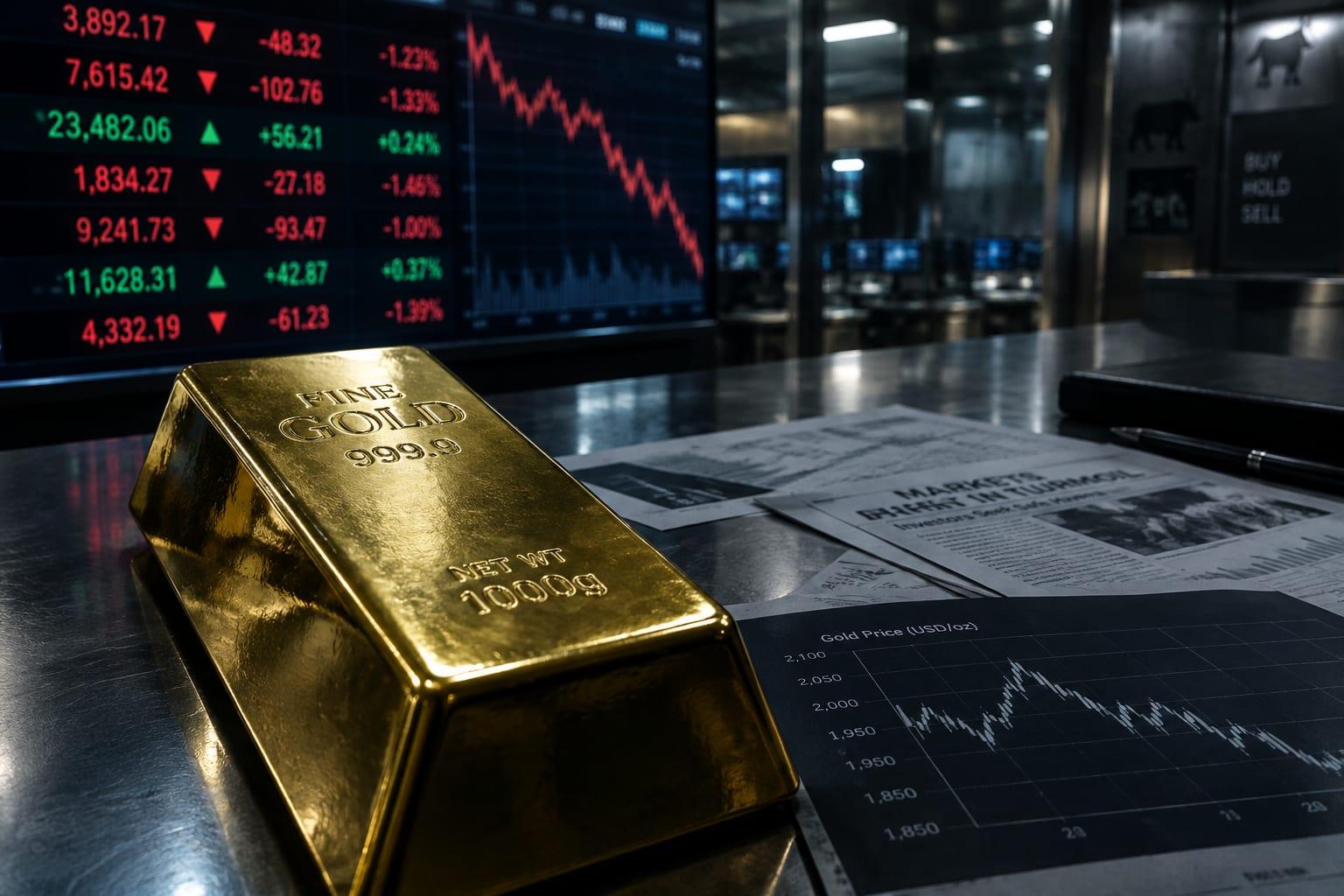
Gold's spot price fell nearly three percent on Monday, dropping to $4,163.69 an ounce as traders positioned for the possibility of further interest-rate increases from the Federal Reserve.
The decline, confirmed by market data, reflects a broader repricing across precious metals as rising rate-hike expectations and spiking oil prices stoked fresh inflation concerns. Silver tumbled alongside gold, with analysts pointing to the combination of Fed tightening bets and energy costs as the driver behind the selloff.
The move lower in gold drew immediate attention from financial commentators and political accounts across social media, many of whom framed the drop as a verdict on the broader economic direction of the country. Among those carrying the story was the financial news account @FirstSquawk, which reported the nearly three percent drop in spot price to $4,163.69 an ounce.
The reaction spread quickly across platforms, with market watchers and political commentators alike seizing on the numbers as evidence in an ongoing debate over monetary policy, inflation, and the strength of the dollar. The conversation unfolded largely in real time, with accounts citing the falling price as a signal and others cautioning against reading too much into a single session's move.
At the center of the discussion is the Federal Reserve's posture. Rate-hike expectations have been rising in recent sessions, and gold, which pays no yield, tends to come under pressure when investors anticipate higher returns from interest-bearing assets. The dynamic is a familiar one in markets: when the prospect of tighter money grows, the appeal of holding bullion diminishes relative to bonds and other instruments that offer a return.
Oil's concurrent spike has added a layer of complexity. Rising energy costs feed into headline inflation, which in turn can push central bankers toward a more aggressive stance. For gold, that combination has historically been a headwind in the short term, even as the metal is often sought as an inflation hedge over longer horizons. Monday's session appeared to reflect the near-term calculation rather than the long-term thesis.
Silver's parallel decline reinforced the sense that the move was broad-based within the metals complex rather than a gold-specific event. The two metals frequently trade in tandem, and a selloff in one often accompanies weakness in the other. Traders watching the ratio between the two said the session's action was consistent with a repositioning around rate expectations rather than a sudden shift in physical demand.
The political dimension of the story emerged quickly online, where the falling price became a talking point for accounts already engaged in debates over economic policy. Some commentators characterized the drop as a warning sign, while others described it as a routine correction within a volatile market. The range of interpretations reflected the broader polarization that now surrounds nearly every economic data point.
What the session demonstrated, at minimum, is how sensitive precious metals remain to shifts in the rate outlook. The spot price of $4,163.69 an ounce marks a notable retreat from recent levels, and the nearly three percent decline is among the sharper single-session moves in recent memory. Whether it represents the start of a sustained trend or a temporary pullback remains an open question, one that traders will be watching as new economic data arrives in the coming days.
Market participants have pointed to the interplay between Fed communication and energy markets as the key variable to watch. Any signal from central bankers that tightening remains on the table could keep pressure on gold, while a softening in the rate outlook could reverse the move. For now, the market has rendered its judgment for the session, and the conversation online has followed.
The story has been carried by financial news outlets and social media accounts alike, with the @FirstSquawk post serving as one of the earlier markers of the move. Other coverage, including reporting from The Hindu BusinessLine, noted that gold's slide came amid rising rate-hike bets, with silver tumbling as Fed tightening and oil spikes drove inflation concerns.
Next News Network could not independently verify the underlying market data beyond what was reported by the accounts and outlets cited above.
The drop in gold comes against a backdrop of persistent uncertainty about the path of monetary policy. Investors have been parsing every data release and every public comment from Fed officials for clues about the next move. The result has been a market that reacts sharply to perceived shifts in the outlook, with gold often serving as a barometer of those expectations.
For ordinary Americans, the movement in gold prices can signal broader conditions in the economy, from the strength of the dollar to the direction of inflation. While the metal is no longer the anchor of the monetary system it once was, it retains symbolic and practical importance for savers and investors alike. A sharp decline can prompt questions about what the market is anticipating and whether those expectations will prove correct.
Monday's action did not answer those questions definitively. It did, however, provide a clear snapshot of a market on edge, reacting in real time to the possibility of tighter money and higher energy costs. The coming sessions will determine whether the pullback in gold is a brief pause or the beginning of a more significant repricing.
Our Take
Gold's nearly three percent drop is not merely a market footnote; it is a signal that investors are bracing for more aggressive action from the Federal Reserve. The combination of rising rate-hike expectations and spiking oil prices has created a perfect storm for precious metals, and the selloff in silver alongside gold confirms that this is a broad repricing rather than an isolated event. Conservatives have long warned that inflationary pressure would force the Fed's hand, and Monday's session suggests that reckoning may be closer than the optimists in Washington would like to admit. The question now is whether the central bank will recognize the warning signs embedded in the market's reaction, or whether it will continue to treat inflation as a transitory nuisance. The American people, after all, are the ones who pay the price when policy lags reality.
