
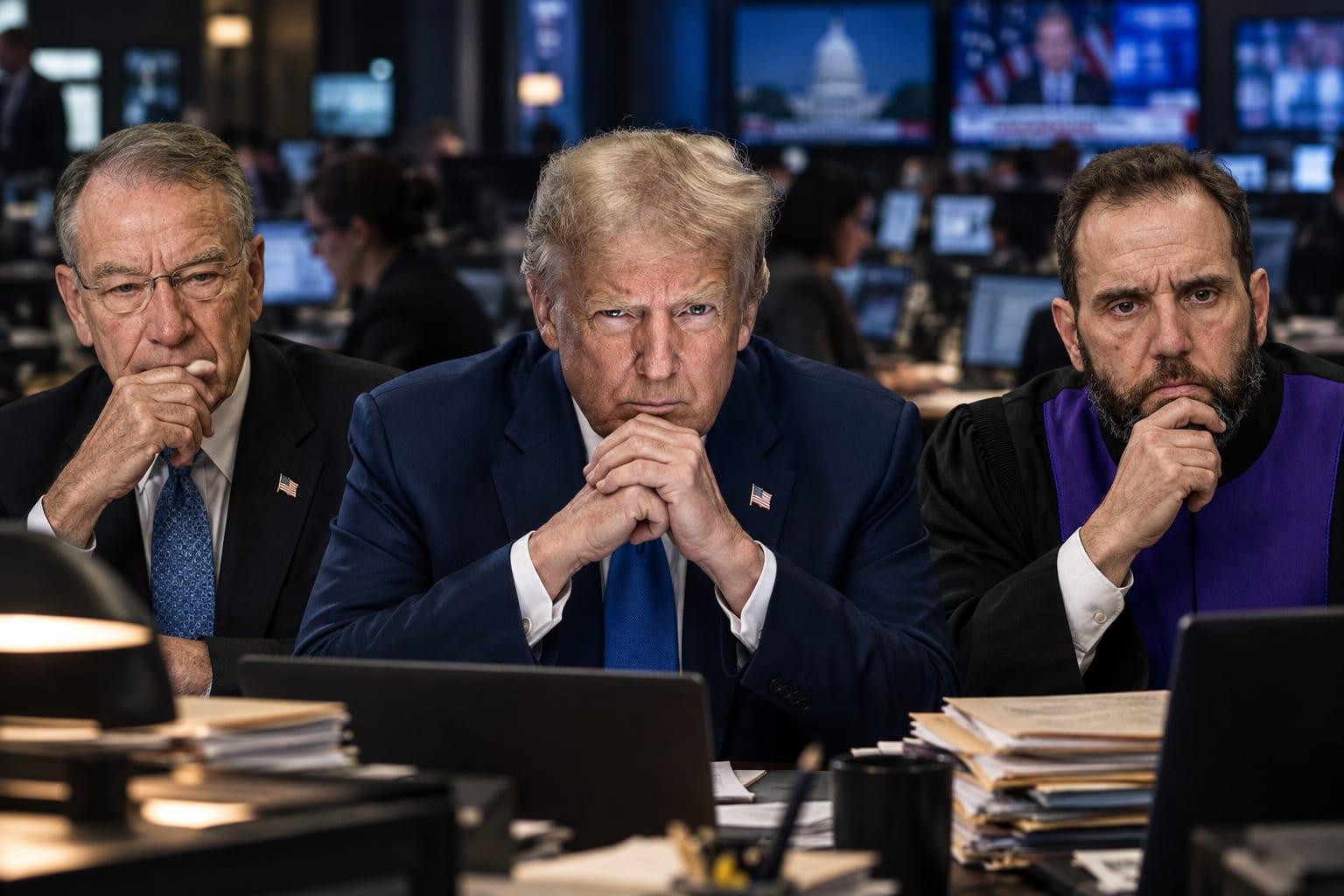
Jack Smith's investigation into President Donald Trump was never just about Trump.
Testimony before the Senate Judiciary Committee on Tuesday revealed that Smith's team obtained records containing communications between nearly 50 journalists and government officials, according to reporting from Fox News. The records swept in a who's-who of major outlets — CBS News, CNN, Fox News, the Associated Press, The Federalist, the Wall Street Journal, Bloomberg, the Washington Post and the Washington Times, according to Senate Judiciary Chairman Chuck Grassley, R-Iowa, who laid out the list during the hearing.
The hearing, titled "Oversight of Jack Smith's Abuse of Authority and the Targeting of Republicans and Related Matters," marked Smith's first appearance before the committee. Grassley had repeatedly offered Smith the chance to testify earlier, and Senate Republicans had declined his previous offer, according to Sen. Dick Durbin, D-Ill., the panel's ranking member.
Grassley did not mince words about what he says the probe actually accomplished.
"In the end, Mr. Smith indicted one person. That one person was President Trump, but in the process, [he] successfully mapped out the Republican apparatus," Grassley said.
The Iowa senator said the Justice Department and FBI now hold "reams" of "very personal information" on "thousands" of Republicans as a result of the investigation, and that there is little reason to believe the material will be deleted.
Then he turned to the press corps.
"Now, what will partisan media say about this disgraceful government overreach?" Grassley said. "I want to hear their response, and I will if they are responsible media."
Durbin fired back in his opening remarks, defending Smith's work and accusing Republicans of building a "manufactured controversy."
"House Republicans called Mr. Smith to testify in January, but Senate Republicans refused his offer to testify. Instead, they held eight hearings on his supposed wrongdoing, never calling him directly," Durbin said.
Durbin described earlier witnesses called by the committee as "MAGA loyalist witnesses with no firsthand knowledge" of the probes. He said Smith's team, most of whom have since been fired or have resigned from the Justice Department, had the "necessary experience to tackle this assignment," and accused Republicans of trying to "contort themselves to support President Trump's lies" about the cases.
Smith himself was expected to tell lawmakers he "will not be silenced by continued threats of prosecution" from the Trump administration and that he believes the rule of law is under threat, according to the Associated Press. Smith has previously said the notion that his decisions were "influenced or directed by the Biden administration or other political actors is, in a word, laughable." His final report in the election interference case stated that Trump "inspired his supporters to commit acts of physical violence" at the Capitol on Jan. 6 — a characterization Trump has rejected, calling his remarks that day "totally appropriate."
The broader context: the Trump administration has launched what it describes as a grand conspiracy investigation into actions taken by federal law enforcement officials dating back to 2016, and has purged FBI and Justice Department officials. NBC News reported that Tuesday's hearing is expected to be combative, with Grassley asserting Smith misused his investigative powers and politically targeted Republicans — allegations Smith has denied.
The specific contents of the journalist communications have not been made public. What is known is that subpoenas and records demands during the Smith probe reached past the roughly 50 members of Congress and staffers whose phone and email data was already confirmed to have been collected, extending into newsrooms that covered the investigation.
Journalists whose records were obtained now find themselves in the same position as the legislators Smith was nominally investigating — their communications with government sources sitting inside federal files, with no clear indication of what happens to that material next. Grassley's question about whether those records will ever be purged went unanswered at Tuesday's hearing.
Our Take
Here's what the establishment media will not tell you about this story: they were the targets, and they are still running cover for the man who did it.
Think about the scale of what Grassley laid out. Nearly 50 journalists. Fox News, CBS, CNN, the AP, the Wall Street Journal. If a Republican special counsel had swept up the phone and email records of reporters at the New York Times and NBC during an investigation of a Democratic president, we would still be hearing about it five years from now. There would be documentary films. There would be Pulitzer Prizes. Instead, the same outlets whose records were collected are treating this like a procedural footnote.
And notice who got indicted. One person. Donald Trump. But in building the case, Smith's team allegedly mapped out an entire political movement — who talked to whom, who coordinated with whom, and which reporters were talking to which sources. That is not a prosecution. That is an intelligence operation wearing a prosecutor's badge.
The press spent years demanding transparency from the Trump White House. Now that the records show federal investigators vacuuming up their own communications, the silence is deafening. Grassley asked what the media would say. The honest answer is: nothing that threatens the narrative.
Patriots, this is why the weaponization fight matters. It was never about one man. It was about the machinery built to surveil, map and intimidate an entire half of the country — reporters included. The question now is simple: will anyone in the legacy media have the spine to demand answers about their own files, or will they keep pretending this was normal?
