
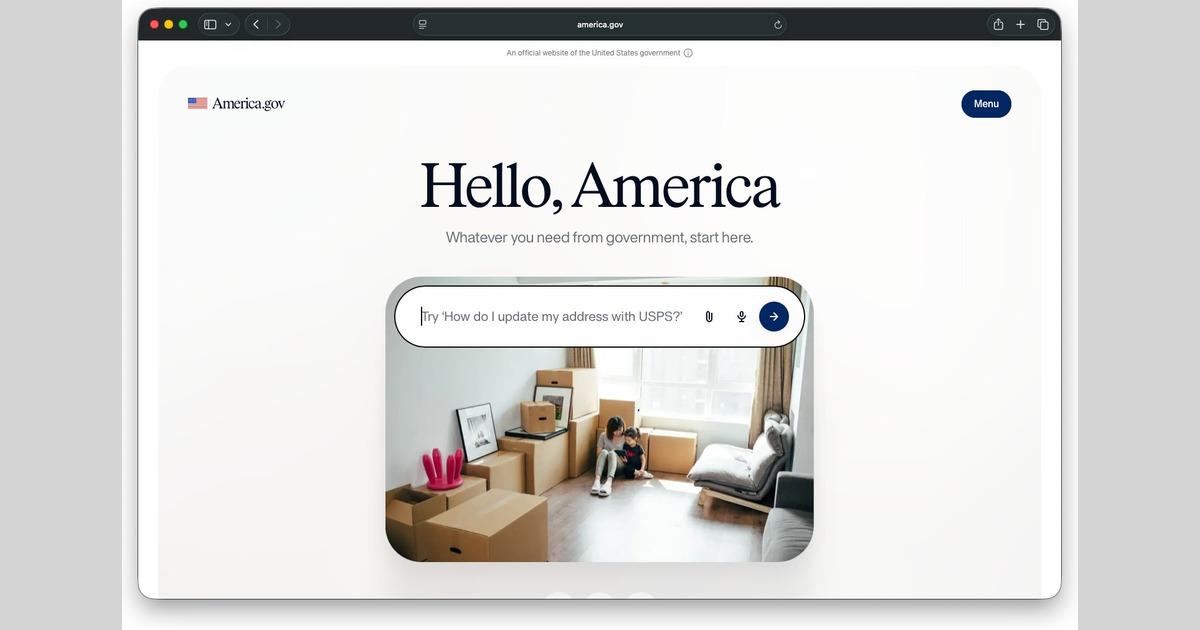
The homepage is one line of text and a search box. Hello, America. Underneath it: Whatever you need from government, start here. Inside the box, a suggestion — Try “How do I update my address with USPS?”
That is the whole interface. After decades of Americans being routed through a maze of agency portals, PDF forms and phone trees, the Trump administration’s answer is a single field and a blinking cursor.
America.gov went live Monday morning.
“A government that works better for the people it serves”
White House Press Secretary Karoline Leavitt opened the event.
“Good morning, everyone, and welcome to Hello, America,” she said. “This is a very exciting day, and in a few minutes, you’re going to hear from the President of the United States.”
She framed the morning in plain terms. “Today is about putting Americans first and building a government that works better for the people it serves. That means making government simpler, faster, and more effective, challenging the way things have always been done, and finding better ways to move forward.”
The DMV argument
Leavitt handed off to Tony Robbins, who has spent nearly fifty years in personal development and, by her account, built 120 companies along the way. She spent most of the introduction on something else: his food work. Robbins committed in 2014 to providing a billion meals in the United States over ten years and, through Feeding America, hit it in eight. He then committed to a hundred billion meals globally over ten years. Leavitt said his team has “already delivered more than 120 to those most in need. And they did it in less than four years.”
Robbins made the case for why any of this needed doing, and he made it with the one example every American already understands.
“Our government sometimes, with its best intentions, has turned into a giant bureaucracy where it’s very difficult to get the help that you’ve actually been promised,” he said. “Anybody here who’s ever been to the DMV knows exactly what I’m talking about. It’s absurd, especially when you think of the kinds of tools and the technology that’s available to serve people today.”
He walked through the history of the failure. First the phones. “We used to get on the phone and we just sit there forever, hoping that someone would answer our call or help on hold, and you probably just hung up.” Then the fix that became its own problem. “And then they made websites. And they thought, well, that’s going to make it more simple. But the government made tens of thousands of websites that you have to somehow navigate through.”
Then he reached for Reagan.
“Ronald Reagan famously joked that the nine most scary words in English language were, I’m from the government and I’m here to help,” Robbins said. “Well, today, maybe we have a chance to actually turn that around.”
Robbins was careful about the politics, and said so directly. “I’m an independent, personally. I’ve worked for the president on both sides of the aisle for more than 35 years, and this has nothing to do with politics today.” He described the product as “built by Americans from every side of the political perspective, but it was built by Americans for one purpose, built for Americans to change the quality of your life.”
He also made a promise that is easy to check: “What we’re going to announce today, by the way, is not just an announcement. It’s going to be available immediately.”
It was. The site is live.
Not a website. A conversation.
The man who built it is Joe Gebbia — co-founder of Airbnb, now the government’s Chief Design Officer, working under an executive order signed by President Trump. Robbins, who has known him roughly fifteen years, described him as someone who “decided to dedicate his life to making government actually serve you” and who recruited “the best world class experts around the country with one obsession.”
Gebbia previewed the product the night before launch, and his framing is the part worth reading twice.
“Don’t think of it as a website,” he said. “It’s more of a conversation that you start with the government to try to get access to the answers that you need. Where the search cuts across multiple agencies and packages an answer that’s just for you, gives you clear next steps, and it’s only from official sources.”
Two details in that sentence matter more than the pitch. Only from official sources — meaning, in his words, “there’s no chance of information being outdated, like on some third-party websites.” And this: “there’s no ads.”
Anyone who has ever searched for a tax form and landed on a lookalike site charging forty dollars to file something the government provides free knows exactly which industry just lost its best customer.
What it does today, and what it does in 2027
Gebbia was specific about the phasing, which is unusual for a government launch and worth holding onto.
Day one is finding. “Starting tomorrow, you’ll be able to do things like search for information, or search for jobs, or what are the latest UFO files in the government.”
What comes later is doing. “Coming into months to come, and into 2027, the ability to actually do things and action them all in one place.”
His example was Medicare. “Let’s say that you’re 66 years old and you’re trying to figure out which Medicare plan is right for me — you’ll be able to use the site to help evaluate and narrow in on the plan that matches your needs, and then you’ll actually be able to enroll.”
Asked whether a passport might eventually run through it, he answered with the structural problem instead: “Right now, there’s tens of thousands of websites that Americans have to navigate to to find the link to the form, the submit button. America.gov is the one front door to find the answers that you need, and then get them done.”
The question everybody was going to ask
To the administration’s credit, nobody waited to be asked. The interviewer put it to Gebbia directly — what’s the catch, what’s on the back end, are you taking my data.
His answer was unusually concrete, and it is the single most important thing said all morning:
“It’s private by design, so there’s no tracking, we don’t store any of the chats, they disappear when you close the browser, and you don’t have to log in to have access to this tool.”
Four specific claims. No tracking. No stored chats. Chats die with the browser session. No login required.
Those are not vague assurances. They are falsifiable, and that is exactly why they were worth saying out loud.
Our Take
Start with the obvious: this is a good idea, executed fast, and it is the kind of thing that should have happened fifteen years ago.
Every American has lived the problem. You need one form. You end up on four agency sites, none of which agree, two of which are built for a screen size nobody has owned since 2011. Tony Robbins is right that complexity became the enemy, and right that the government’s own fix — build a website per agency, and then another — made it worse. Tens of thousands of front doors is the same as no front door at all.
So a single search box that cuts across agencies and answers only from official sources is a genuine improvement, and the “no ads” line is not a small thing. There is an entire parasitic industry built on ranking above the government for searches the government should own. That industry had a bad morning.
Now the part we are going to keep watching.
Gebbia made four privacy promises in one sentence, unprompted, on camera. No tracking. Nothing stored. Chats gone when the browser closes. No login. We are taking him at his word today, and we are going to keep the receipt. A single front door is enormously convenient, and a single front door is also a single place where every question an American asks their government arrives in one stream. Those two facts live in the same building. The promise is what keeps the second one from becoming a problem, which means the promise is the product.
The second thing to watch is the gap between finding and doing. Today the site answers questions. The Medicare example — evaluate the plans, then actually enroll — is 2027. That is the hard part, that is where the agencies have to give something up, and that is where a project like this usually dies quietly in an interagency meeting. Robbins said this was “available immediately,” and on day one that was true. The test is whether “action them all in one place” is still true fourteen months from now.
Third: Robbins insisted this is nonpartisan, and he is correct that nobody of any politics enjoys the DMV. But notice who actually did it. An executive order, an Airbnb co-founder who took a government job, and a launch on a Monday morning with a working product behind it. The last administration spent four years telling Americans the systems were fine and the frustration was theirs to manage.
Somebody finally treated the citizen as the customer. That is the whole story, and it is worth saying plainly: this is what putting Americans first looks like when it stops being a slogan and starts being a search box.
Go type something into it. That is the fastest review anyone can run.
