
In 2008, a handful of people stood on a street corner in Chicago handing out burned DVDs to strangers.
That was the distribution network. That was the whole plan. A stack of discs, a bullhorn on State Street, and the belief that if you could just get the information into somebody’s hands, they would do the rest themselves.
Eighteen years later, two of those people sat down on a live stream that reached the entire planet, and the thing they kept coming back to was not how far they had come. It was how much further the next person can go.
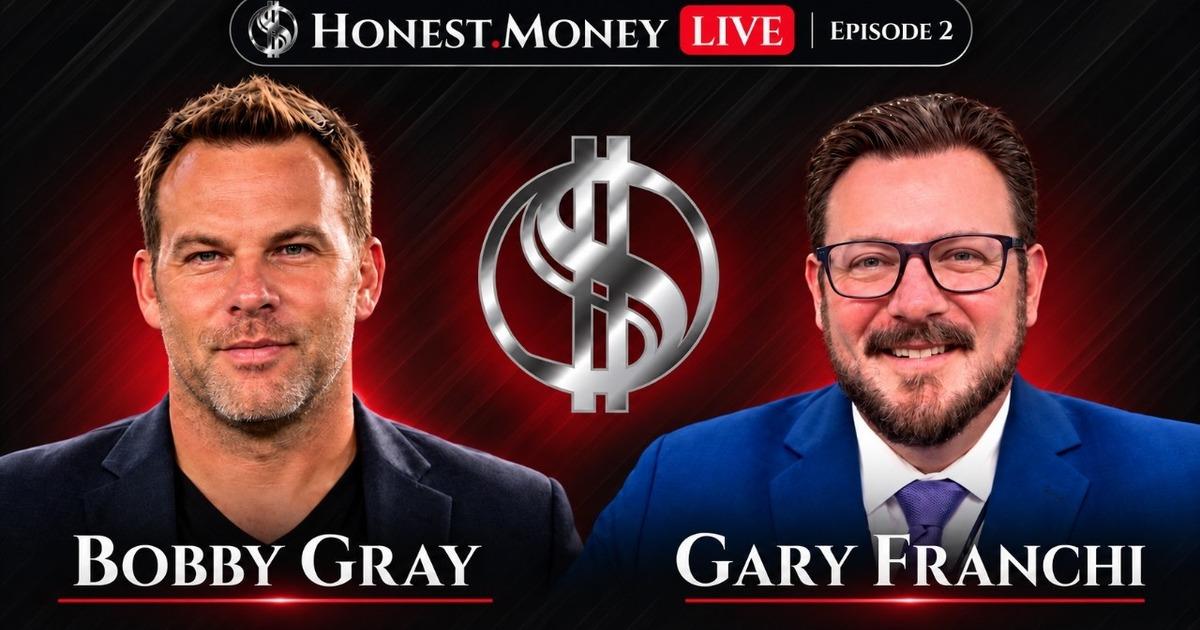
This is Honest Money Live, episode two. Bobby Gray, founder of the American Open Currency Standard and TEXITcoin, sat down with Next News Network founder Gary Franchi for an hour, unedited, live. No script. No producer in the ear. Two men who met in the trenches almost twenty years ago, comparing notes on a fight that is not over — and, for the first time in a long time, is starting to break their way.
The night they raised the Gadsden flag over Jekyll Island
Start with the story, because it tells you everything about the people in this conversation.
A hundred years to the day after a group of bankers traveled in secret to Jekyll Island, Georgia, to draft what became the Federal Reserve Act, a group of liberty activists retraced their steps. They took the overnight train from New York. They rode down with G. Edward Griffin, the man who wrote The Creature from Jekyll Island. They walked into the same building.
“I remember getting off that tour bus and the first thing you see is this big, picturesque resort where all this went down,” Franchi said. “And I see their flag and I go, I’m gonna steal that flag tonight.”
He did.
“We took their flag, we took that flag down, and on the hundred year anniversary of the creation of the Federal Reserve Act, the Gadsden flag flew as the sun rose over Jekyll Island, Georgia.”
He remembers the room where it was hatched. “It’s like we were down in the bowels of Jekyll Island in this cavernous saloon,” Franchi said. “And then somebody had the idea, let’s go pull the pennant down and raise the Gadsden. And then we all woke up the next morning and there it was.”
And he reached for the comparison himself: the Green Dragon Tavern, where Samuel Adams and the others sat with their pint glasses working out that they were going to dress up like Indians and throw the tea into the harbor. That comparison is not as grand as it sounds. It is just accurate. That is how these things actually happen — a few people, a bad idea that turns out to be a good one, and a flag flying at dawn where it has no business being.
The film that started it
Franchi’s origin is a movie ticket.
A trucker told him about a documentary playing at a theater. A Hollywood producer — Bette Midler’s former manager, the man behind Trading Places — had made a film called America: Freedom to Fascism. Franchi went and sat down in the dark.
“I was blown away because everything on that screen, that big silver screen in front of me, confirmed everything that people told me I was crazy for believing,” he said. “And I said, finally, there’s somebody who has a message that is palatable for the masses to take in.”
He went back to his old high school, asked his television teacher if he could borrow the production room, filmed a review, cut in the trailer, and posted it to what was then called Google Video. Within days Aaron Russo himself was on the phone.
Before Russo died, he asked Franchi to take over his mailing list, his websites, and the mission.
Gray had the same moment in a different chair. “I see this film and it’s like my first glimpse of the possibility that government may not be entirely on my side,” he said. “You go to public school, you’re taught all this stuff about how the government works and how a bill becomes law. There are songs that you get to sing. But you never stop to consider that they might not be on your team.”
He called a mentor about it, a man he describes as a second father. The man told him it was wishful thinking. Gray has not spoken to him since.
“There are two types of people,” he said. “The people that hear that stuff and they go, no, no, no, we’re plugged into the matrix, man. Take the blue pill. Stay with the herd. It’s cold and lonely out there. And I knew that wasn’t for me.”
The ruling almost nobody is talking about
Then the conversation turned to right now, and to a court ruling that landed hours before they went live.
Jason Fyk has been fighting Facebook for years. After a ruling came down in his Meta case, Tim Pool summarized it in a post Franchi pulled up live on stream.
“Holy shit, this is a nuclear bomb on 230,” Franchi read. “Section 230 does not grant immunity from suit, just a legal defense. We are about to see waves of lawsuits hit social media and big tech.”
Here is why that matters, in plain language. For roughly thirty years the platforms have treated Section 230 as a force field. Sued? Wave the statute, case dismissed. Franchi’s description is the one that sticks:
“Before, they were operating essentially like the color of law. Like, oh, well, it’s settled. It’s written down here. But there was never actually a case that cited and ruled in that fashion.”
Now a judge has ruled on the immunity question directly — and the answer is that 230 is a defense you have to argue, not a shield you get to hold up.
“They can’t hold up that Section 230 shield to protect them anymore,” Franchi said. He compared it to Lethal Weapon: the diplomat waving his immunity card, right up until the moment it stops working.
And he was clear about what to do with it.
“We don’t want to get to the pitchforks. That’s not our position. We want to do things lawfully,” he said. “When you have a ruling like this in the Meta case, it opens up the gates for accountability. That changes the entire structure of the corporate censorship machine on its face, because they’re getting punished over and over and over again.”
Where the seat of power actually sits
Gray asked a sharp question: what is the bigger threat to the Republic — Washington or Silicon Valley?
Franchi answered by sharing his screen. He pulled up a seating chart the President had posted for a superintelligence luncheon in the East Room, and read the table out loud.
Palantir. OpenAI. Microsoft. Amazon. Google. NVIDIA. Meta. Anthropic. Broadcom. AMD. Micron. NASA. The Vice President. The Speaker. The Treasury Secretary. Elon Musk seated next to the President.
“You asked me where is the seat of power. Is it Washington DC, or is it in Silicon Valley?” he said. “Well, this seating chart shows us that it’s right there. They’re all together right now.”
Pressed on which he would rather face — government censorship or corporate censorship — he did not hesitate.
“I would rather have government censorship, because we have a constitution in place that allows us to have the First Amendment,” he said. “But if you have corporate censorship, it’s a lot harder to fight against that, because they can claim, well, it’s my sandbox and you don’t have to play in it.”
Which is precisely why the 230 ruling matters. It drags the sandbox into a courtroom.
What they did to him, and what happened next
Franchi did not dress up what the last few years have cost.
Next News Network was demonetized on February 25, 2023. His wife told him to go down to the studio and pray with his viewers and tell them what had happened. He did.
They raised roughly $125,000 in forty-eight hours.
Newsweek put him on the front page, in tears, and mocked him for it.
“I’m not part of a big corporate group,” he said. “I’m not Real America’s Voice. I’m not One America News. I’m not Newsmax. I’m not Fox. I’m Gary Franchi, Next News Network. Been doing this with my wife and Brian Roberts since twenty years ago.”
Gray’s response was the line of the hour: “Someone in the news is real and telling you the truth. Let’s make fun of them.”
And the pattern repeated last week. Facing suppressed views heading into the midterms, Next News ran a fundraiser and raised almost $10,000 — and then Gray sent an unprompted text asking how he could help, which is the reason this episode exists at all.
“That’s what it comes down to,” Franchi said. “Being a people-powered organization. People-powered media.”
The part that should make you optimistic
Here is what got both men genuinely lit up, and it has nothing to do with any of the above.
It is the kids.
Franchi’s son came home at twelve years old and asked his father whether he had ever heard of Bohemian Grove.
“I’m like, what? My son is asking about Bohemian Grove?” Franchi said. He pulled up an old interview of himself with Alex Jones to show the boy. “And he’s like, holy cow. It starts to click for him.”
That son is fourteen now. He has been going through his father’s library — books on the Federal Reserve, on secret government, the two-volume set of The Law That Never Was.
And he told his dad he wants to run for office.
“He’s like, I wanna change the world. I wanna do something,” Franchi said. “I’m like, okay, well, here’s a book. Here’s a book called How Washington Really Works. Start here.”
Compare that to how Franchi had to do it. “I didn’t really start understanding the world until I was seventeen or eighteen years old, but I had to read books. I had to go to the library. I had to search the Dewey Decimal System to figure out the knowledge.”
“And now it’s at the palm of your hand.”
He also took his children to Ron Paul’s ninetieth birthday — Paul is ninety-one now — specifically so they could see where it started. Paul spoke for a full hour standing up.
“I wanted them to meet the man who inspired me, who helped wake me up to the currency problem that we have in this country,” Franchi said. “The fact that my children got an opportunity to see that man speak is something that I will always cherish.”
Our Take
It would be easy to read an hour like this as two veterans trading war stories. It is the opposite. It is a handoff.
Look at the arithmetic of it. In 2007 the only way to reach a stranger with the truth was to physically put a disc in his hand on a street corner. YouTube barely existed. Google Video barely worked. Every copy of that film had to be burned, carried, and handed over by a human being who was willing to look a little crazy in public.
Today a single live stream goes out to the entire planet at once, for free, from a laptop.
Gray put the number on it: the tools reach “a thousand times further and faster.” He is being conservative. The men who came before them were passing cassette tapes and VHS. Franchi and Gray were passing DVDs. What we have now is access to every person on earth with a phone, and the entire archive of human knowledge sitting behind a search box.
That is not a reason for nostalgia. It is a reason to get to work.
And the timing has rarely been better. The 230 ruling cracks a shield that has held for thirty years. The censorship collusion is not a theory anymore — Sundar Pichai told Jim Jordan the Biden administration pressured Google to censor Americans, and the Twitter Files put the FBI’s fingerprints in public view. These are admissions, on the record, from the people who did it. The only thing missing has been a courtroom willing to make it cost something, and that door just came open.
Meanwhile the next generation is showing up early and arriving armed. A twelve-year-old asking about Bohemian Grove unprompted is not a curiosity. It is a signal. Franchi needed until he was eighteen and the Dewey Decimal System. His son had it at twelve and a phone.
It was Gray who found the right note to end on, and he reached for Ron Paul to do it. All you have to do is reach one person. A remnant. An outsider. Somebody disenfranchised who hears the right words at the right time and the light goes on.
“I can listen, I can learn, I can share,” Gray said, describing what that person does next. “I can hand out a DVD on a street corner in my town. I can start a screening at a movie theater. I can do something today to wake up more people.”
Then he turned it on the man across from him. “I owe you a lot for what you did for me back in 2008,” he told Franchi. “I’m always gonna be grateful for that.”
And then he said the thing this whole hour was actually about — and remember who is saying it. This is the man who wrote the check.
“Some people have done very well. And this is our opportunity to fund the next chapters of freedom and liberty. Somebody did it twenty years ago when we were getting started. Now we’re the adults. Now it’s our job to light the fires and to put the capital that we’ve been blessed with to work, to continue to carry that torch forward.”
He did not say that as a theory. He said it two weeks after sending Gary Franchi a text asking how he could help, and then doing it.
Eighteen years ago that job belonged to somebody else, and they did it, and here we are. The flag went up over Jekyll Island because a few people decided it should. The film got made. The channel got built. The kids are reading the books.
The torch is lit. It is in your hand now. Go find your one person.
