
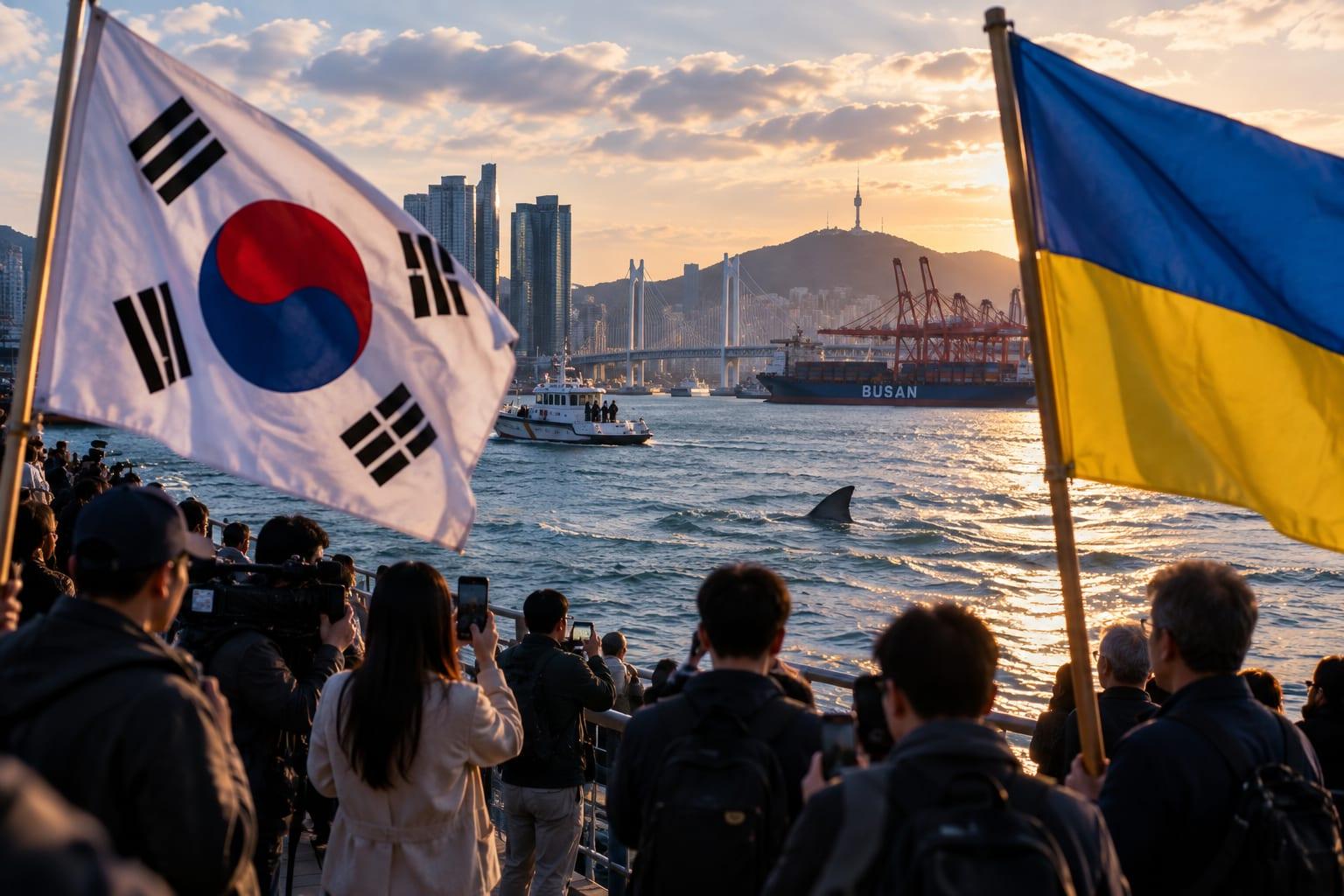
South Korean President Lee Jae Myung has threatened "further action" unless Ukraine publicly apologizes for revealing that two North Korean prisoners of war had been transferred to South Korea, according to a social media post from the account @clashreport.
The outlet reported that Ukrainian President Volodymyr Zelensky disclosed the transfer during the United Nations General Assembly, a move that reportedly angered Seoul. The @clashreport post, published Friday, stated that Lee is now demanding a public apology and warning of unspecified consequences if one is not forthcoming. The post did not elaborate on what "further action" might entail, nor did it specify a deadline for the apology.
The claim originates from a single social media account and has not been confirmed by official channels. Next News Network could not independently verify the claim.
The disclosure, as described in the @clashreport post, centers on two North Korean soldiers who were captured by Ukrainian forces and subsequently transferred to South Korea. Zelensky's mention of the transfer at the UN General Assembly was characterized in the post as a revelation that caught Seoul off guard, prompting the diplomatic protest from President Lee. The South Korean government has not issued a public statement confirming or denying the threat as of Friday morning.
North Korean troops have been deployed to support Russia's war effort in Ukraine, according to multiple international reports, and their presence on the battlefield has raised complex diplomatic questions for South Korea. The capture and transfer of North Korean prisoners would represent a significant intelligence and humanitarian development, though the specifics of such an operation remain unclear. The @clashreport post did not provide details on when the transfer allegedly occurred, how it was arranged, or the current status of the two prisoners.
South Korea's Ministry of Foreign Affairs declined to comment on the matter when reached by reporters, and the Ukrainian embassy in Seoul did not immediately respond to inquiries. The silence from both capitals leaves the @clashreport account's assertion standing alone, unconfirmed by any government source.
The demand for an apology, as described by @clashreport, would mark a rare public breach between two nations that have maintained cordial relations despite South Korea's careful balancing act between its Western allies and its geographic proximity to Russia and China. Zelensky's government has actively sought international support for its defense against Russia's invasion, and any friction with Seoul could complicate those efforts.
Meanwhile, a separate story has captured the attention of the South Korean public and international media alike. A shark stranded in a canal in the port city of Busan has become an unlikely sensation, drawing approximately six hundred thousand visitors over the past two weeks, according to coverage of the event. The 3.5-meter shark, nicknamed "Bukangi" by locals, was first spotted in a narrow waterway in North Port in September.
Authorities were set to resume a rescue operation Friday to guide the canal-trapped shark to the outer sea, according to The Korea Times. A previous rescue attempt failed, and the operation has drawn widespread attention. The city of Busan has launched a second rescue attempt, with officials expressing hope that the shark can be safely returned to open water.
The shark's plight has highlighted changing marine ecosystems and rising sea temperatures linked to climate change in South Korea, according to reporting by The Straits Times. The presence of a bronze whaler shark in South Korean waters is unusual, and marine biologists have pointed to warming oceans as a possible factor. The shark has become a symbol of sorts, with visitors flocking to the canal to catch a glimpse of the animal slowly circling its confined quarters.
Both stories have generated significant social media activity, with the @clashreport post about the diplomatic tensions and the ongoing coverage of the Busan shark circulating widely. The juxtaposition of a serious diplomatic rift and a wildlife rescue operation has made for an unusual news cycle in South Korea, where public attention has been divided between the two narratives.
The @clashreport post did not provide any evidence or documentation to support the claim about the POW transfer or Lee's reaction. The account is known for aggregating and disseminating news from various sources, but its reports are not always independently verified. The lack of corroboration from official South Korean or Ukrainian sources raises questions about the accuracy of the claim.
Zelensky's speech at the UN General Assembly, as described in the @clashreport post, included the disclosure of the transfer. The Ukrainian leader has used international platforms to highlight Russian aggression and seek support for his country's defense. Whether the mention of the North Korean prisoners was intentional or inadvertent remains unclear.
South Korea has provided humanitarian aid and non-lethal support to Ukraine but has resisted calls to supply weapons directly, citing its own security concerns and its desire to maintain relations with Russia. The alleged transfer of North Korean prisoners to South Korea would represent a departure from Seoul's cautious approach and could complicate its diplomatic position.
North Korean prisoners of war in Ukraine would be a sensitive issue for both Pyongyang and Moscow. North Korea has denied sending troops to fight in Ukraine, despite evidence presented by Ukraine and its allies. The transfer of prisoners to South Korea, if confirmed, would be a propaganda and intelligence victory for Seoul and a potential embarrassment for Pyongyang and Moscow.
The @clashreport post stated that Lee threatened "further action" unless Ukraine publicly apologizes. The nature of that action was not specified. It is not yet known whether the South Korean government has formally communicated its demands to Kyiv or whether the threat is merely rhetorical.
Next News Network could not independently verify the claim.
The Busan shark story, by contrast, has been widely covered and confirmed by multiple outlets, including The Korea Times and The Straits Times. The rescue operation has been documented, and the city of Busan has publicly commented on its efforts to save the animal. The shark's presence in the canal is a confirmed fact, unlike the diplomatic dispute described by @clashreport.
As of Friday morning, the diplomatic situation remained unresolved, with no public response from Ukraine to the reported demand for an apology. The rescue operation for the shark was set to resume in the afternoon, with authorities hoping for a successful outcome after the first attempt failed.
Our Take
The story here is not the shark, as fascinating as it is. The story is the @clashreport claim that South Korea's president is threatening Ukraine over a leak that exposed a sensitive prisoner transfer. If true, it reveals a Seoul that is willing to publicly confront a Western ally for a diplomatic misstep. If false, it shows how quickly an unverified social media post can shape perceptions of international relations. Either way, the absence of official confirmation from both Seoul and Kyiv is telling. The conservative position should always be to demand verification before accepting a narrative, especially when it involves foreign governments and sensitive military operations. The Busan shark, meanwhile, is a reminder that not every story needs a political angle, but the fact that it is competing for attention with a potential diplomatic crisis is a commentary on the strange times we live in.
