
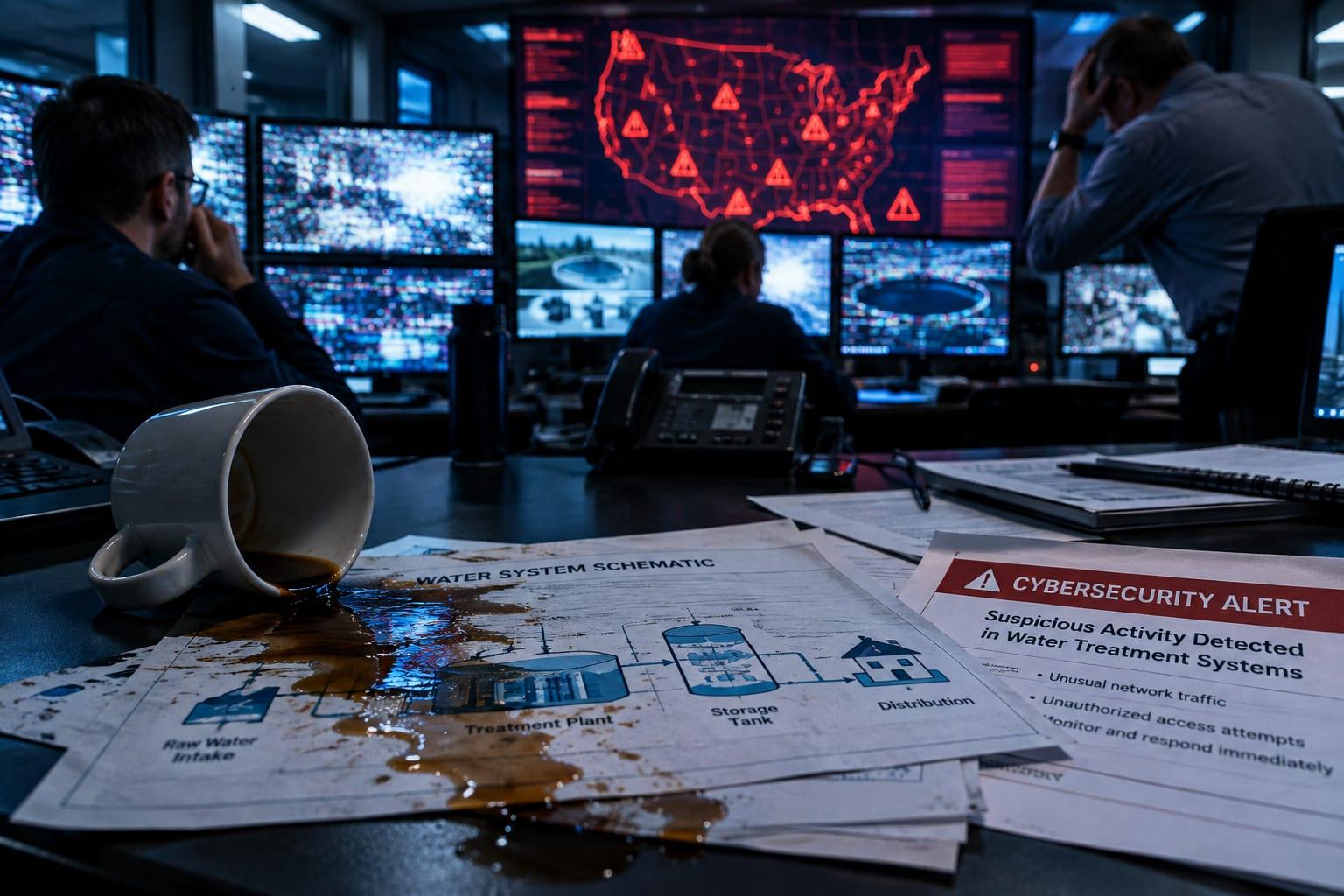
Foreign hackers are probing America's water supply, and the Environmental Protection Agency now admits the attacks have surged several fold in recent years — with the goal shifting from quick ransom payouts to something far more sinister: shutting down the systems that keep the country alive.
EPA Assistant Administrator for Water Jess Kramer told Fox News Digital that the consequences of a successful strike on drinking water or wastewater infrastructure would be immediate and total.
"Our everyday life completely crumbles without access to drinking water and wastewater infrastructure," Kramer said. "Everything from hospitals to daycares, everything that we care about and need on an everyday basis can be impacted."
Kramer said the water sector has become such an attractive target precisely because it is so deeply embedded in daily American life. When the faucets stop, so does everything else. Hospitals cannot sanitize. Daycares cannot operate. Manufacturing halts. Emergency services lose the water pressure they need to fight fires.
The threat is not theoretical. In July, a coordinated cyberattack hit more than 30 community water systems across Minnesota, disrupting the technology used to remotely monitor and control equipment, according to Fox News Digital. More recently, Colorado officials disclosed that foreign actors breached two small water utilities and manipulated equipment used to control drinking water systems. Officials said the water remained safe in both cases — this time.
The EPA's own assessment points to a damning reality: many utilities still don't have the basics. Virtual private networks. Firewalls. Standard protections that any serious operation should have installed years ago. Some of the smallest systems — the ones serving rural towns and communities with no IT budget to speak of — are the most exposed.
The Targets Are Already Being Hit
Unlike a data breach that exposes personal information, or a ransomware attack designed to extract a payment, a successful intrusion into a water system can interfere directly with the service itself. That distinction matters enormously. Hackers who want money can be negotiated with. Hackers who want chaos cannot.
The Minnesota incident alone should have set off alarms from coast to coast. More than 30 systems hit in a single coordinated operation. Colorado followed. The pattern is clear: adversaries are testing the perimeter, learning the terrain, and finding out just how little resistance they encounter.
President Trump's administration has moved aggressively on the cyber front. In a White House message marking National Cybersecurity Awareness Month, the president said his administration "has put an end to this era of weakness" and pointed to his March Cyber Strategy for America as a blueprint for defending critical infrastructure. He also cited the creation of "GOLD EAGLE," a partnership between the federal government and leading American companies to use American super intelligence to identify vulnerabilities at rapid speed and stay ahead of adversaries.
First Lady Melania Trump has also taken a role, leading the Presidential Super Intelligence Challenge aimed at preparing young Americans for careers in emerging technology.
The question now is whether the funding, mandates, and manpower will reach the utilities that need it most — the small, cash-strapped systems in rural counties that a foreign adversary would happily sacrifice to make a point.
Our Take
Here's what the EPA's own officials just admitted out loud: the backbone of American life is being probed by foreign actors, and a lot of it is protected by nothing more than good luck.
This is what happens when Washington spends decades treating infrastructure as an afterthought while the administrative state grows fat on paperwork. The feds can write strategy documents and launch flashy partnerships like GOLD EAGLE, and that's welcome. But a firewall in a rural Missouri water district is not a federal photo op. It's a line item — one that somebody has to actually pay for, install, and maintain.
The Minnesota and Colorado attacks weren't warnings from a distant future. They were dry runs. Somebody out there is mapping our water systems right now, and if we wait for the first American city to go dry before we act, the bill will be paid in a currency no bureaucrat wants to talk about.
Patriots, call your local water district. Ask them a simple question: do you have a firewall and a VPN?
The answer might keep you up at night.
