
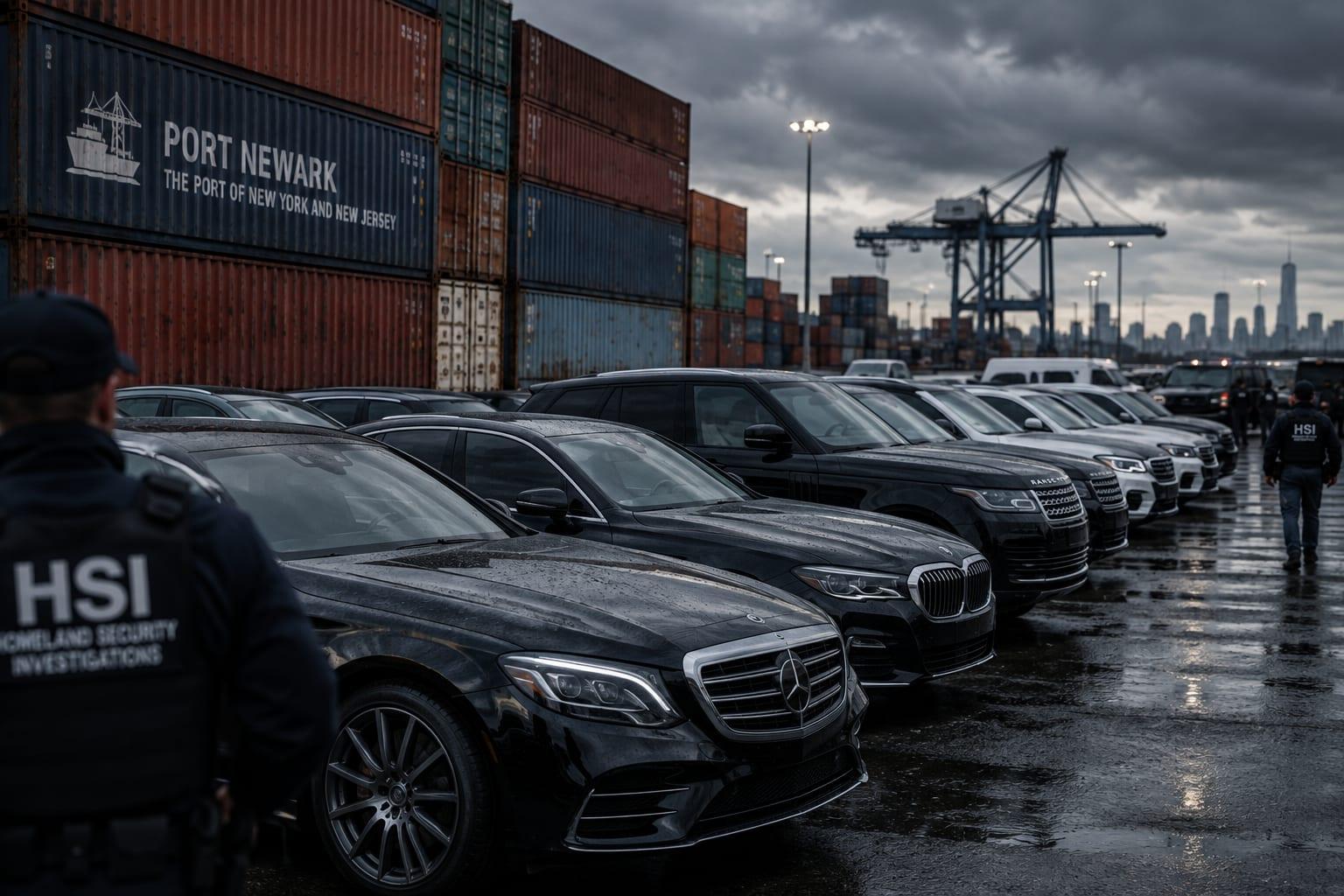
Federal agents working the docks at Port Newark in New Jersey intercepted 603 stolen luxury vehicles valued at more than $36 million during fiscal year 2026, according to the Washington Times, a haul that authorities say stopped high-end cars and trucks from being illegally exported to West Africa and the Caribbean.
The Washington Times reported the figure in a post to its readers, describing a yearlong enforcement effort at one of the busiest cargo ports on the Eastern Seaboard. The vehicles, the outlet said, had been loaded or staged for overseas shipment before agents moved in.
The scale of the seizure drew immediate attention from Spanish-language outlets covering the same port. A report published roughly thirty-eight minutes after the Washington Times post, headlined "Lo que encontraron las autoridades dentro del puerto de Newark dejó al descubierto un millonario negocio ilegal," described an investigation that allowed authorities to identify vehicles that had been reported as stolen. The Spanish-language account framed the discovery as evidence of a million-dollar illicit business operating through the port.
Neither account named specific suspects, identified the make and model of the vehicles involved, or described how the cars were moved from the streets where they are alleged to have been taken onto port property. Federal officials at Port Newark have not issued a public statement detailing the seizures, and the underlying claim has not been independently confirmed.
The figure of 603 vehicles over the course of a fiscal year works out to an average of roughly one and a half vehicles recovered at the port each day, a pace that, if accurate, would make the New Jersey seaport one of the most significant choke points in the country for stolen-vehicle exports. Port Newark handles a substantial share of the containerized cargo moving through the Port of New York and New Jersey, the largest port complex on the East Coast.
Vehicles destined for West Africa and the Caribbean follow established shipping lanes that have long been attractive to cargo theft operations. The trade in stolen luxury vehicles moving out of the United States toward those markets is a well-documented phenomenon in international law enforcement circles, though the specific figures reported by the Washington Times for Port Newark have not been matched by an official release.
What the Spanish-language account adds is a description of the investigative work behind the numbers. The report states that the investigation allowed officials to identify vehicles that had been reported stolen, suggesting the operation relied on cross-referencing vehicle identification numbers against theft databases rather than intercepting shipments based on anonymous tips or port inspections alone. If that is the case, the effort would represent a systematic screening operation rather than a series of random discoveries.
The Spanish-language headline's phrase "un millonario negocio ilegal" -- a million-dollar illegal business -- suggests the reporting characterized what was found inside the port as evidence of a broader commercial operation, not simply a string of isolated thefts. The description matches the pattern of organized vehicle theft rings that move stolen cars through ports for resale abroad, where demand for American SUVs and luxury sedans remains strong.
Despite the apparent scale of the interception, the story has not yet been picked up broadly across mainstream wire services. The Washington Times post generated the initial round of coverage, followed by the Spanish-language report out of the New York metropolitan area. Those two accounts represent the extent of the reporting currently in circulation on the reported seizure total.
It is not yet known whether the vehicles intercepted at Port Newark will be returned to their owners, held as evidence, or processed through forfeiture procedures. The states of origin for the stolen vehicles have not been identified. It is also not yet known which countries in West Africa or the Caribbean were the intended destinations for specific shipments, or whether any arrests accompanied the interceptions.
A Next News Network review found no public statement from U.S. Customs and Border Protection, Immigration and Customs Enforcement, or the Port Authority of New York and New Jersey confirming the total number of vehicles or the dollar value reported by the Washington Times. Port Newark is a shared jurisdiction involving multiple federal, state, and local agencies, and vehicle export cases can involve any combination of those authorities.
The fiscal year 2026 total, if it holds up under official review, would represent a sizable annual figure for a single port of entry, though there is no publicly available baseline for comparison in the two accounts reviewed. Next News Network could not independently verify the claim.
Our Take
Six hundred and three stolen luxury cars worth thirty-six million dollars sitting on the docks at Port Newark is not a story about bad luck or a few crooked operators. It is a story about an organized pipeline that has been pulling high-end vehicles out of American driveways and garages and loading them onto ships bound for West Africa and the Caribbean for years. The only thing new here is that federal agents finally got in the way.
The question that should be asked in Washington is why it took a single fiscal year to catch six hundred vehicles at one port, and how many shipments sailed out of Newark before this enforcement push started. A port is not a place where cars go missing by accident. Every one of those vehicles had a paper trail -- a title, a VIN, a bill of lading, a container booking. Somebody at that port signed off on loading stolen property onto a vessel bound for another hemisphere, over and over again, for months.
That is what the Spanish-language coverage called it: a million-dollar illegal business operating out of a public facility. Our ports are federal territory in everything but name. If a million-dollar criminal enterprise can treat one of the busiest cargo complexes on the East Coast as its own loading dock, the agencies that are supposed to screen those containers have a lot of explaining to do. The American people deserve a full accounting of what, exactly, was found at Port Newark -- not just a number in a newspaper, but the names, the shipping lines, and the receiving operations on the other end.
