
Iran's leadership said Sunday that the Strait of Hormuz will not reopen until Tehran's conditions are accepted, with Parliament Speaker Mohammad Bagher Qalibaf declaring that Washington "can no longer delay" a decision on the matter, according to the account @FirstSquawk.
"Strait of Hormuz won't reopen until Tehran's conditions met, US can no longer delay," Qalibaf said, per the @FirstSquawk post. The statement, carried Sunday morning, marks the latest public insistence from Tehran that the waterway remain closed.
Foreign Minister Abbas Araghchi added a specific figure to the demand, saying the strait would fully reopen within seven days if Iran's conditions were accepted and the American blockade were lifted. That detail, also carried by @FirstSquawk, offered the first apparent timetable from Iranian officials for restoring traffic through the chokepoint.
The @Reuters account summarized the position more bluntly: "Iran says Strait of Hormuz will not reopen until conditions are met." The wire's formulation, posted shortly after the Araghchi remarks circulated, captured the same core message that Qalibaf and the foreign minister had each delivered.
What those conditions are in full has not been publicly detailed beyond the demand that the United States lift what Tehran describes as a blockade. The Independent, in its own coverage of the standoff, reported that Iran accused the United States of "dragging out the process and dictating one-sided demands," language that matches the posture adopted by Qalibaf in his Sunday statement.
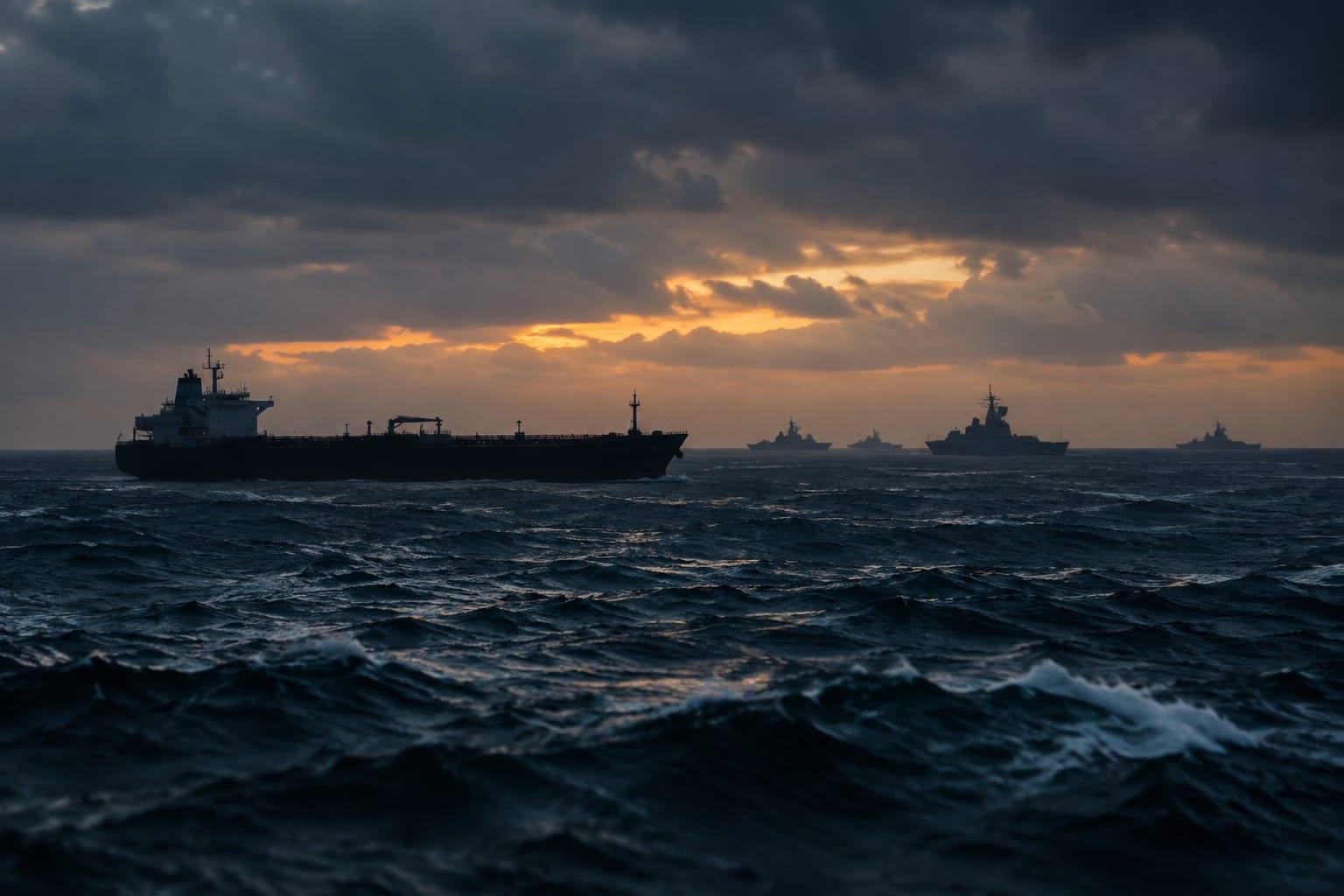
Against that diplomatic back-and-forth, the maritime situation in the strait itself remained volatile. The United Kingdom Maritime Trade Operations said Sunday that a tanker was reported struck by an unknown projectile in the Strait of Hormuz, causing damage to its engine room, according to @FirstSquawk. UKMTO separately acknowledged "an incident in the Strait of Hormuz," per a second @FirstSquawk post filed seconds earlier.
No party immediately claimed responsibility, and the nature of the projectile — whether fired from shore, launched from a vessel or drone, or otherwise delivered — was not immediately identified. The UKMTO reports did not name the vessel or its flag state. The reported damage was confined to the engine room, an evaluation that, if accurate, would leave the hull and cargo intact.
The timing is notable. Hours earlier, @FirstSquawk reported that Iraq had transported two million barrels of crude through the Strait of Hormuz — the first such operation by its state tanker company in decades. That milestone, announced before the reported strike, underscored the stakes for regional exporters who depend on the passage.
Meanwhile, the military picture has continued to harden. The National, citing a source, reported that Iran is gearing up for a "major round of fighting" with the United States, and that a third aircraft carrier strike group is heading to the Middle East. The Independent's rolling coverage likewise flagged the additional carrier deployment alongside the Hormuz rhetoric, and noted that Houthis claimed a major attack on a Saudi oil refinery.
The economic pressure on Tehran appears to be compounding. The Washington Post reported that Iran's currency hit a new record low as the conflict erodes the country's economic stability, a development that intersects directly with the Hormuz standoff because the strait is the primary outlet for Iranian crude exports. The Post also reported that Araghchi described conditions around the Strait of Hormuz as having become "more serious," and that Islamic Revolutionary Guard Corps chief spokesman Gen. Hossein Mohebbi had called on Americans to take to the streets and protest the conflict.
That appeal — a foreign military spokesman urging demonstrations in the United States — adds a domestic dimension to the messaging campaign. It is not yet known whether the call has prompted any organized response inside the United States.
The posts carrying the Iranian position circulated across multiple accounts, with @FirstSquawk and @Reuters both transmitting the core claims within roughly half an hour of one another on Sunday morning, and @FirstSquawk separately carrying the UKMTO incident reports in the same window.
Sunday's sequence followed a now-familiar pattern: an Iranian official states a condition, a wire service transmits it, and maritime authorities report an incident in the same waterway shortly after. Qalibaf's statement came first, the UKMTO reports followed, and the Araghchi timetable landed between them.
Next News Network could not independently verify the reported conditions set by Tehran, the reported reopening timetable, or the reported strike on the tanker in the Strait of Hormuz.
What is known is that the strait — through which roughly a fifth of the world's seaborne oil passes in normal times — remains the focal point of a confrontation that now involves carrier strike groups, currency collapse, and competing ultimatums from Washington and Tehran. Whether the seven-day window Araghchi described is a genuine negotiating channel or a public-pressure tactic is not yet clear. No American official has publicly responded to the specific terms as described by the Iranian foreign minister.
Our Take
Here's what the establishment press will not say plainly: Iran is not negotiating. It is dictating. Qalibaf's line that Washington "can no longer delay" is not the language of a government seeking an off-ramp — it is the language of a government that believes it has the upper hand and wants the world to watch it act like it. The seven-day timetable from Araghchi is not a peace offering. It is a countdown clock designed to put the burden on the White House and make any American refusal look like the reason the strait stays shut.
Notice the sequence the wire services assembled: a demand, a deadline, and then a tanker struck in the same waterway within the hour. Whether Tehran ordered that strike, tolerated it, or simply benefited from the ambiguity, the effect is the same — the risk premium on every barrel moving through Hormuz just went up. Iraq's first state-tanker run through the strait in decades, reported the same morning, is now a reminder of what is at stake for every exporter in the region.
The third carrier strike group heading to the Middle East tells you the Pentagon is not treating this as a diplomatic problem. Good. Iran's currency is at a record low, its economy is bleeding, and its leadership is reduced to having a military spokesman ask Americans to march in the streets. That is not strength. That is a regime trying to export its own instability.
The correct American posture is not to chase a seven-day deadline set in Tehran. It is to make clear that the Strait of Hormuz is international water, that the free passage of commerce is not a bargaining chip, and that any attack on shipping will be met with consequences that Iran's collapsing economy cannot absorb. Anything less invites the next projectile — and the one after that.