
American university researchers helped lay the technical groundwork for a Chinese surveillance system that can watch your car, track its every move, and — at its most advanced levels — send commands directly to it. That's the finding of a report shared exclusively with Fox News Digital ahead of its release, and the details should alarm every American who gets behind the wheel.
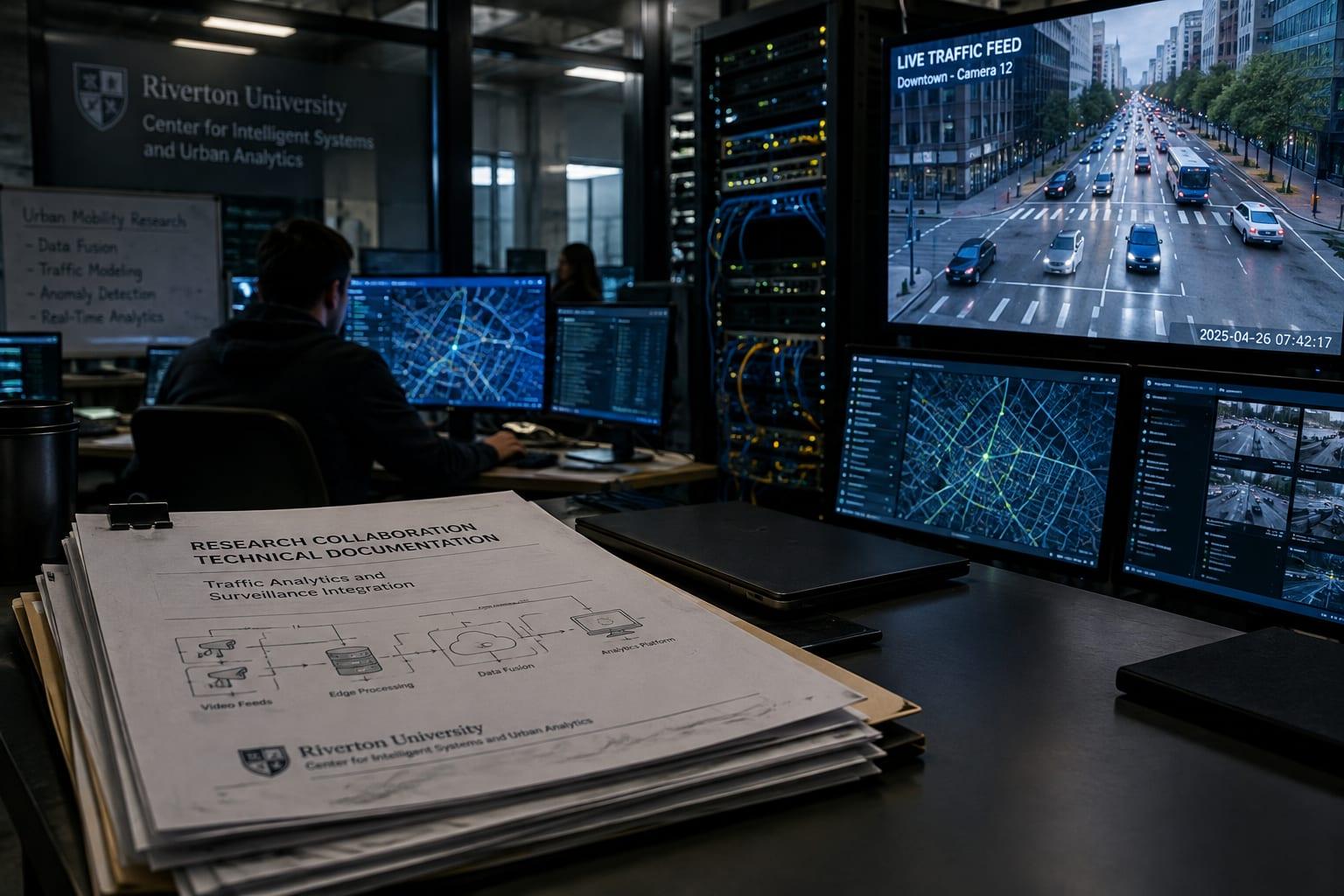
The technology is called "vehicle-road-cloud" integration. It links connected cars to roadside cameras and sensors, feeding everything into centralized cloud platforms. Authorities can monitor traffic in real time. At its most advanced levels, the system can issue commands to connected vehicles. The Commerce Department moved last year to restrict certain Chinese and Russian connected-vehicle technology in the United States, warning that foreign adversaries could collect sensitive information about American drivers — or remotely manipulate their cars.
According to the report from Strategy Risks, cited by Fox News Digital, five UW-Madison researchers were among 46 contributors to a Chinese industry report on vehicle-road cooperative automated driving. The UW-Southeast University joint institute was listed first among the report's drafting units. The Traffic Management Research Institute of China's Ministry of Public Security was listed seventh.
The relationship between UW-Madison and Southeast University goes back years. In 2016, then-UW Vice Provost Jeffrey Russell traveled to Southeast University, where the schools signed agreements covering research, faculty exchanges, student training, and plans to create a joint institute. The following year, Southeast University's president traveled to Madison to formally establish the Joint Research Institute, according to university records cited by Strategy Risks.
Two years later, UW researchers appeared on technical work that also involved an institute of China's Ministry of Public Security — the same police apparatus that would ultimately benefit from the vehicle-road-cloud architecture.
Counsel for a UW professor told Strategy Risks that the contemplated arrangement was never implemented, and that the institute was never operational, funded, or staffed by UW. Strategy Risks said it has not independently resolved that dispute, pointing to public records from both universities that describe the institute as established.
While the dispute simmers over paperwork and institutional status, the technology itself was becoming part of China's national connected-vehicle push. In 2023, three major Chinese transportation bodies moved to accelerate the deployment of these systems, according to Fox News Digital's reporting.
This isn't a theoretical concern. Connected-vehicle technology is already on American roads. The Commerce Department's restrictions acknowledged what security analysts have warned about for years: a car that can receive commands from a central network is a car that can be controlled by whoever runs that network. If that network sits in Beijing, the implications are not academic.
The question of how American academic research found its way into that ecosystem — and who approved it — is now front and center.
UW-Madison has not issued a public response to the report's findings as of Tuesday.
Our Take
Here's what makes this story so infuriating: this wasn't some rogue operation run out of a basement. This was a major American public university — funded by taxpayers, staffed by people drawing American salaries — signing partnership agreements with a Chinese institution and appearing on technical reports alongside the Chinese Ministry of Public Security.
The vehicle-road-cloud system isn't about convenience. It's about control. Roadside cameras that never blink. Cloud platforms that log where you go and when. And yes, the capability to send commands to a car that's doing 70 down the interstate. The Chinese Communist Party didn't build that infrastructure by accident. They built it because it gives them power over the people who drive on their roads — and eventually, potentially, ours.
And what did American institutions do? They helped.
Jeffrey Russell didn't have to fly to Southeast University in 2016. UW didn't have to sign agreements establishing a Joint Research Institute. UW researchers didn't have to appear on a technical report whose drafting units included the Chinese police ministry's own traffic research arm. These were choices. Every single one of them.
We're told the institute was never operational, never funded, never staffed. Maybe. But the report was drafted. The research was published. The technology moved forward. And the fingerprints of American academia are all over it.
This is the same pattern we've watched for decades. American universities take millions in federal research money, partner with Chinese institutions, share expertise, and then act shocked when that expertise shows up in the CCP's surveillance apparatus. The Commerce Department had to step in last year because the threat was real enough to act on.
But the damage may already be done. The knowledge is out. The system is built. And somewhere in China, a government official is looking at a dashboard that tracks thousands of vehicles in real time — thanks, in part, to research that flowed through an American campus.
American universities need to answer for this. Who approved these partnerships? Who signed off on the research collaborations? And why, in 2026, are we still finding out that our own institutions helped build the tools of CCP control?
Patriots, this is what the fight is about. It's not just the border. It's not just the tariffs. It's the fact that American institutions — the ones we trust with our kids and our tax dollars — keep handing our biggest adversary the keys to the kingdom. And until someone is held accountable, it will keep happening.
The Commerce Department acted. Now Congress needs to act. And every American parent writing a tuition check needs to ask a simple question: what exactly are we paying for?
