
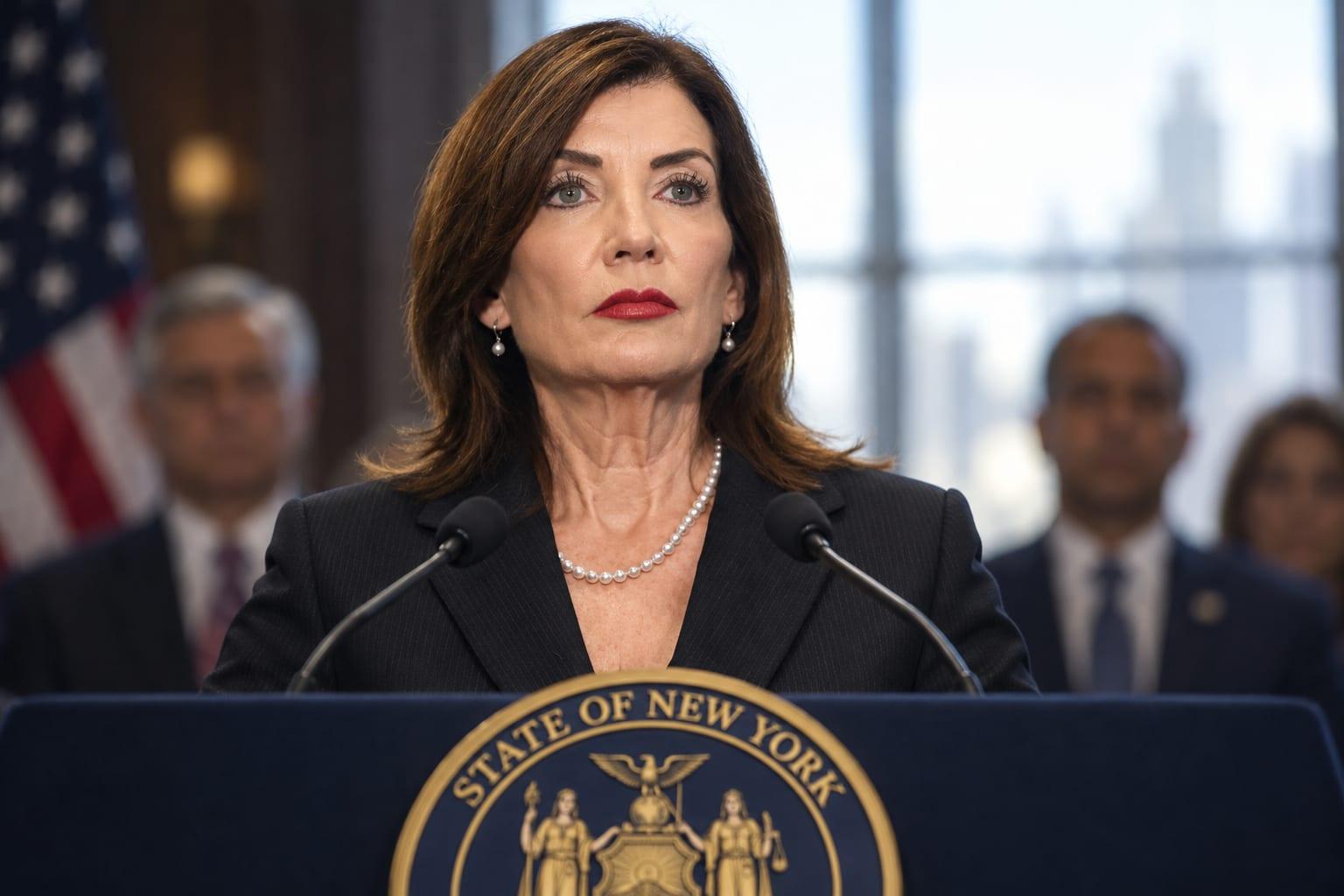
New York Gov. Kathy Hochul has declared a statewide disaster emergency in response to reported measles case counts, according to a post from the account @dcexaminer, which stated that the declaration marked the first time a state has taken such a step since measles cases began surging in 2025.
The post from @dcexaminer read in part that Hochul "has declared a statewide disaster emergency in New York over the latest numbers linked to the measles outbreak," and included a partial quote attributed to the governor: "No one should get seriously ill." The account framed the declaration as the first of its kind since reported cases began climbing last year.
Coverage of the same subject from other outlets described the declaration as driven by rising case counts in rural areas of upstate New York and in neighboring Pennsylvania. Gothamist reported that the emergency was prompted by increasing numbers in rural communities and across the state line. One report said New York has recorded 108 confirmed measles cases so far this year, with about half arising in three rural counties. Another headline stated simply that New York declared a disaster emergency as cases hit 108 in upstate areas.
According to a report from erienewsnow.com, Pennsylvania has topped 1,000 measles cases, and New York's declaration is intended to enable wider involvement of healthcare professionals in vaccination efforts and additional testing. State health officials, that report said, are collaborating with local authorities. A comparison of ten outlets assembled by NewsCord described the declaration as a statewide disaster emergency issued Monday over a measles outbreak spreading through the region, with the outlets it surveyed split among Western mainstream, local Western, and West Asian sources.
The claim at the center of the coverage -- that 108 confirmed cases have been recorded in New York this year, with roughly half in three rural counties -- is being reported by multiple outlets but has not been independently confirmed by Next News Network. The declaration itself is being described across outlets as an action taken by the governor, while the specific case counts and the characterization of the outbreak's spread remain as reported claims.
What can be stated plainly is what the outlets carrying the story have said: a state disaster emergency has been declared, and it is being presented as a response to reported case numbers in upstate New York and neighboring Pennsylvania. Reports describe the emergency mechanism as one that allows for expanded involvement of healthcare professionals in vaccination efforts and for additional testing capacity. Whether those expanded authorities have already been exercised, and how far they extend, is not yet known from the material available.
The account @dcexaminer carried the declaration with the partial quote from the governor. Other outlets carried the same declaration with different emphasis: Gothamist foregrounded the rural and cross-border dimensions; the 108-case figure appeared in several headlines; erienewsnow.com connected the declaration to Pennsylvania's case count exceeding one thousand and to the practical authorities the emergency unlocks. The comparison assembled by NewsCord showed the story moving across ten outlets with varying regional perspectives, indicating the declaration has traveled well beyond New York local coverage.
It is not yet known whether the case figures cited in the coverage reflect confirmed laboratory cases, probable cases, or a combination, nor is it known how the reported counts were compiled or when they were last updated. The reports describe the outbreak as concentrated in upstate rural areas and linked to spread in Pennsylvania, but the underlying data behind those descriptions has not been independently verified by Next News Network.
Next News Network could not independently verify the reported case counts, the geographic distribution of cases, or the sequence of events described in the coverage. The declaration is being reported by multiple outlets, and the figures are being attributed to state health officials, but the specifics remain as claimed rather than confirmed.
Our Take
Here is the part of this story the mainstream coverage will skate past. A governor of New York has now signed a statewide disaster emergency over a measles outbreak -- the kind of declaration usually reserved for hurricanes, blizzards and floods. That is a serious instrument of state power, and it is being deployed over a disease that was declared eliminated in the United States a quarter-century ago. The question every parent in upstate New York should be asking is not whether Kathy Hochul cares about sick children. The question is what changed, and why this is happening now.
Notice how the coverage frames the emergency as a mechanism to expand "healthcare professional involvement in vaccination efforts." That is bureaucratic language for a real expansion of state authority over medical decisions. It arrives alongside reports of case counts that have not been independently verified, and it arrives in a media environment where the numbers have moved faster than the confirmation. New Yorkers are being told to accept a disaster declaration on the strength of figures they cannot check themselves. That is not how public trust is built. That is how it is spent.
The pattern here is familiar. A health scare emerges, the numbers climb in headlines, a governor declares an emergency, and the emergency unlocks powers that outlast the scare. The rural counties bearing the brunt of this outbreak are the same communities that were lectured, mandated and vilified during the last round of this. They have reason to be skeptical, and they deserve straight answers instead of press releases. If the outbreak is as serious as the declaration suggests, the state should release the data, county by county, case by case, and let the public see it.
Until then, we report what is being claimed and who is claiming it. If the numbers hold up, the declaration may be justified. If they do not, New York will have handed its governor emergency powers on the basis of a scare the public was never allowed to verify.
