
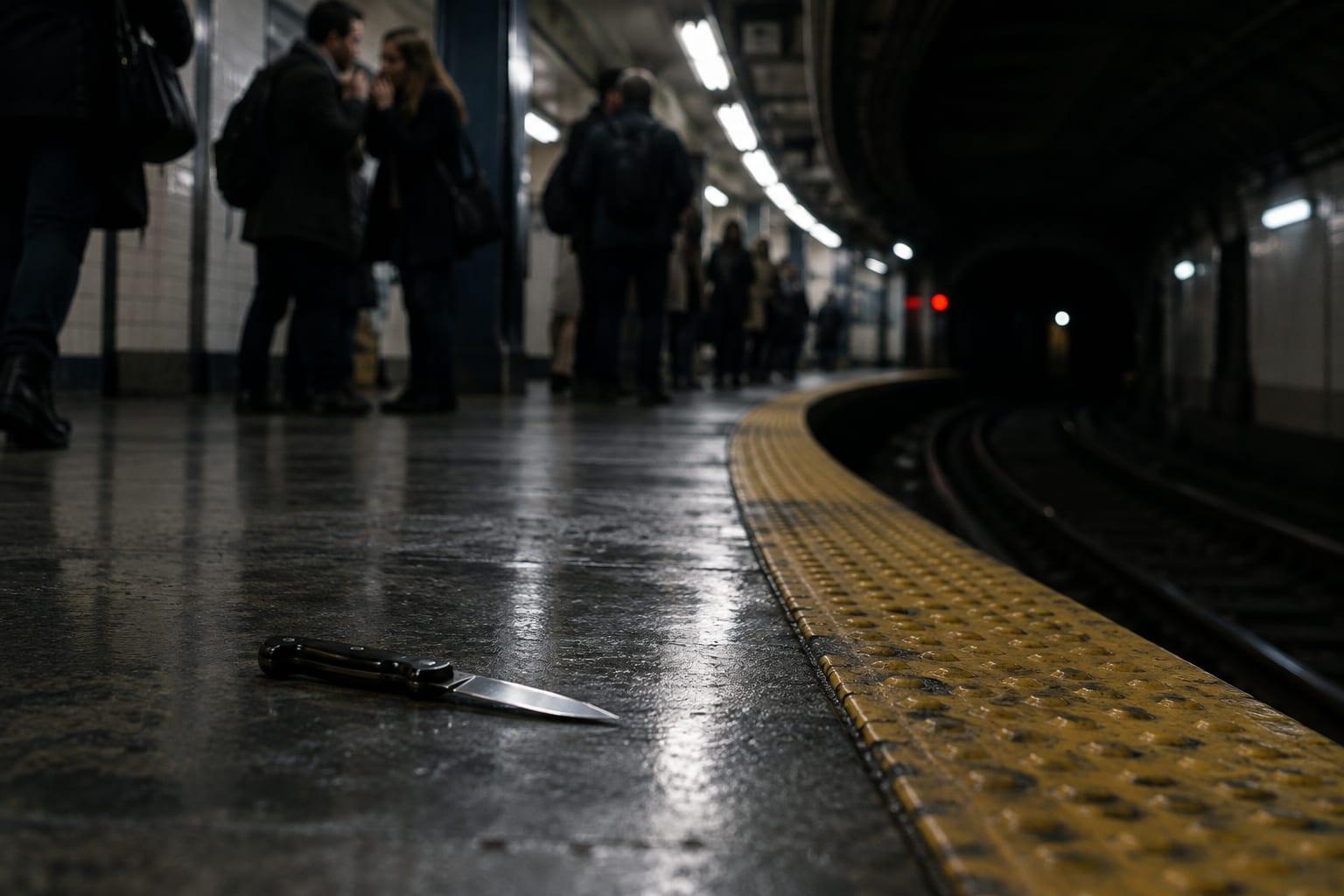
A knife-wielding man's confrontation on what is described as a train platform has become the subject of a spreading online reaction, after the account @MarioNawfal posted a clip with the taunting caption, "Bro thought wielding a knife made him a tough guy — Right up until the fists started flying."
The post, attributed by the account to a writer identified only as Ian, pairs that one-line caption with video described as showing a transit setting. The post does not identify the man, the location, the date or the outcome of the confrontation.
The clip itself, as carried in the post, includes audio of an automated train announcement: "The next station is Stratford-on-Avon. We will be arriving at Stratford-on-Avon at the end of this video." The same audio track continues with a creator's sign-off — "Thank you for traveling with us and we hope you enjoyed our walk. Please like and subscribe and leave a comment if you have any questions or if you have any questions that you want to be answered in the next video. Thank you for watching and we'll see you again in the next video. Bye!" — language typical of a walking-tour or transit vlog, not of a news broadcast.
The account @MarioNawfal is the one carrying the confrontation claim and the caption framing it. The post presents the fight as something that followed the display of a knife, and presents the man as having been subdued by people who fought back. Nothing in the material establishes who the man was, what preceded the confrontation, whether anyone was injured, or whether any arrest followed.
The reaction has moved outward from that single post. Accounts across the platform picked up the clip and the caption, repeating the framing that the man's weapon did not protect him once "the fists started flying." The phrase itself became the shorthand for the story as it traveled, with the caption traveling further than any detail of the confrontation itself.
Conservative and news-oriented accounts were among those carrying it forward, treating the clip as an illustration of a broader argument about public safety and what happens when bystanders decide to intervene rather than retreat. The exchange followed a familiar pattern for viral confrontation footage: a short, declarative caption sets the tone, and the argument that follows is conducted almost entirely over the caption rather than over the underlying facts.
What the posts do not supply is the record that would ordinarily anchor a story like this. There is no named police force, no charge, no court date, no hospital, no witness account beyond the video itself. The station announcement places the setting at or approaching Stratford-on-Avon, but the announcement is audio from the clip, not a confirmed location for the confrontation, and Stratford-on-Avon station is not identified by any authority in the material.
The sequence as it stands is short and entirely account-driven: @MarioNawfal posts the clip with the taunting caption; other accounts repeat the caption and the framing; the phrase about the knife and the fists becomes the way the clip is described as it circulates. At no point in that chain does an official source, a newsroom or a named witness enter the record.
That gap is what makes the reaction the story rather than the confrontation. Readers encountering the clip are being asked to accept a caption as the account of what happened, and the caption is doing the work that reporting would ordinarily do: it identifies the man as the aggressor, identifies the knife as his instrument, and identifies the fight as his comeuppance. Each of those is a claim carried by the post, not a finding.
The posts also carry an implicit argument about deterrence — that a weapon did not make its bearer safer, and that the response came from people willing to close the distance. That argument is being made in the captions and the replies, not in any verified account of the confrontation.
Next News Network could not independently verify the events described in the clip or the circumstances surrounding them.
What is verifiable is the shape of the reaction: a single account's post, a one-sentence caption, and a set of other accounts repeating both. The confrontation itself remains what the posts claim it to be — an alleged incident, described from one angle, with no independent record attached.
Readers who encounter the clip should treat the caption as the account being offered, not as established fact. The distinction matters less for the argument the clip is being used to make than for the person in it, who is unnamed, uncharged in any public record described here, and known to the audience only through a few seconds of video and a caption written by someone else.
Our Take
The clip is being used to make a point about deterrence, and the point may well be sound — a knife is not a shield, and a man who pulls one in a crowded public place is not owed the outcome he imagined. But the caption is doing the work of a police report, and it should not be. We do not know who this man is, what led up to the confrontation, whether he was arrested, or whether anyone was hurt. We know what one account told us to think about a few seconds of video. That is enough to start an argument and not enough to finish one. The lesson the clip is being used to teach — that the decision to fight back belongs to the people in the carriage, not to the man with the knife — is one worth making. It is also worth making honestly, with the caveat attached, rather than with a one-liner doing the work of a case file.
