
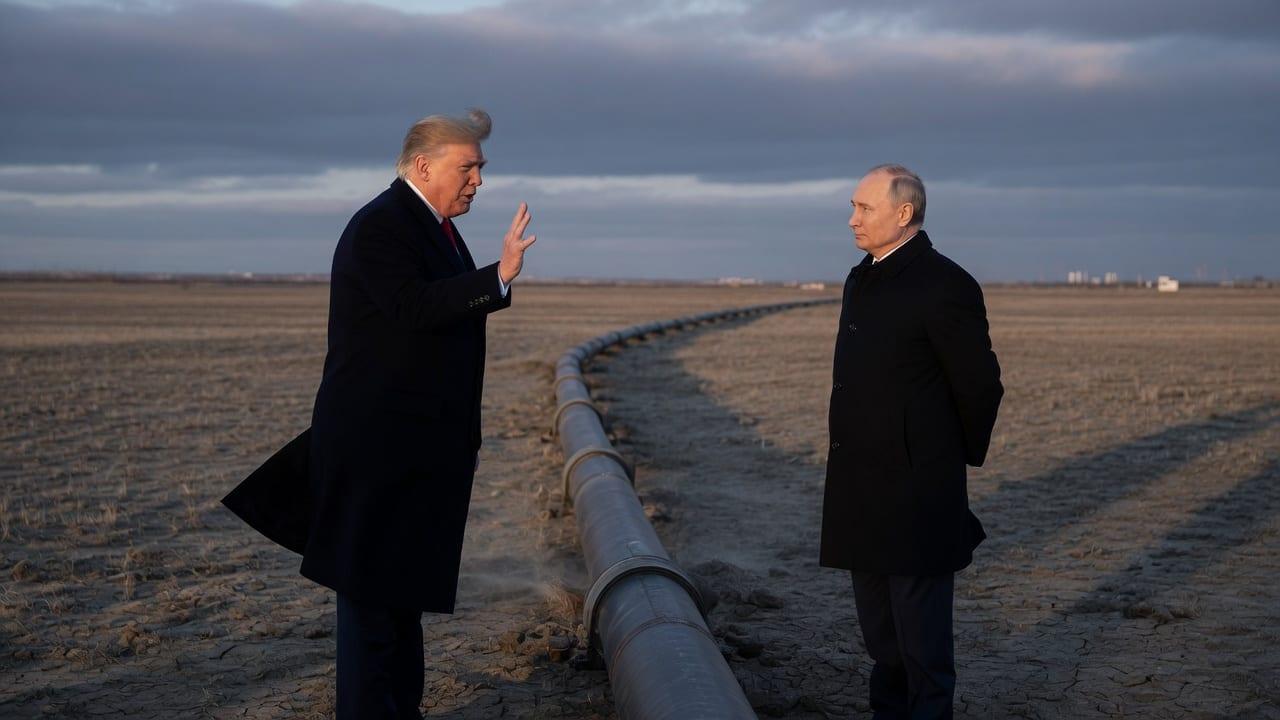
An agreement being attributed to President Donald Trump that would release Russian diesel supplies into global markets is drawing sharp criticism from commentators who describe it as a giveaway to Moscow delivered just weeks before the midterm elections.
Reuters reported that Trump is working with Russian President Vladimir Putin to release Russian diesel supplies into global markets, a move the outlet described as upending years of sanctions and angering Ukraine, and promoted its World News podcast coverage of the development under the account @Reuters. The arrangement had not been previously announced in the terms described, and the accounts reacting to it treated the diesel release as a new and consequential shift in policy.
The account @MeidasTouch responded that Trump "just handed Putin a lifeline weeks before the midterms," adding that energy analysts say the Russian diesel deal "won't meaningfully lower prices." The same account raised a question about timing, noting that a tanker that left Russia weeks before the announcement suggests the arrangement may have been in the works longer than the public timeline indicates. The account did not name the analysts it was citing or identify the vessel.
The MeidasTouch Network, in its Saturday updates post, laid out the arithmetic it says undercuts the stated purpose of the deal. Diesel runs at roughly seven and a half barrels per ton, so the first tranche of two point two million barrels works out to about half a day of United States distillate demand, which the outlet noted runs about four million barrels a day. Investor Bill Browder put the figure at fifteen hours, and the network said some analysts put it at even less. The entire four point eight million tons Trump promised adds up to roughly nine days of United States demand, the outlet said, and that assumes Russia has the surplus, which the network said does not appear to be the case. Poland's foreign minister noted that Russia has fuel shortages even in Moscow and that Ukraine has damaged about half its refining capacity, according to the outlet.
The same MeidasTouch Network post argued that a line about the "condition" of Russia's refineries in Trump's post is the tell, and cited a Ukrainian official, via Axios, who said that Witkoff and Kushner threatened to cut off intelligence sharing with Ukraine if Kyiv kept striking.
Other accounts pushed the criticism further. The account @cenkuygur wrote that "Israel had Zelensky attack an Iranian ship to try to merge Iran and Ukranian wars," and argued that in such a scenario "we'd be at war with Russia." The account added that "Israel is definitely pulling the strings on this, too," and that "they won't be satisfied until they cause WWIII." No evidence was offered in the post for the specific claim about the ship.
A separate thread of the story moved through the Kremlin's own account of a Friday call between the two presidents. Newsmax, under the account @NEWSMAX, reported that Putin conveyed Iran's position on a possible agreement to end the war with the United States during a telephone conversation with Trump on Friday, according to a Kremlin disclosure. The Kremlin statement did not describe the substance of Iran's position or say how Trump responded.
MeidasTouch returned to the subject with a critique that paired the diesel arrangement with the broader question of Ukraine's leadership. The account wrote that Trump "thanked Putin for a few hours' worth of diesel, then told Ukraine it's 'time to get a new president,'" and noted the timing came hours after Russia killed twelve people in Zaporizhzhia, including three children.
The account @TheLastRefuge2 took a different approach to the same set of events, pointing readers to three previous articles it said should be read in sequence to understand the current moment. The account wrote that in his own words Vladimir Putin explains why EU-NATO must have an expanded war with Russia, and that it "has nothing to do with" a point the post left unfinished before it was cut off.
What ties the responses together is a shared read on the sequence: an arrangement described by Reuters as a Russian diesel release, a Kremlin readout of a Friday call covering Iran, and a wave of commentary from accounts including @MeidasTouch, @cenkuygur, @TheLastRefuge2 and @NEWSMAX that treats the diesel move as a sanctions rollback rather than an energy price measure. The MeidasTouch Network post described the announcement as "not only traitorous, but a sham designed to pretend he's doing something to help oil costs while removing sanctions on Russia, funding the Russian war machine, and trying to push Ukraine to surrender."
The critics quoted here are commentators and advocacy accounts, and their characterizations of motive and effect are their own. The posts do not identify the analysts cited on price impact, do not name the tanker referenced, and do not provide documentation for the claim about an attack on an Iranian ship.
Next News Network could not independently verify the claims described in these posts.
Our Take
The reaction is the story here, and the reaction tells you what the White House walked into. An arrangement framed as a way to ease diesel costs is being received by its critics as a sanctions rollback with a price tag measured in hours, not relief. When the math being circulated is fifteen hours of supply against years of sanctions architecture, the administration has a selling job it has not yet done. Add a Kremlin readout about Iran arriving in the same news cycle, and the timing does the opposition's work for it. Republicans heading into November should expect every one of these posts to be quoted back at them, and the White House should expect the question it has so far avoided: if the diesel is this small a share of demand, what exactly was traded away to get it?
Conservatives should also refuse the trap of letting the loudest voices on the other side define the terms. The reasonable ground is oversight: show the tonnage, show the terms, show what Ukraine was told, and show whether any sanctions were lifted rather than waived. If the administration can answer that plainly, the criticism collapses. If it cannot, then the critics are not the problem, and the voters will figure that out on their own.
