
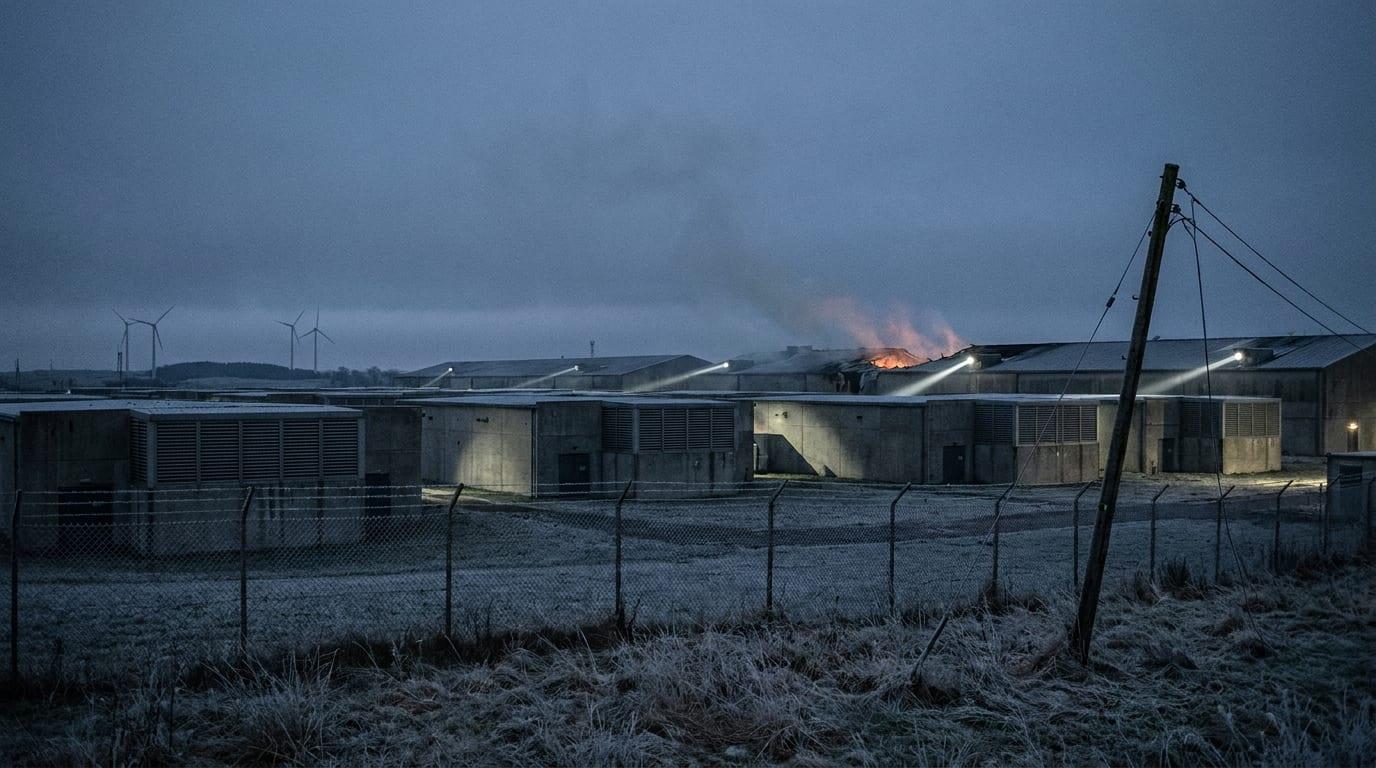
Ukraine has struck the Yandex data center in Vladimir, Russia, the third strike on the company's facilities in four days, according to accounts tracking the attacks. The strike reportedly forced a complete shutdown of the facility and disrupted more than eighty Yandex services, including music streaming, taxi services, AI tools and smart home systems.
Yandex, often described as Russia's equivalent to Google, said in a statement that its infrastructure had been damaged in a drone attack, resulting in the complete shutdown of its data center in the Vladimir region. The company said some services were unavailable and that two other data centers had also been taken out of operation within days.
According to the account @visegrad24, the strikes have now hit all the sites which host the company's supercomputers. The account listed the sequence of attacks, beginning with a strike on October 8 in Sasovo, which it said housed two of Yandex's three AI supercomputers. The Vladimir strike followed, marking the third facility taken out in a four-day span.
The account @clashreport reported that the attack was linked to major disruptions affecting more than eighty Yandex services. Among those affected were music streaming, taxi services, AI tools and smart home systems, according to the account. The disruption represents one of the most significant outages for the Russian tech giant in recent memory, affecting services that millions of Russians rely on daily.
On October tenth, Yandex updated its user agreement to include drone and missile attacks among circumstances of force majeure that could exempt the company from contractual obligations. The timing of the update, coming just before the Vladimir strike, suggests the company was already preparing for the possibility of further attacks on its infrastructure.
Next News Network could not independently verify the claims made by the accounts reporting the strikes or the extent of the damage to Yandex facilities.
The attacks on Yandex infrastructure represent a significant escalation in Ukraine's targeting of Russian technological assets. Yandex is not merely a search engine but a sprawling technology ecosystem that powers everything from ride-hailing to food delivery to artificial intelligence research in Russia. Its supercomputers are central to the company's AI ambitions, and their destruction could set back Russian technological development by years.
The Vladimir data center was reportedly one of the company's most critical facilities, hosting the infrastructure needed to run its most advanced AI models. With all three facilities hosting the company's supercomputers now offline, Yandex faces an unprecedented challenge in maintaining service continuity for its millions of users.
The strikes come amid a broader Ukrainian campaign targeting Russian infrastructure, including energy facilities, military installations and now technology centers. The targeting of Yandex, a civilian technology company, represents a notable expansion of Ukraine's target set.
Russian authorities have not issued a comprehensive statement on the full scope of the damage or the timeline for restoring services. The company's silence on the matter, beyond confirming the shutdown, has left many questions unanswered about the long-term impact on its operations.
For ordinary Russians, the disruption has been immediate and tangible. Yandex services are deeply embedded in daily life, from ordering a taxi to streaming music to controlling home devices. The outage has highlighted just how dependent Russian consumers have become on a single technology ecosystem, and how vulnerable that ecosystem is to targeted attacks.
The force majeure update in Yandex's user agreement is particularly telling. By explicitly naming drone and missile attacks as circumstances that could exempt the company from contractual obligations, Yandex is signaling that it expects further disruptions and is preparing to manage the legal and financial fallout. This is not the action of a company that believes the threat has passed.
The strikes also raise questions about the vulnerability of critical technology infrastructure in modern warfare. Data centers, which house the servers that power everything from search engines to AI models, are increasingly being viewed as legitimate military targets. The destruction of such facilities can have cascading effects on civilian populations, disrupting communication, commerce and access to information.
For Yandex, the challenge now is to restore services while simultaneously hardening its remaining infrastructure against future attacks. The company has not indicated how long the restoration process might take or whether it has contingency plans in place to shift operations to other facilities.
The broader implications for Russia's technology sector are significant. Yandex has long been a symbol of Russian technological achievement, a company that could compete with global giants like Google and Amazon. The sustained attacks on its infrastructure could undermine its position and accelerate the brain drain that has already seen many Russian tech workers leave the country.
As the situation develops, the world will be watching to see whether Yandex can recover from these strikes and what the long-term consequences will be for Russia's technological sovereignty. The attacks have already demonstrated that even the most sophisticated technology infrastructure is vulnerable to relatively low-cost drone strikes, a lesson that will not be lost on militaries and technology companies around the world.
Our Take
Ukraine's drone campaign against Yandex is a calculated escalation that targets not Russian military assets but the technological backbone of civilian life. The message is clear: if you build your digital future in a country waging war against its neighbor, that future is fair game. The fact that three data centers housing Yandex's supercomputers have been taken offline in four days is a stunning achievement for Ukrainian drone operators, and a humiliating failure for Russian air defense.
But let's be honest about what this really represents. Yandex is not a military target. It is a search engine, a ride-hailing app, a music streaming service. When Ukrainian drones strike Yandex data centers, the people who suffer are ordinary Russians trying to order a taxi or listen to music. That is not to say the strikes are unjustified—Russia has spent years bombing Ukrainian civilian infrastructure, and turnabout is fair play. But we should not pretend this is a purely military operation.
The force majeure update in Yandex's user agreement is the most telling detail. A company that explicitly names drone and missile attacks as circumstances beyond its control is a company that knows it is at war. The Russian government, which has spent years telling its citizens that everything is fine, is now presiding over the systematic destruction of its most important technology company. This is what happens when you start a war you cannot win and then discover that your enemy can reach out and touch you where it hurts.
The implications for Russia's technology sector are dire. Yandex was the crown jewel of Russian tech, a rare success story in a country known more for resource extraction than innovation. Now its infrastructure is being picked apart one data center at a time. The smartest Russian engineers have already fled. The ones who remain are watching their life's work go up in smoke. This is what strategic incompetence looks like.
Ukraine is demonstrating something important: that a smaller, motivated force can use relatively cheap technology to inflict disproportionate damage on a larger, more complacent adversary. The drone strikes on Yandex are not just a tactical victory; they are a strategic message. They say that no target is out of reach, no infrastructure is safe, and no amount of propaganda can hide the truth.
The real question is whether these strikes will accomplish anything beyond the immediate disruption of Yandex's services. Will they force Russia to divert resources to defend its technology infrastructure? Will they undermine public confidence in the Russian government's ability to protect its citizens? Or will they simply become another data point in a war that grinds on with no end in sight?
What is clear is that the era of Russia's technological isolation is over. The war has come home, not just to the border regions but to the data centers that power daily life in Moscow and beyond. Yandex thought it could build a digital empire in the heart of a war zone. It thought wrong.
