
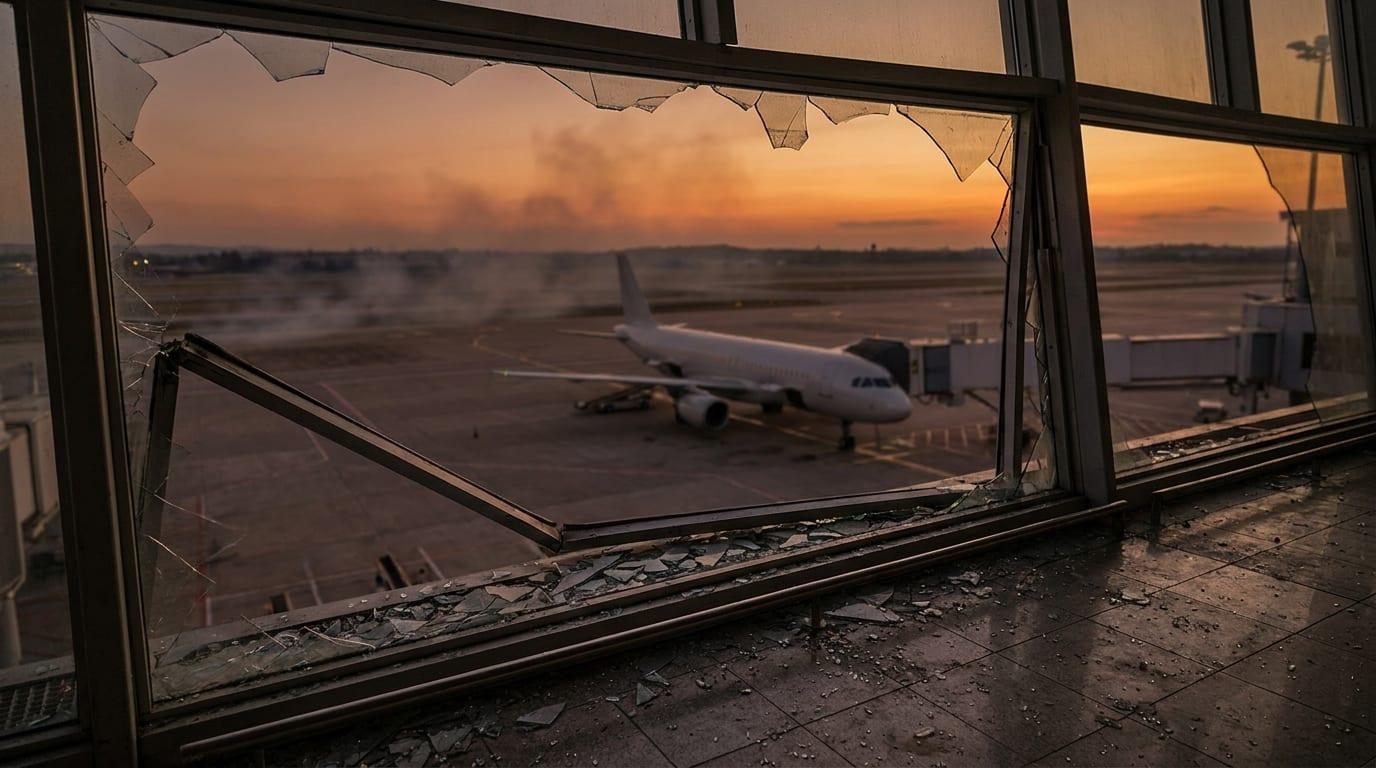
Yemen's Houthi group claimed responsibility for missile strikes on Riyadh's King Khalid International Airport that killed at least thirteen people and injured more than three hundred others, according to the group's own statements and Saudi authorities, and the group has now issued a direct warning to international airlines to avoid Saudi airports entirely.
The footage, released Monday by Saudi Arabia's Media Ministry, shows the moment of the strike on Saturday at King Khalid International Airport. The video, distributed to international outlets including the Associated Press, shows travelers waiting in lines inside a terminal when a sudden explosion tears through the building. CBS News reported that at least twelve people were killed and three hundred nine others injured, based on footage released Monday. Fox News later reported the death toll had risen to at least thirteen, including one American. The New York Post reported that the dead included four Saudi nationals, two Bangladeshis, an Egyptian, a Jordanian, a Palestinian, a Syrian, a Sudanese, and an Indian national, citing NBC News. The victims have not been publicly named.
The attacks did not stop with Saturday's strike. Fox News reported that a second projectile hit a different terminal at the same airport on Sunday, killing an additional person. The AP reported that Saudi authorities said a projectile struck a passenger terminal at Riyadh Airport again on Sunday, killing twelve people in the initial attack and wounding over three hundred, and that a Pakistani national was killed in the follow-on strike, without publicly naming the victim. The account posted by @AP on Monday at 12:10 p.m. stated that Saudi Arabia's main international airport had come under attack again and that the Saudis had blamed Yemen's Houthi rebel group for both strikes. The @AP account further noted that a Saudi-led coalition had recently launched an offensive against the Houthis in Yemen and that the two sides had been exchanging blows for days.
The Houthis now say they are directly warning foreign airlines away from Saudi airspace. The group said, according to Fox News reporting, "We reiterate our warning to all international companies, experts, employees, workers and travelers from all over the world to not operate flights to Saudi airports, as they aren't safe, except for the airports and airspace of the holy cities of Mecca and Medina." The Houthis have also claimed to have attacked Dammam airport and threatened further strikes, according to the New York Post. The group claims its attacks are a response to what it calls "brutal Saudi aggression" in Yemen, and it claims a Saudi strike on a home in the Yemeni capital of Sanaa killed a child and injured six others.
The strikes have had immediate practical consequences. The airport has been closed since Saturday's missile attack, the deadliest in a Gulf Arab nation since the Iran war began, according to the New York Post. At least five hundred forty flights scheduled to arrive and depart Riyadh on Monday have been canceled, according to FlightRadar, as have more than three hundred slated for Tuesday. The AP reported that Saudi authorities have ordered schools in the capital to hold lessons online only for the coming week.
Even the kingdom's energy sector has been affected. The account @clashreport posted Monday morning that the CEOs of ExxonMobil, TotalEnergies, Shell, Chevron and BP were removed from the schedule of the WPC Energy Congress in Riyadh following the deadly Houthi attacks on the Saudi capital. The post noted that Saudi Arabia proceeded with the event despite security concerns. The account also referenced Energy Minister Prince Abdul Aziz bin Salman, who has warned that the country's response "must be equally serious" to Houthi aggression, according to the New York Post.
The strikes have raised questions about whether the United States could be drawn deeper into the conflict. Fox News reported that the attacks "raised questions about if the United States could come to the defense of Saudi Arabia and launch a new round of strikes against this Iranian proxy group." The @FoxNews account posted Monday morning that another deadly strike had hit Saudi Arabia's busiest airport "and now the U.S. could be drawn deeper into the conflict." The network's live report from correspondent Trey Yinks noted that Houthi rebels in Yemen are now issuing a direct threat to foreign airlines over Saudi airspace or using airports inside the kingdom.
The video itself has become a focal point of international coverage. The @CBSNews account posted Monday morning that footage released on Monday shows the moment of the deadly strike at King Khalid International Airport in Riyadh on Saturday, and that Yemen's Houthi group said it had carried out at least four operations targeting King Khalid airport. The @nypost account posted that "disturbing video shows moment Houthi terrorists bombed Saudi Arabia's Riyadh airport, killing 13 people." The @visegrad24 account posted that Saudi Arabia has published footage of Saturday's deadly Houthi missile strike on Riyadh Airport and that thirteen people were killed, including an American.
The coverage has spread across multiple outlets and platforms. The New York Times reported on surveillance footage showing the moment of the attack, noting that the footage was released by Saudi state media and that the Iran-backed Houthi militia claimed responsibility for the strike. The Times of India reported that new footage from Al Arabiya showed the moment a strike hit the airport as passengers, including Umrah pilgrims preparing to board their flights, waited inside the terminal. The AP's transcript of its video report stated that Saudi Arabia's main international airport had come under attack again and that Saudi authorities said a projectile struck a passenger terminal.
The Saudi response has been swift. Saudi's energy minister, Prince Abdul Aziz bin Salman, warned that the country's response "must be equally serious" to Houthi aggression. The kingdom has closed Riyadh Airport and ordered schools in the capital to hold lessons online only for the coming week. The Houthis, for their part, say one child was killed in a Saudi strike in Yemen on Sunday.
Next News Network could not independently verify the claims made by the Houthi group or the casualty figures reported by Saudi authorities or any of the outlets cited in this report. The accounts cited here are presented as what is being claimed or alleged, not as independently confirmed facts. The footage released by Saudi Arabia's Media Ministry has not been independently authenticated by Next News Network.
Our Take
The strikes on King Khalid International Airport are a stark reminder that the Houthi threat is not confined to Yemen's borders or to the Red Sea shipping lanes. When a missile can hit Terminal 3 at Riyadh's busiest airport, killing an American citizen and injuring hundreds, the conflict has escalated to a point where U.S. interests are directly in the crosshairs. The Houthis have now issued a direct warning to international airlines to avoid Saudi airports, a move that effectively creates a no-go zone over one of the world's most important energy hubs.
The Biden administration's approach to the Houthis has been one of appeasement and half-measures, delisting the group as a foreign terrorist organization and then scrambling to restore designations after attacks began. Now an American is dead, and the question is no longer whether the United States will be drawn deeper into the conflict, but how far the administration will allow the situation to deteriorate before taking serious action. The Saudis have been fighting this proxy war against Iran-backed Houthis for years, and they have been clear that they expect their partners to stand with them. The closure of Riyadh Airport, the cancellation of hundreds of flights, and the withdrawal of major oil company CEOs from a Riyadh energy conference all demonstrate that the economic and security costs are mounting.
President Trump has made clear that he will not tolerate attacks on American citizens, and the death of an American in this strike demands a response. The administration must consider a robust military response against Houthi targets in Yemen, and it must also send a clear message to Iran that its proxy warfare will no longer be tolerated. The American people deserve a strategy that protects American lives, secures the free flow of energy, and holds the Houthis and their Iranian sponsors accountable. Anything less is a recipe for further attacks and further American casualties.
