
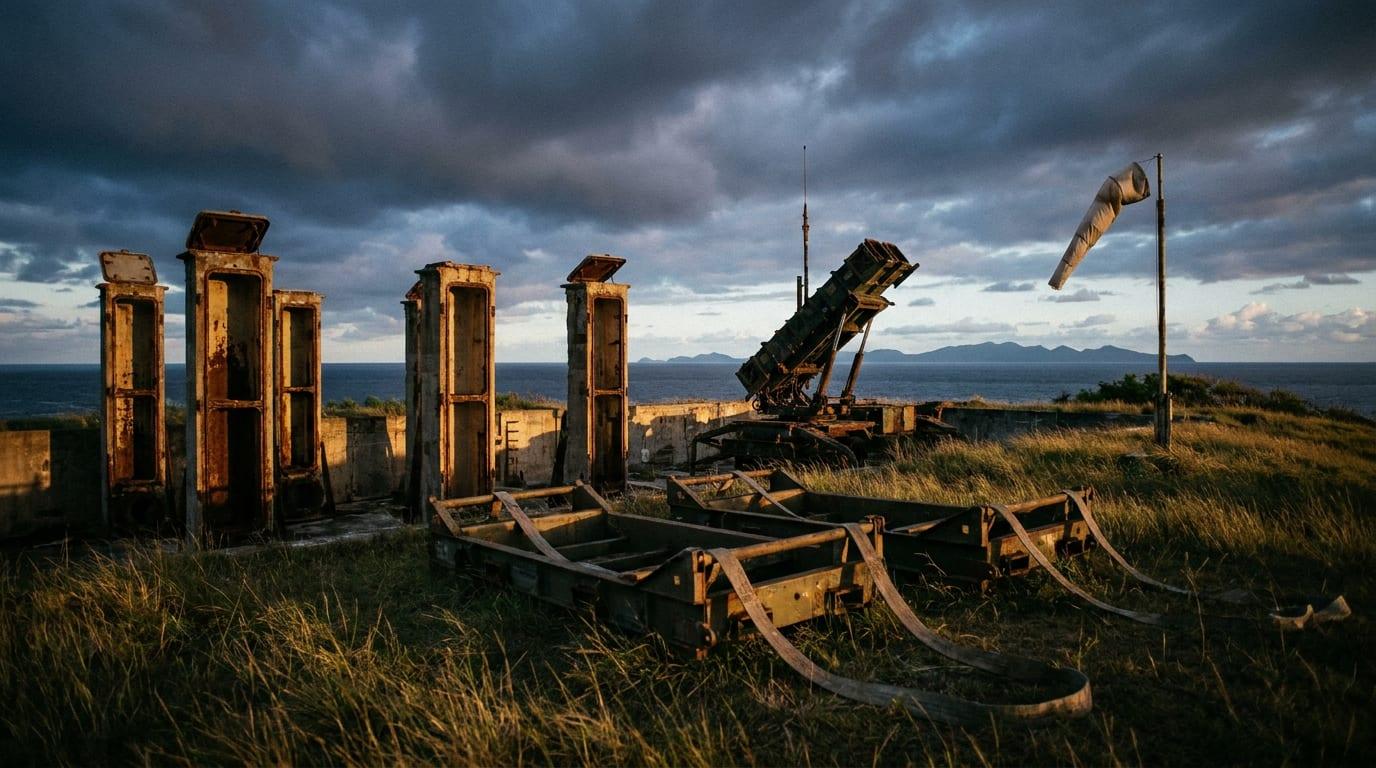
The top U.S. Army commander in the Pacific says the redeployment of American missile defenses from China's doorstep to the Iran war has not increased risk to forces in the Indo-Pacific — and that the shift has instead given his troops a chance to modernize.
Gen. Ronald Clark, commander of U.S. Army Pacific, made the assessment Tuesday during a small-group interview with Fox News Digital at the Association of the United States Army's annual conference in Washington, D.C.
"Actually, it's given us an opportunity to modernize our systems here," Clark told Fox News Digital.
Patriot systems have been pulled from the Indo-Pacific to support operations in the Middle East, while U.S. forces in South Korea have sent Terminal High Altitude Area Defense, or THAAD, interceptors to the region, according to Fox News Digital.
The strain on stockpiles is documented in federal analysis. An October Congressional Research Service report cited estimates that U.S. forces expended roughly 1,700 Patriot and 200 THAAD interceptors during the conflict, Fox News Digital reported. The Congressional Budget Office estimated the military used between half and two-thirds of certain interceptor inventories. The Pentagon's inspector general has cited strategic inventory shortfalls and manufacturing bottlenecks stemming from the conflict.
Clark argued the deployments are producing a real-world benefit: Patriot crews are getting firsthand experience defending against enemy attacks, while equipment upgrades are expanding what individual batteries can accomplish. He said an upgraded Patriot battery can now provide coverage that previously required an entire battalion. He did not specify whether he was referring to geographic coverage or the number of threats the system can engage.
Asked whether recent diplomatic progress between President Donald Trump and Chinese President Xi Jinping had changed his assessment of the threat from China's People's Liberation Army, Clark said the PLA continues preparing despite the diplomacy, Fox News Digital reported.
The comments come as U.S. Army Pacific expands deterrence operations across the Indo-Pacific — the theater the Pentagon has long identified as the pacing challenge for American military planning. The Congressional Research Service and Congressional Budget Office figures on interceptor expenditure were first reported by Fox News Digital and were also referenced by NewsBeep.com in its coverage of Clark's remarks.
What the numbers mean in practice is simple math. If the United States fired between half and two-thirds of certain interceptor inventories in one regional conflict, then any future contingency in the Pacific starts from a smaller magazine. Manufacturing bottlenecks flagged by the inspector general determine how fast that magazine gets refilled — and how many batteries can be forward-stationed while the line runs.
It is not yet known how long current production rates would take to restore pre-conflict inventory levels, or whether additional Patriot or THAAD units will be repositioned to the Indo-Pacific in the coming months. The Army has not released a public timeline for modernization upgrades Clark referenced.
Critics of the resource shift have argued the Iran war drew critical defenses away from China's doorstep. Clark's assessment directly disputes that framing, at least as it applies to risk levels in his theater. The inspector general's findings on shortfalls and bottlenecks remain the harder data point in the debate — an official government accounting of what was spent and what it takes to build more.
Trump-Xi diplomacy has not produced a visible slowdown in PLA preparations, per Clark's assessment to Fox News Digital. The commander's message to the conference was that deterrence work continues regardless of the diplomatic calendar.
Our Take
Read Clark's comments twice, because the general is doing two things at once. He is reassuring — no increased risk, modernization underway — and he is confirming every number that worries us. Half to two-thirds of certain interceptor inventories. Seventeen hundred Patriots. Two hundred THAADs. An inspector general's report on shortfalls and bottlenecks. That is not a talking point from a rival network. That is the federal government's own bookkeeping, and it lands while our forces in South Korea are shipping interceptors out of the theater to cover a war in the Middle East.
Patriots, the general says, can now do the job of a whole battalion. Fine. But defenses that work better are not the same as defenses that exist in sufficient quantity. You can have the most upgraded battery on earth and still lose the math problem if there are not enough interceptors in the rack when the first wave comes. The PLA is not pausing its buildup because Trump and Xi shook hands. Clark said so himself. Beijing reads our inventory reports too.
The establishment will tell you this is fine, that deterrence is holding, that the system works. Ask them one question: if China moves on Taiwan while our magazines are one-third full and the production line is still catching up, what is the plan? Nobody has answered that.
