
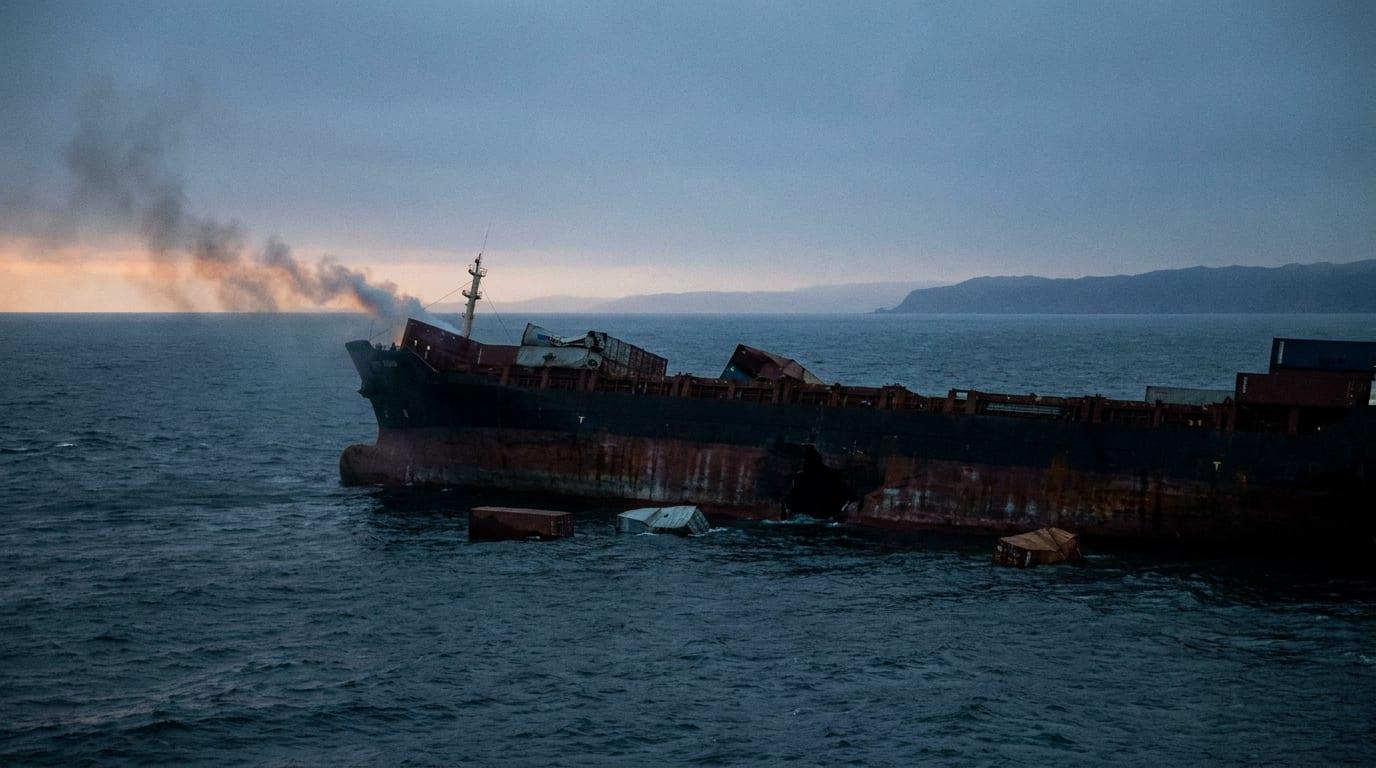
The Islamic Revolution Guard Corps Navy said Wednesday that a container ship carrying more than 2,500 containers sank in waters south of the Strait of Hormuz after striking a naval mine and catching fire, according to a statement carried by the IRGC's Sepah News outlet and circulated by regional broadcasters and financial news wires.
The IRGC Navy's account, as relayed by the state-affiliated Mehr News Agency, said the vessel was attempting to pass through what the Guard described as an "unauthorized and dangerous" strait when the explosion occurred. The same statement warned local vessels and fishermen to transit the route with what it called the utmost safety to avoid collision with floating containers that had spilled into the waterway.
The claim moved quickly through financial and regional news channels. The news aggregator account @FirstSquawk carried the IRGC Navy's language Wednesday morning, telling its followers that the container ship had sunk after hitting a naval mine and catching fire and that the vessel had been attempting to pass through the strait. In a follow-up post seconds later, the same account relayed the IRGC's advisory to local vessels and fishermen to transit the route with care to avoid colliding with floating containers.
Iran International, a London-based outlet that covers Iranian affairs, reported within the hour that the IRGC Navy had said a container ship carrying more than 2,500 containers had sunk south of the Strait of Hormuz after striking a naval mine and catching fire. Mehr News Agency, based in Tehran, carried a nearly identical account, attributing the information to the IRGC Navy and dating the sinking to Wednesday morning. The financial wire aggregator Newsquawk repeated the Sepah News statement that the vessel exploded after hitting the mine while attempting to pass through the strait.
Those three channels — the IRGC's own Sepah News, the Tehran-based Mehr, and the aggregators and international outlets that picked up their language — form the entire sourcing trail for the claim. No independent maritime authority, port operator, flag-state registry or shipping industry body has been cited in any of the accounts circulating Wednesday. The identity of the vessel, its flag, its owner, its crew and its cargo manifest have not been disclosed by the IRGC or by any of the outlets repeating its statement.
The Strait of Hormuz is the narrow waterway connecting the Persian Gulf to the Gulf of Oman and the open ocean, and it is the single most important oil transit chokepoint on earth. Roughly a fifth of the world's petroleum moves through it by tanker. Any disruption there — a sinking, a mine strike, an advisory to local fishermen — carries immediate weight for global energy markets and for the navies that patrol the corridor, including the United States Fifth Fleet, which is based in Bahrain on the western side of the Gulf.
Mine warfare has a long and specific history in these waters. During the so-called Tanker War of the 1980s, mines damaged or sank multiple vessels and drew the U.S. Navy into a series of engagements that culminated in Operation Praying Mantis in April 1988. In 2019, explosions damaged several tankers near the strait in incidents that the United States and its allies attributed to Iranian limpet mines; Tehran denied involvement. In each case, the initial reports came from the affected parties and were only sorted out over days and weeks as salvage, intelligence and inspection data came in.
The IRGC Navy's characterization of the strait as "unauthorized and dangerous" is itself notable. The phrase suggests the Guard is asserting that the vessel had no right to be where it was — a framing that, if accepted, shifts responsibility for the sinking onto the ship's operators. It is a claim about legal authority over a waterway that the United States and most maritime nations treat as an international transit corridor under the United Nations Convention on the Law of the Sea, a treaty Iran has signed but not ratified.
The advisory to local fishermen is the second half of the IRGC's message and the more immediately verifiable part. Floating containers are a genuine hazard to small craft; a loaded forty-foot container sits mostly submerged and can hole a fishing boat at speed. It is common practice after a container loss for coastal authorities to warn small vessels away from the debris field, and the IRGC's instruction to transit "with utmost safety" tracks standard maritime caution — though in this case the debris field's location, extent and even existence rest entirely on the Guard's own statement.
The regional backdrop is unusually tense. A deadly missile attack on Riyadh's international airport has intensified the wider Iran conflict's regional fallout, according to reporting from The Times of India's live coverage, which noted that the strike killed twelve people including foreign nationals. That coverage does not connect the Riyadh attack directly to the Hormuz sinking, and no outlet in the material reviewed has drawn a direct operational link between the two. But the two stories moving at once — an airport attack in Saudi Arabia and a claimed mine strike in the Gulf — illustrates the environment in which the IRGC's claim is being received.
The sequence of the reaction, rather than the sinking itself, is what has been firmly established: the IRGC Navy issued a statement through its Sepah News outlet; Mehr News Agency in Tehran reported it; Iran International reported it; Newsquawk relayed the Sepah News language to financial markets; and the aggregator account @FirstSquawk pushed both the sinking claim and the fisherman advisory out to its audience within seconds of each other. The market-facing accounts treated it as urgent and immediate. The regional outlets treated it as a statement from a military authority, which is what it is.
The IRGC has not released the ship's name, its registry, the number of crew aboard, whether there were casualties, or the precise coordinates of the sinking. It has not said what cargo the containers held beyond the count. It has not said when the mine was laid or by whom. It has not said whether any vessel has been dispatched to the scene. None of the outlets repeating the statement have added any of these details, and none have reported independently confirming the sinking with a second source.
The Strait of Hormuz has been the subject of repeated Iranian threats to close it in response to sanctions or military pressure, and repeated American pledges to keep it open. A mine strike on a container ship, if confirmed, would represent the most significant physical disruption to commercial traffic in the strait in years. A claim of a mine strike, made by the same force that has an interest in portraying the strait as dangerous and under its control, is a different thing entirely — and at this hour, that is what exists.
Next News Network could not independently verify the IRGC Navy's claim that the container ship sank after striking a mine, nor the number of containers aboard, nor the advisory to local fishermen.
Our Take
Here is what we know and what we don't. We know the IRGC Navy said a ship went down with more than 2,500 containers after hitting a mine. We know those words moved through Sepah News, Mehr, Iran International, Newsquawk and @FirstSquawk within roughly an hour. We know we cannot confirm a single material fact about the vessel. That gap — between the confidence of the push and the thinness of the sourcing — is the story, and it is the same gap we have seen in every Gulf incident for forty years. The IRGC is a belligerent in a live conflict, and it is also the sole source for a claim that serves its narrative: the strait is dangerous, unauthorized, and under its guns. Treat the sinking as a claim until salvage, satellite imagery, or a flag state says otherwise. But do not treat the tenseness as false. Something put those fishermen on notice, and something has the oil markets' attention. Watch the water, not the wire.
