
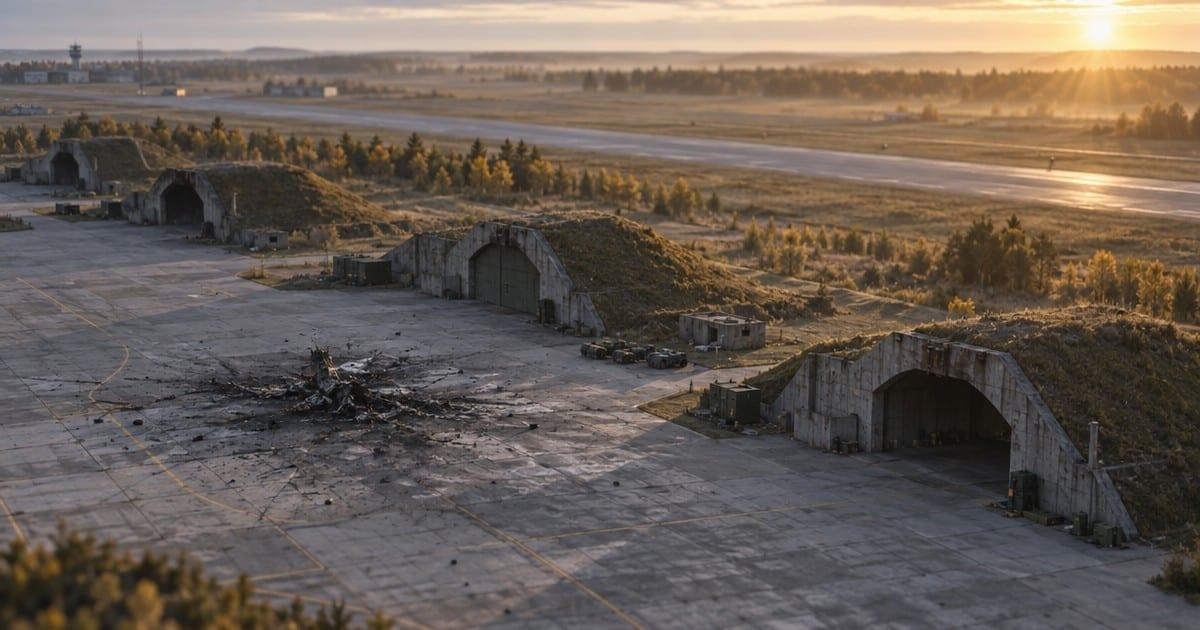
Ukraine's Navy says it destroyed six Russian Air Force Su-34M fighter-bombers in a cruise missile strike on Borisoglebsk Airbase overnight, an allegation that has moved swiftly through open-source intelligence channels and Eastern European news aggregators.
The Ukrainian Naval Forces said the attack was carried out using the Neptune coastal missile system against the Borisoglebsk military airfield in Russia's Voronezh region. The claim was carried first to wider audiences by the open-source intelligence account @Osinttechnical, which wrote at 08:13 UTC that Ukraine's Navy says it destroyed six Russian Su-34 fighter-bombers in the strike, adding that "at least one massive explosion was seen at the airfield."
Roughly sixteen minutes later, the Warsaw-based aggregator account @visegrad24 circulated the same claim with additional detail, writing that "Ukraine's Navy struck the Borisoglebsk military airfield in the Voronezh region" on the night of October fifteenth and that "the Navy said it used the Neptune coastal missile system." That account repeated the six-aircraft figure, identifying the airframes as Su-34M variants.
Neither account purported to have independently confirmed the results of the strike. Both framed the six-aircraft figure as a Ukrainian Navy statement, and that is how it has continued to circulate across the open-source ecosystem throughout the morning.
Ukrainian outlets picked up the claim quickly. Ukrainska Pravda reported that Ukraine's Navy says it struck six Russian Su-34M bombers at Borisoglebsk airfield in Voronezh Oblast using a Neptune missile system. A separate report said Ukraine's navy had destroyed six Russian Su-34M military aircraft in the strike. Another headline stated that Ukraine hit six Russian Su-34 bomber jets with the Neptune missile, describing the attack as carried out with the Neptune coastal missile system, according to Ukraine's naval forces.
One outlet framed the operation as Ukrainian cruise missiles hitting six Su-34 bombers "deep inside Russia," language that emphasizes the distance from the front line to the Voronezh region target.
The most detailed version of the claim to emerge came from a report citing satellite imagery of Russia's Borisoglebsk air base. According to that account, the imagery shows a Ukrainian Neptune missile strike destroyed four Su-34 fighter-bombers and badly damaged two more. That assessment, if accurate, would back the Ukrainian Navy's claim that it hit six of the jets on the night of October fifteenth. The imagery-based accounting is consistent with the Ukrainian figure but does not by itself establish the operational status of each airframe, and it has not been presented as an independent munitions or battle-damage assessment by an outside military.
Borisoglebsk airfield sits in the Voronezh region of southwestern Russia, well inside Russian territory and at a considerable distance from the front lines in eastern and southern Ukraine. The Su-34M is a twin-seat, twin-engine fighter-bomber that forms a significant part of Russia's tactical strike fleet, used extensively for glide-bomb and missile launches against Ukrainian positions and cities. Losses of the type are of recurring interest to open-source analysts because each airframe represents a substantial industrial and trained-crew investment.
The Neptune is a Ukrainian-designed coastal defense cruise missile system originally developed as an anti-ship weapon. Its adaptation for land-attack roles has been a subject of considerable discussion among military analysts throughout the war, and its reported use against a target as far inland as Borisoglebsk would mark another instance of Ukraine pushing domestically produced systems into a strike role beyond their original design parameters. Ukraine has not released the precise flight path, launch location, or number of missiles fired in the operation, and none of the circulating accounts provide those details.
The claim has not been met with any public acknowledgment from the Russian Ministry of Defense in the accounts and coverage circulating this morning. Russian officials have not confirmed the loss of the aircraft, and no independent battle-damage assessment from a neutral party has been published. The satellite imagery reference appears in only one of the circulating reports and has not been widely reproduced with the underlying images attached in the versions that have spread across the aggregator accounts.
The sequence of distribution has been consistent across the morning. The Ukrainian Navy statement appears to have been the origin point. @Osinttechnical carried the core claim to an English-language audience with the observation about a large explosion at the airfield. @visegrad24 followed with the operational detail naming the Neptune system and the Su-34M variant. Ukrainian news outlets then published their own versions, and a subsequent report added the satellite imagery assessment distinguishing four destroyed airframes from two badly damaged ones. Each retelling has preserved the six-aircraft figure, and none has claimed independent verification of the underlying strike result.
That pattern -- a national military claim moving through aggregator accounts into news coverage, with the airframe count remaining stable but the sourcing never advancing beyond the original statement -- is the shape of the story as it stands. The six-aircraft figure is what is being claimed. It is not what has been established.
Next News Network could not independently verify the Ukrainian Navy's claim that six Russian Su-34M aircraft were destroyed at Borisoglebsk airfield.
Our Take
The striking thing about this story is not the claim itself -- Ukraine has been hitting Russian airfields throughout the war, and the Neptune's conversion to a land-attack role is old news to anyone following the conflict closely. What is worth noting is how the claim traveled. Within roughly half an hour, a Ukrainian military statement moved through an open-source intelligence account, a Warsaw-based aggregator, and a spread of Ukrainian news outlets, arriving at a satellite-imagery-based assessment that appeared to corroborate the six-aircraft figure. Every step of that chain traced back to the same origin point: the Ukrainian Navy's own announcement. That is not verification. It is repetition with better production values. The satellite imagery account is the only element that gestures toward external evidence, and the images themselves have not been widely circulated alongside the claims they are said to support. American readers should treat the six-aircraft figure as a Ukrainian military claim, not a confirmed battlefield result, and should notice how quickly a single statement can acquire the texture of established fact when enough accounts pass it along. The war has produced genuine Ukrainian successes against Russian aviation, and it has also produced claims that did not hold up under scrutiny. This one sits in the unverified middle, and the responsible posture is to wait for evidence rather than to celebrate a headline.
