
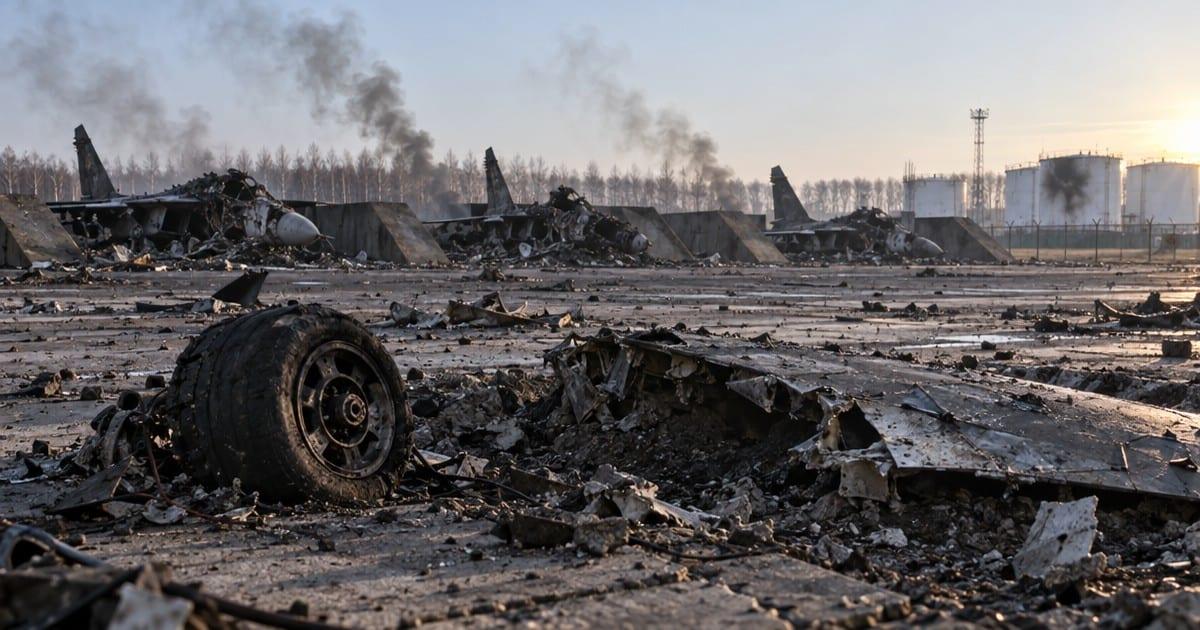
Ukraine's Navy said Thursday that it destroyed six Russian Su-34M fighter-bombers in a cruise missile strike on Borisoglebsk military airfield in Russia's Voronezh region, an operation it says was carried out overnight using the Neptune coastal missile system.
The claim, posted by Ukraine's Naval Forces and relayed by open-source monitoring accounts including @Osinttechnical and @visegrad24, has not been independently confirmed by Next News Network. According to @Osinttechnical, "at least one massive explosion was seen at the airfield," a detail consistent with satellite imagery circulated later in the morning.
@clashreport posted satellite imagery said to show "the aftermath of a Ukrainian Navy strike on Borisoglebsk airfield in Russia's Voronezh region." The images, reviewed by the account but not independently authenticated, appear to show damage at the facility.
The Borisoglebsk base, located in western Russia's Voronezh Oblast, is used to station Su-34 and Su-35 aircraft, which Russian forces deploy in attacks on Ukrainian positions and frontline towns, according to reporting on the strike. The Su-34M is a modernized variant of Russia's primary fighter-bomber, used extensively for glide-bomb and missile strikes against Ukrainian targets.
Ukraine's Navy described the operation as a single coordinated missile strike on the airfield's aircraft parking area. The Neptune system, originally developed as an anti-ship cruise missile, has been adapted by Ukrainian forces for land-attack missions over the course of the war.
The strike claim came as Ukrainian President Volodymyr Zelenskyy told the Financial Times that his country will restart strikes on Russia's oil refineries, ending a pause that had been observed amid diplomatic pressure.
"The block [on attacking refineries] is out. We're done," Zelenskyy said in the interview, according to @JavierBlas, who reported the president's remarks. The comments signal a shift in Ukraine's targeting posture, opening the door to renewed long-range attacks on Russian energy infrastructure.
The refinery strike pause had been a point of contention between Kyiv and its Western partners, with Washington reportedly urging Ukraine to avoid hits on Russian oil facilities over concerns about global crude prices and escalation. Zelenskyy's remarks suggest that restraint has now been set aside.
Together, the two developments — the airfield strike claim and the lifting of the refinery ban — point to a broadening of Ukraine's deep-strike campaign against Russian military and economic targets. The Borisoglebsk operation, if confirmed, would represent one of the more significant single-day losses of Russian tactical aircraft since the early months of the war.
Russian officials have not publicly commented on the Borisoglebsk strike claim. Independent verification of the number of aircraft destroyed, the munitions used, and the extent of damage at the airfield remains unavailable. Satellite imagery reviewed by open-source analysts suggests activity consistent with a strike, but does not on its own confirm the six-aircraft figure cited by Ukraine's Navy.
The accounts carrying the claim span a range of open-source monitoring channels. @Osinttechnical, an account that tracks military developments in the conflict, reported the Navy's claim that six Su-34 fighter-bombers were destroyed and noted the explosion observed at the airfield. @visegrad24, a Central European news account, relayed the Navy's statement that the Neptune coastal missile system was used in the overnight operation. @clashreport posted satellite imagery said to show the aftermath. The claim has spread across these channels and others, though the underlying figure remains attributable only to Ukraine's Navy.
Next News Network could not independently verify the Ukrainian Navy's claim that six Su-34M aircraft were destroyed at Borisoglebsk airfield.
The strike, if confirmed, would add to a pattern of Ukrainian long-range attacks on Russian airfields using domestically produced missiles and drones. Ukraine has increasingly relied on its own weapons systems — including the Neptune and long-range drones — as Western partners have restricted the use of donated weapons for strikes inside Russian territory.
Zelenskyy's comments to the Financial Times came amid ongoing discussions with Western allies about the scope of Ukraine's targeting authorities. The president's phrase — "The block is out. We're done" — was reported by @JavierBlas, who conducted the interview for the Financial Times.
The lifting of the refinery strike pause could have significant implications for global energy markets, as Russian oil refineries have been a recurring target of Ukrainian drone attacks throughout the war. Previous strikes have disrupted Russian refining capacity and, at times, contributed to fluctuations in global crude prices.
Neither the Ukrainian Navy's claim nor Zelenskyy's remarks have been independently confirmed by Next News Network. The figures and statements cited above are attributed to the parties making them.
Our Take
Ukraine's strike on Borisoglebsk airfield, if the Navy's account holds up, is a meaningful blow to Russia's tactical aviation fleet — six Su-34Ms is a substantial loss for a country that has struggled to replace modern combat aircraft at scale. But the more consequential story may be Zelenskyy's declaration that the refinery strike pause is over. For months, the Biden administration and its European allies have pressured Kyiv to avoid hitting Russian oil infrastructure, worried about price spikes and escalation. Zelenskyy's blunt message to the Financial Times — "We're done" — is a signal that Ukraine intends to prosecute this war on its own terms, regardless of whispered concerns from Western capitals. The question now is whether Moscow responds by escalating its own strikes on Ukrainian energy infrastructure, and whether the West will continue to fund a war effort it no longer fully controls. Conservatives have long argued that Ukraine should be allowed to hit legitimate military and economic targets inside Russia without hand-wringing from Washington. Zelenskyy, it seems, has decided to act on that logic — with or without permission.
