
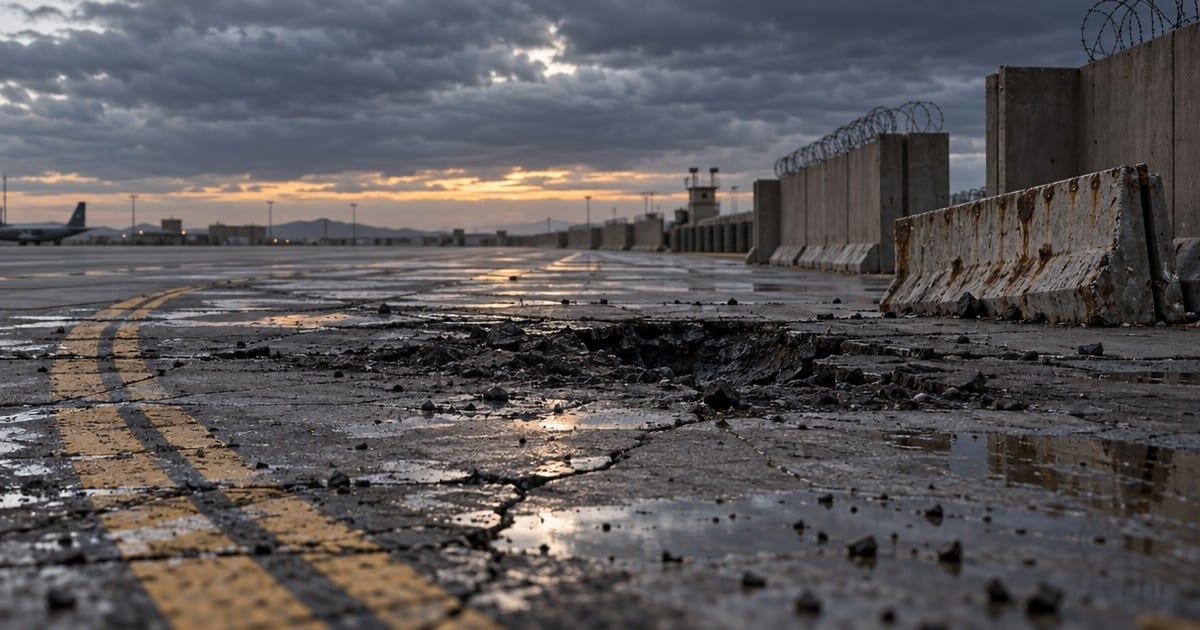
American forces could come under attack on U.S. soil before they ever reach a battlefield overseas, the Army's acting chief of staff warned this week, as the service rolled out a new warfighting framework built around a hard admission: the assumptions that kept America safe during two decades of Middle East combat no longer hold.
"If we're going against a pacing threat, power projection will be contested," Gen. Christopher LaNeve told Fox News Digital on Wednesday, speaking at a small-group roundtable during the Association of the United States Army's annual conference in Washington.
LaNeve said the Army is rethinking the comfortable math of the Global War on Terror, when U.S. bases, supply lines and communications were largely untouchable at home. "During the Global War on Terror, we took a lot of things for granted, because we could," he said.
What 'Contested' Actually Means
The scenario Army planners are working through goes like this: a conflict with China begins, and instead of American troops flowing freely to the fight, the flow itself becomes the target. Disrupting U.S. military bases, transportation networks and communications could delay American forces from ever reaching the battlefield, according to Fox News Digital's reporting on LaNeve's remarks.
That is not a hypothetical pulled from a war game. The Pentagon's latest report on China's military capabilities warns that Beijing has positioned cyber capabilities inside U.S. critical infrastructure networks that could be used to disrupt American military mobilization during a conflict, per Fox News Digital.
The threat has already shown up closer to home. U.S. officials have previously confirmed drone incursions over installations including Joint Base Langley-Eustis in Virginia and Picatinny Arsenal in New Jersey. Fox News Digital noted that those incidents have not been publicly attributed to China.
The warning came alongside the rollout of "How the Army Fights," a new operational framework that places heavier emphasis on preparing American forces to deploy, communicate and sustain operations even when military bases, networks and supply chains are under attack. LaNeve pointed to lessons drawn from Iran, Ukraine and cartel drone operations as drivers of the shift, describing changes that reach all the way down to soldiers' basic battlefield skills.
Homeland Defense Moves Back to the Center
The Pentagon has placed renewed emphasis on homeland defense and the security of military installations, per Fox News Digital's reporting, a posture shift that tracks with the framework's core premise — that the next fight may not wait for American troops to arrive overseas.
Coverage from RedState noted that the last major war fought by the United States, World War II, was fought with two vast oceans as a buffer, and that even then Japanese troops landed in the Aleutians, Japanese submarines launched minor attacks on the West Coast, and German U-boats patrolled the American east coast within sight of city lights.
The Army's Western Hemisphere ambitions are part of the same picture. Gen. Joseph Ryan, commander of U.S. Army Western Hemisphere Command, said Monday at the AUSA conference that American "economic supremacy" is an overarching goal of Washington's regional security strategy, pointing to the Panama Canal as a chokepoint through which a high percentage of U.S. trade passes. Ryan said the partnership allows the U.S. to "keep an eye on those states that are aligned with other adversaries in the region," naming Cuba, Nicaragua and formerly Venezuela, and adding that Lebanese Hezbollah has a presence in the area. The U.S. military recently co-led PANAMAX in Panama, an exercise with personnel from 19 countries that practiced defending the canal. Ryan also said officials approved a capacity increase for Joint Task Force Bravo, based at Soto Cano Air Base in Honduras, to expand its footprint over the next few fiscal years.
What It Means for Americans
The practical effect for everyday Americans is not abstract. If military bases, rail lines, ports and communications networks are treated as wartime targets from day one, then the infrastructure in the towns around them is in the conversation too. Drone incursions over a Virginia installation are a local story before they are a strategic one.
It is not yet known which specific capabilities, units or timelines the "How the Army Fights" framework will change, or how the service intends to fund homeland defense improvements alongside its existing missions. Those details were not laid out in LaNeve's remarks as reported.
What is clear from the general's own words is that the Army is no longer planning around the assumption that the fight stays far away.
Our Take
For twenty years, the American people were told the war was over there — and for the most part, it was. That deal is expiring.
Gen. LaNeve just said out loud what the Pentagon's own China report has been signaling: our enemies have already prepositioned the tools to hit us here, inside the networks we depend on, before a single soldier boards a plane. The drone incursions over Langley-Eustis and Picatinny Arsenal weren't weather balloons. They weren't hobbyists. And the fact that nobody in the previous administration was willing to publicly name the culprit tells you everything about how unserious our homeland defense posture had become.
This is what "peace through strength" actually looks like in practice. Not a slogan — a rebuild. It means hardened bases, real counter-drone defenses, secure supply chains, and an Army that trains to fight while under attack at home. It means taking the Panama Canal seriously again, keeping Hezbollah's footprint in our hemisphere on the radar, and treating cartel drone operations as the national security threat they are, not a border-state nuisance.
The open question is whether the Pentagon and Congress will fund this shift with the urgency it demands, or whether the next round of budget fights buries it under business as usual. Patriots should be calling their representatives and asking one simple question: if the next war can reach our soil, why is homeland defense still treated like an afterthought?
