
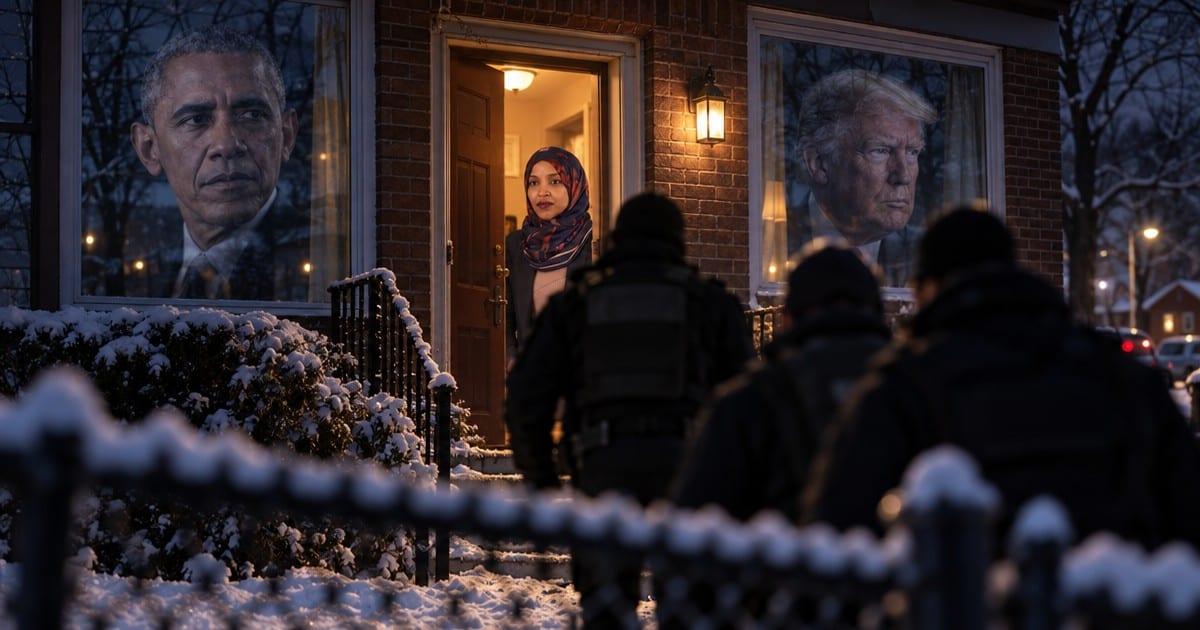
Former President Barack Obama said the federal government cannot selectively target individuals because of their political beliefs or speech, and accused the Trump administration of doing precisely that to Rep. Ilhan Omar of Minnesota following a federal raid at her home.
"It is a basic principle of American democracy that the government can’t selectively target individuals simply because of their political beliefs or what they say," Obama posted on X, writing from his account, which carries 119 million followers. "But that’s exactly what the Trump Administration is doing to Congresswoman Ilhan Omar of Minnesota."
Obama served two terms in the White House before leaving office in 2017. His statement is the most prominent Democratic voice to weigh in on the raid, and it came in the middle of the afternoon on a Sunday, days into a growing fight over the federal action at Omar's residence.
The comments arrived as the raid itself was drawing reactions from across the political spectrum. Just The News reported on Obama's post roughly half an hour after it went up, quoting the first line of his statement and noting that he had published it on X, the platform formerly known as Twitter.
Omar, who represents Minnesota's Fifth Congressional District, has been a frequent target of Republican criticism since entering Congress. The raid at her home has thrust that conflict into a new phase, with the former president now framing the federal action as a test of a founding principle rather than a dispute over one lawmaker.
Obama's argument rests on a straightforward claim: that the government cannot use its investigative and law enforcement powers to punish people for their politics or their speech. He leveled that claim directly at the current administration, naming the sitting president in the post and tying the raid to the treatment of a specific member of Congress.
The former president's statement was not universally welcomed. Twitchy, the political commentary site, responded hours later under the headline "Obama, Whose Own IRS Targeted Conservatives, Clutches Pearls Over Ilhan Omar Raid and Wow, How DUMB." The outlet's response points to the Internal Revenue Service controversy that marked Obama's own tenure, when conservative groups applying for tax-exempt status faced heightened scrutiny from the agency. That episode became a sustained line of attack from Republicans and shaped how many on the right view Democratic complaints about politically motivated federal action.
The contrast between Obama's post and that history is now the central fault line in the reaction. Where the former president described a principle being violated, his critics described a standard being applied unevenly by the man who once led the executive branch that enforces it.
Twitchy's reaction is part of a broader pattern in the response to the raid, in which commenters on the right have focused less on the facts of the federal action at Omar's home than on the identity of the person condemning it. The outlet's headline does not engage the substance of Obama's claim about the current administration; it argues instead that the messenger has a credibility problem rooted in his own record.
That is the shape the exchange has taken. First came the raid. Then came Obama's statement, framing the federal action as a violation of a basic democratic principle and naming the Trump administration as responsible. Then came the counterattack, which did not dispute the raid's existence but instead argued that the former president has no standing to complain about it.
The dispute also landed in the middle of a broader conversation on the political right about the language of democracy itself. One commentary published the previous day, "Who Should Defend Democracy?", examined a disagreement between writers over libertarianism and democracy, part of an ongoing argument about who gets to invoke the word and what they mean by it. That piece was not about Omar or the raid, but its timing illustrates how charged the vocabulary of democratic principle has become across the spectrum.
For his part, Obama's statement was brief and did not go beyond the principle he laid out. He did not describe the raid in detail, nor did he specify what federal agency conducted it. The substance of his claim is that the targeting is happening because of Omar's political beliefs and speech, and he attributed the conduct to the administration by name.
Readers encountering claims about the raid should note that the account of it circulating in this exchange comes from the statements and coverage surrounding Obama's post. The former president's characterization of the administration's motives is his own, and the administration has not been quoted here responding to it.
What is clear is the sequence. A federal raid took place at the home of a sitting congresswoman from Minnesota. The former president used his platform to call it a selective targeting of a political opponent and to tie it to the sitting administration. A conservative outlet answered hours later by pointing to the IRS controversy from his own years in office, arguing that his objection is hollow. Democrats now have a statement from their most prominent living figure to rally around. Republicans have a ready reply. Neither side appears interested in letting the other's framing stand.
Our Take
Obama's posturing would be easier to take seriously if it did not come from the man whose IRS subjected conservative groups to years of delayed applications, intrusive questionnaires and demands for donor lists before the agency finally admitted the targeting was real. He spent eight years presiding over an executive branch, and the lesson his critics drew from that tenure is that the machinery of government is easy to aim at people you dislike. Now that the aim is pointed elsewhere, the principle has suddenly become sacred. The raid on Omar's home deserves scrutiny on its own facts, and the administration should be able to explain exactly what it did and why. But a lecture on the sanctity of political neutrality from the architect of the IRS scandal is not scrutiny; it is a reminder that the people most eager to defend democracy tend to discover its value only after they have lost the power to use it.
