
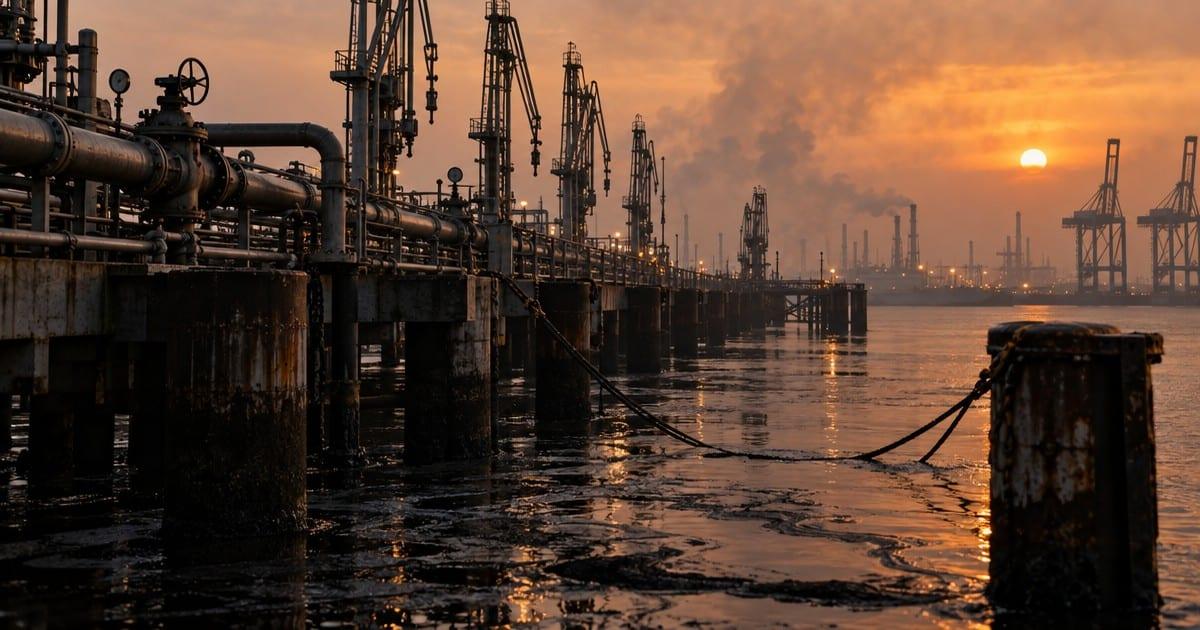
An Iranian Revolutionary Guard spokesman said even a limited American military action would trigger a global energy crisis, according to a statement carried by Sepah News and circulated Monday by the market wire account First Squawk.
First Squawk, which has 567,000 followers, relayed the spokesman's warning in a single line attributing it to Sepah News, the outlet tied to the Islamic Revolutionary Guard Corps. The statement did not specify what form of American action it was responding to, nor did it identify the spokesman by name.
The warning came as Iranian outlets pushed a second, more expansive set of claims about American military posture in the region. Tasnim, the semi-official news agency, reported that the IRGC spokesman said Iran does not have the capacity to create a new conflict, adding that most of America's bases in the region have been deactivated and that its forces are "worn out and exhausted and are hundreds of kilometers away from Iran." Newsquawk, a market news service, carried that report as well.
The same spokesman, Brigadier General Hossein Mohebbi, gave an exclusive interview to the Tehran Times in which he claimed Iran's missile and drone capabilities have increased by at least fifty percent since the start of the war and that the country holds weapons it has yet to deploy. He warned in that interview that any renewed American military action would carry consequences. The Tehran Times did not publish the full text of the interview in the excerpt circulated Monday, and the specific consequences he described were not detailed in the accounts available.
Taken together, the statements form a two-track message: a public claim that Washington lacks the capacity to sustain a new fight in the region, paired with a warning that even a constrained American move would be felt far beyond the battlefield, in global energy markets.
The energy warning is the more consequential of the two for markets, because it links a limited military action to a worldwide price shock rather than to a localized exchange of fire. The spokesman did not explain the mechanism by which a limited American action would produce a global crisis, and no shipping data, production figure or market assessment accompanied the claim in the material carried by First Squawk.
The claims about American bases and force readiness rest entirely on the Iranian spokesman's account. No American official was quoted in any of the coverage responding to the assertion that most bases in the region have been deactivated, and no independent assessment of force posture accompanied it. The characterization of American forces as "worn out and exhausted" is the spokesman's language, carried by Tasnim and repeated by Newsquawk.
The claim of a fifty percent increase in missile and drone capability since the start of the war is likewise the general's own figure, offered in an interview with a Tehran-based outlet. It was not accompanied by data, and no outside military assessment was cited in the accounts. The assertion that Iran holds undeployed weapons is similarly unattributed beyond the spokesman himself.
What the statements point to is an information campaign running in parallel through multiple Iranian outlets and picked up by market-facing accounts in the West. First Squawk, which describes itself as a breaking news service for traders, carried the energy warning to an audience that watches headlines for price signals. Newsquawk, which aggregates market-moving news, carried the Tasnim report. The Tehran Times interview circulated separately through Iranian state-aligned channels.
The sequence matters for how the story reached English-speaking audiences. The Sepah News line about a global energy crisis traveled first through First Squawk. The Tasnim report, with its claims about deactivated bases and exhausted forces, followed through Newsquawk. The Tehran Times interview, with the general's name attached and the fifty percent figure, supplied the most detailed version. By Monday, three distinct threads of the same spokesman's messaging were circulating in English, each emphasizing a different element: energy disruption, American weakness, and Iranian military growth.
None of the three accounts provided evidence for the underlying claims about American force posture or Iranian capability, and none cited American officials responding to them. The IRGC spokesman's statements were relayed as statements, not as findings.
Next News Network could not independently verify the claims made by the IRGC spokesman or the reports carried by the outlets above.
The episode fits a pattern in which Iranian military messaging is released through multiple outlets at once, each calibrated to a different audience: Sepah News for the domestic and regional audience, Tasnim for the semi-official wire function, and the Tehran Times for English-language readers. Western market wires then pick up whichever line carries the sharpest consequence for prices, which in this case was the warning about a global energy crisis.
What remains unclear from the material is what specific American action the spokesman was warning against. The statement carried by First Squawk referred only to "limited US action" without defining it. The Tasnim report referred to a "new conflict." The Tehran Times interview referred to "any renewed US military action." None of the three specified a particular operation, deployment or announcement that prompted the warning.
The general's claims about the state of American bases and the reach of Iranian missiles and drones are the kind of assertions that normally would be tested against satellite imagery, shipping traffic or official statements from the Pentagon. None of that appeared in the coverage. The statements stand as the spokesman's assertions, carried by outlets aligned with or operated by the institution he represents.
For readers tracking the story, the practical takeaway is that a senior IRGC official used three outlets to deliver three messages on the same day: that America cannot win a war with Iran, that America's regional posture has collapsed, and that even a small American move would convulse global energy markets. Each message was attributed to him, and each was relayed by an outlet with an interest in amplifying it.
Our Take
The Iranian regime is running a psychological operation through its own media organs, and the Western wires are dutifully passing it along as though a spokesman's say-so were a battlefield report. Notice the structure of the claims: America's bases are deactivated, its forces are exhausted, its reach is hundreds of kilometers short, and yet a limited American action would somehow trigger a worldwide energy crisis. Those claims cannot all be true at once, and the Iranians know it. The purpose is not to inform but to deter, to convince Washington and the markets that any response carries outsized cost. The responsible thing for American outlets is to report the statements as statements, attribute them to the regime that produced them, and refuse to launder them into fact. That is what we have done here. The general's numbers are his own, his claims about our military are his own, and until the Pentagon or independent analysts confirm any of it, they remain propaganda from a regime that has spent decades perfecting the art of the threatening headline.
