
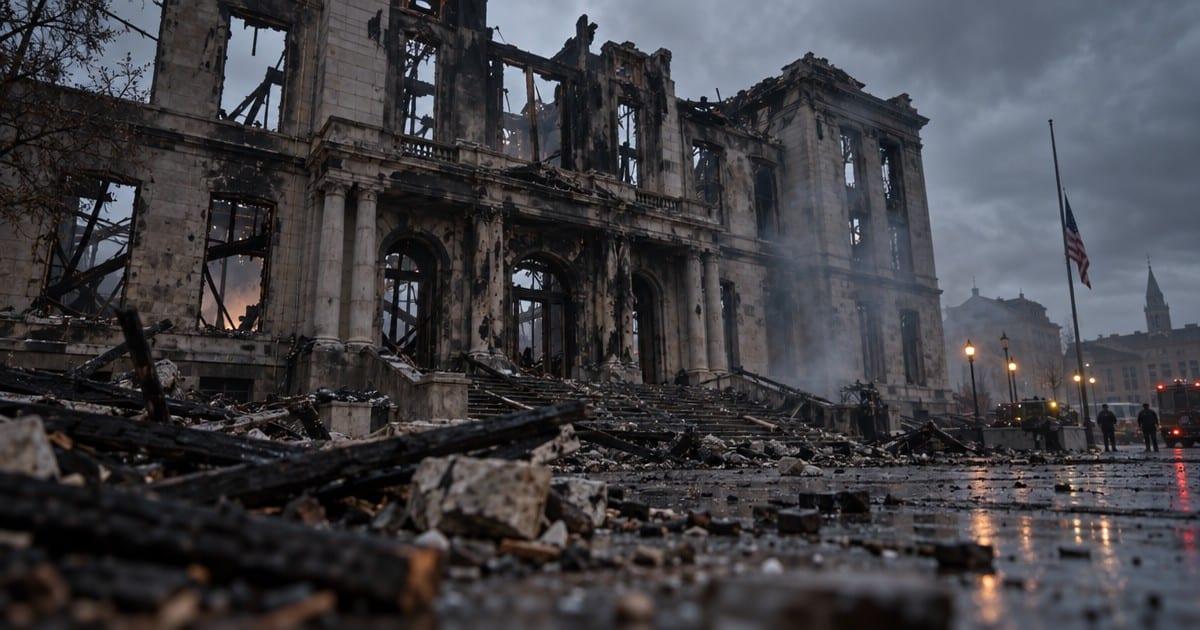
Guillaume Guérin, the mayor of the French city of Limoges, said he refuses to describe the people who wrecked his town hall as rioters or vandals, and called them terrorists instead.
Guérin made the remark while giving a tour of the damaged building, according to a video circulated on X by Mario Nawfal, a commentator with three point nine million followers. In the clip, the mayor walks through the hall and urges the public to look closely at what was done to it, saying it is essential that everyone see the images.
The video was posted on October twentieth and shows the interior of the municipal building in the aftermath of the violence. The English text accompanying the clip renders the mayor's remark as a refusal to call the perpetrators rioters or vandals, followed by the declaration that they are terrorists. The footage itself is in French, and the English wording circulating with it is a translation rather than a transcription of the mayor's own words.
Nawfal amplified the clip with a blunt caption of his own, condemning those responsible in harsh terms and calling them sick.
The translated remarks in the video go further than the headline line. According to the English rendering, the mayor says the images must be seen and refers to the day of the legal process for those who carried out the destruction, describing what that process will be. The translation then refers to the national police and to a situation in which officers had no ammunition, and describes what it calls extremely brutal fire from a crowd of five to seven hundred people who were, in the translation's words, extremely motivated to be in the streets against all the institutions of the Republic.
The translated account continues that the response was a failure, and explains the failure as an inability of the public police to follow the groups through streets they had not seen. It closes with the assessment that it would have been better if officers had ammunition that would allow them to stay in place.
The passage is choppy and at points garbled in the English rendering, and it is presented as a translation throughout. It should be read as a rendering of what the mayor said on camera, not as his own phrasing.
What the clip does not do is establish, on its own, the full circumstances of the confrontation it describes. The mayor's account of the numbers involved, of the police position and of the failure of the response is his account as rendered in translation.
The clip arrived as French unrest dominated conservative and international commentary online. Coverage published in the same window described riots engulfing France and argued that the mainstream press was spinning the story, framing the violence as a warning for the West that the establishment would not admit. That coverage treated the French disturbances as a significant and ongoing story rather than an isolated incident.
The same cycle of coverage also carried a separate argument about political violence and hypocrisy, in a piece criticizing violence by Israeli vandals against visiting diplomats, a journalist and church members, and defending the right of the people of Taybeh to harvest their olives. The pairing of the two subjects reflects how the French story was being folded into a broader argument about who gets condemned for political violence and who does not.
Mario Nawfal, who posted the Limoges clip, is a commentator with three point nine million followers who regularly aggregates and republishes breaking footage and statements from international events. His post carried the mayor's words to an English-speaking audience that would otherwise have had little access to them.
Guérin's choice of language is the substance of the story. In French political debate, the distinction between rioters, vandals and terrorists is not a small one. It bears on how suspects are charged, how the Interior Ministry characterizes the unrest, and how the public weighs the legitimacy of the state's response. A mayor who rejects the gentler labels and reaches for the hardest one available is making a demand about how the justice system should treat the people who wrecked his building.
The French interior ministry has not confirmed the mayor's characterization, and the translated account of police ammunition levels and crowd size has not been corroborated by any official statement in the material reviewed.
Next News Network could not independently verify the events described in the video or the accuracy of the English translation.
The mayor's remarks also carry an implicit criticism aimed inward at the French state. The translation describes a police response that failed because officers could not follow the groups they were facing and suggests they lacked the means to hold their ground. That is a mayor of a major French city saying, in public, that the Republic's forces were not equipped to defend his town hall.
Whether the Limoges episode becomes a turning point in the French debate or another clip in a long stream of them will depend on what French prosecutors do with the cases and whether other mayors adopt Guérin's vocabulary. What is already clear is that the language has been put on the record by an elected official standing in his own ruined building, and that the clip has been carried to an English-speaking audience in the millions.
Our Take
The mayor of Limoges did not stumble into the word terrorist. He chose it, rejected the softer options out loud, and made his town hall the backdrop for the choice. Republicans in this country should pay attention to what he is really saying, because it is not only about France.
The French model of absorbing unrest, of treating burned buildings as the cost of doing business, has been sold to Americans for years as sophistication. Guérin's tour is the bill coming due. He describes a police force that could not pursue the people in front of it and a crowd of hundreds who came out, in the translated account, against every institution of the Republic. That is not a protest that got out of hand. That is an assault on the state, and he says so.
Notice, too, that the story does not stay in France. The same commentary cycle that carried Limoges was arguing about violence against diplomats and church members elsewhere, and asking who gets a pass. That is the right question, and conservatives should press it. The people who call an American city blockaded by mobs a summer of love have no standing to lecture anyone about political violence.
There is a reason the French press and their American imitators reach for the words rioters and vandals. Those words describe property damage, and property damage can be priced, insured and eventually forgotten. Terror is different. Terror describes an attack on a people, and it demands a response that matches. Guérin understands that he is not asking for a cleanup crew. He is asking for a state that shows up.
The warning for America is not subtle. When a mayor has to stand in the wreckage of his own town hall and explain that the police were not equipped to hold the line, the failure started long before the first window broke. It started with years of leaders who softened the language, excused the violence and called it expression. Limoges is what that road looks like when it reaches the end.
