
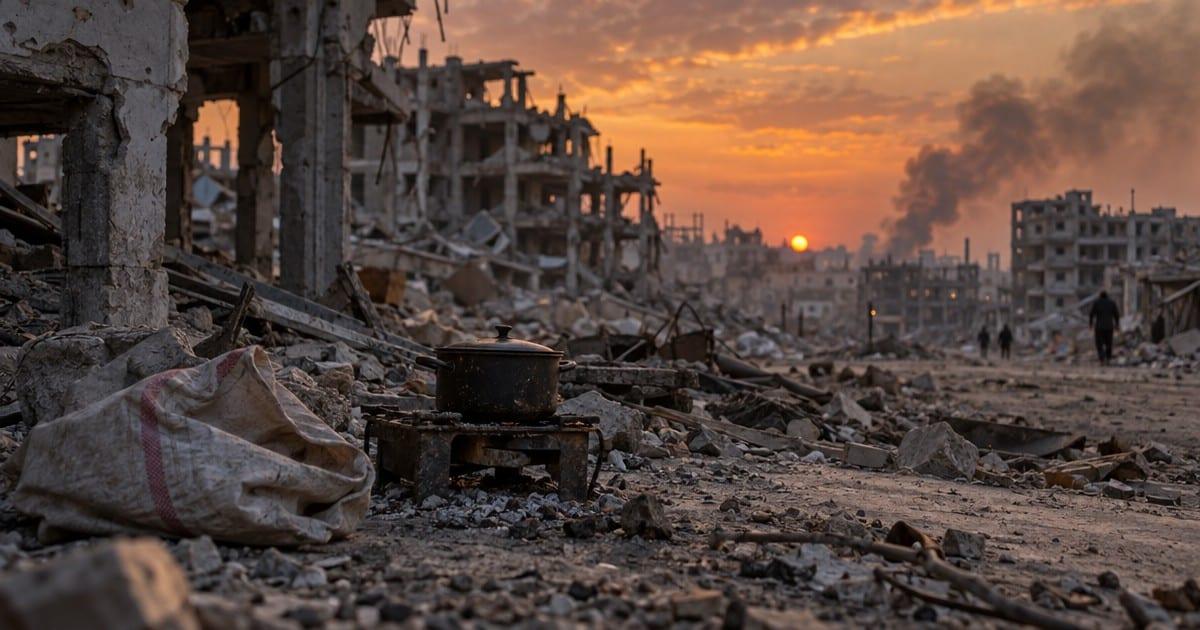
The United Nations World Food Programme is cutting monthly food assistance to five hundred thousand Palestinians in Gaza and two hundred thousand in the West Bank, the agency said, citing a serious funding shortage. Families who keep their support will receive smaller rations and less cash, according to accounts of the announcement, even as the agency describes two-thirds of Gaza's population as facing crisis levels of food insecurity, with two hundred thousand people in danger of famine.
The Washington Times reported the figures, describing a U.N. food agency short of funds and forced to trim its rolls. Euronews carried the same numbers and added the detail that remaining recipients will see their support reduced. The Guardian's Gaza coverage framed the decision around the hunger data the agency itself has published.
The cut landed the same week that a mass funeral was held in Gaza for seventy-five Palestinians whose remains were found under the rubble of homes and buildings destroyed by Israel. Democracy Now! reported the burial, placing it alongside the World Food Programme's announcement of a reduction in monthly assistance from 1.6 million people to 1.1 million.
Coverage of the aid reduction spread quickly across outlets with sharply different audiences. The Washington Times, a news organization with roughly 490,000 followers on X, posted the Gaza and West Bank figures to its account on Monday night, putting the number of affected Palestinians in the headline. The Washington Post, with 19.3 million followers, carried a separate West Bank story the same evening — the arrest of ten people on Monday in connection with the beating of a Washington Post photographer and an alleged assault on European diplomats, according to Israeli authorities.
The New Yorker, an account with 8.4 million followers, posted about that assault in detail. On Friday, according to the magazine's post, a group of Israeli settlers attacked Palestinian farmers harvesting olives in the West Bank and beat up Heidi Levine, a Washington Post photographer. The New Yorker's post identified Jasper Nathaniel as a journalist who was present during the assault on Levine and cut off there.
Democracy Now!, an account with roughly 800,000 followers, carried the funeral in its headlines coverage and tied it directly to the funding news. The program reported that the mass funeral was held Sunday for the seventy-five people whose remains were uncovered, and that the World Food Programme cuts come as two-thirds of Gaza's population faces crisis levels of food insecurity — or worse.
The sequence matters for how the story reached American audiences. The aid cut was reported first as a funding story by outlets covering the agency's own announcement. The funeral was reported as a burial story. The West Bank assault was reported as a law enforcement story, with arrests announced by Israeli authorities. By Monday night, all three were circulating in the same feeds, each outlet carrying the piece of it that fit its audience, and the accounts with the largest followings — The Washington Post and The New Yorker — leading on the West Bank while the smaller accounts led on Gaza.
The World Food Programme's own framing, as relayed in the coverage, is that the reduction is a matter of money rather than need. Two-thirds of Gaza's population requires help to survive, according to the agency's assessment, and the families removed from the rolls are being removed while that assessment stands. The agency did not dispute the hunger figures in its announcement; it cited them.
What the coverage does not establish is the condition of the seventy-five people whose remains were recovered, beyond the fact that they were found under destroyed buildings. The funeral was reported as a burial of remains uncovered from rubble. The cause and circumstances of those deaths were not laid out in the accounts reviewed.
Next News Network could not independently verify the claims and accounts described in this report.
The reaction across these outlets followed a pattern that has become familiar in coverage of the region: an institutional announcement from a U.N. agency, a burial reported by independent media, and a violent incident in the West Bank reported through an arrest announcement and a magazine's account of a beaten photographer. Each was true to its own beat. None of them, on its own, told a reader what the others were reporting.
Our Take
The World Food Programme did not run out of money because of a hurricane or a crop failure. It ran out of money because the governments that fund it have priorities elsewhere, and the people who will eat less this month are the ones with no leverage over that decision. Notice how the announcement is structured: the agency leads with the shortfall, then concedes that two-thirds of Gaza is in crisis and two hundred thousand are at risk of famine. That is not a budget update. That is an admission that a humanitarian agency is choosing which hungry people to stop feeding.
The outlets carrying this story split along predictable lines. The Washington Times put the raw numbers in the headline. The Washington Post and The New Yorker led on the West Bank assault and the arrests. Democracy Now! paired the funeral with the cuts. Every one of those stories is worth telling, but readers who saw only one of them got a partial picture — and the outlets with the largest audiences were not the ones leading on the food cuts. A half-million people in Gaza losing assistance is not a niche story, and it should not take a mass funeral to make it one.
The one thing we will not do is pretend the underlying claims here are beyond dispute. They come to us through agencies, officials and outlets with their own records on this conflict, and we have said plainly that we could not independently verify them. But the funding shortfall is the agency's own announcement, in its own words. If the World Food Programme is telling the truth about its books, the governments that fund it owe their publics an explanation of what they intend to do about it — and the rest of us owe the people on those reduced rations more than a headline cycle.
