
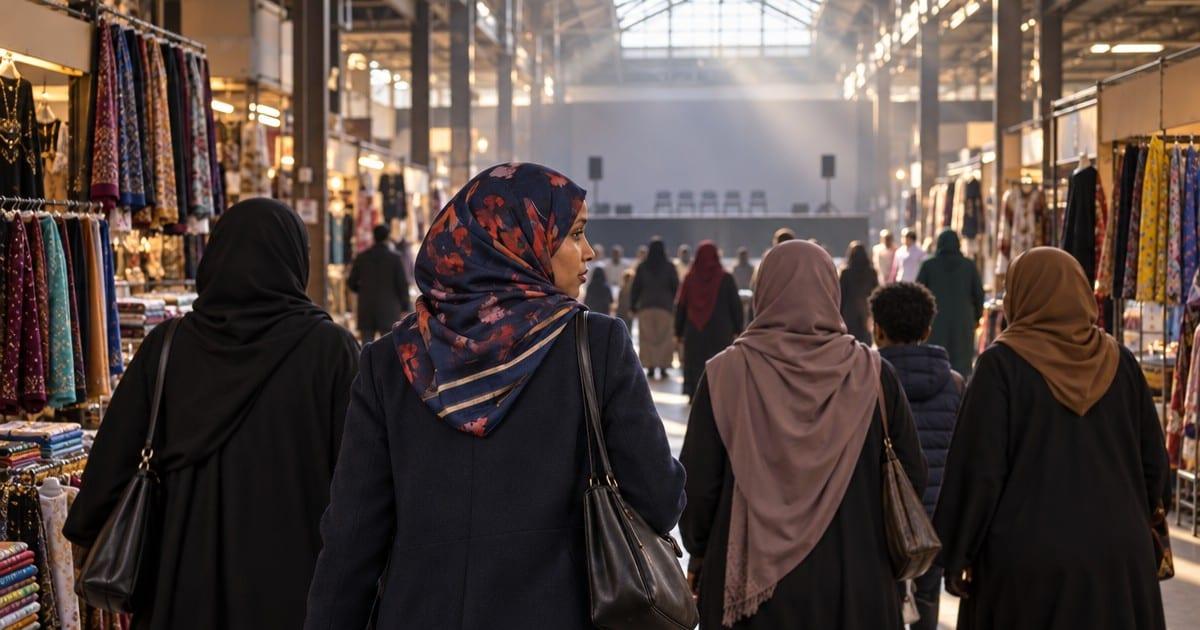
MINNEAPOLIS — The day after Rep. Ilhan Omar made her first public appearance following a federal raid on her Washington, D.C. home, Fox News Digital was given a tour of the place where she reemerged: the Karmel Mall of Somalia, a sprawling shopping complex that its owner describes as the largest Somali mall in the world.
The tour, conducted by owner Basim Sabri, offered a rare look inside what Fox News Digital described as an enclave dominated by Somali language and culture — a community hub that Omar represents in the U.S. House. According to the report, English is the mall's second language for most people inside.
The property is packed with storefronts offering electronic SIM cards for overseas calls, foreign money exchanges, and travel agencies arranging trips to the Middle East and East Africa. Vendors sell gold, fragrances, and traditional Somali fashion, largely for women. There are Somali barber shops, cafes, and henna tattoo shops. The food court features a giant Somali flag painted on the ceiling, alongside Palestinian imagery.
Sabri gave conflicting figures on the exact number of stores, once saying 900 and later saying 750, according to Fox News Digital.
Sabri, who was born in Gaza and came to the United States to study in Minneapolis, built a real estate empire that includes the mall and several apartment complexes in the area that house Somalis. He has political ties at all levels of local and state politics and is friendly with Omar. He also knew her father.
A female shop owner described the mall to Fox News Digital as a "community hub" of mostly women entrepreneurs. "We're here today at Karmel Mall with brother Basim, to kind of browse through this amazing community corridor that is full of amazing women," she said.
Fox News promoted its report on X, writing: "Is a sprawling Somali shopping center in Minneapolis a symbol of the American dream or a sign of challenges facing immigrant assimilation?" The network said that question sits at the center of its examination of the mall where Omar appeared after the raid.
An Instagram post indexed under the mall's name shows video from inside the complex, though the caption does not provide a transcript of what is said.
The raid on Omar's home has already drawn a furious response from Somalis in Minnesota, who, according to Fox News, have directed anger at President Trump over the federal action. Omar's reappearance at the mall — in her home district, among her constituents — came the following day.
For critics of mass immigration without integration, the scene inside Karmel Mall is familiar. A single-language commercial zone. Currency exchanges built around sending money abroad. Travel agencies whose primary business is trips back to the Middle East and East Africa. A revolving community hub that, by its own description, is oriented around life in Somalia as much as life in Minnesota.
None of that is illegal. Sabri is an American real estate investor who built a business. The women running shops are entrepreneurs. But the question Fox News is raising — whether a place like Karmel Mall represents the American dream or the failure of assimilation — is one that millions of Americans are asking about entire neighborhoods, not just one building.
The Trump administration has made immigration enforcement a centerpiece of its second term, with mass deportation operations and a renewed focus on vetting and integration. The raid on Omar's home fits that pattern. Whether it is followed by policy aimed at enclaves like Karmel Mall is not yet known.
What is known is what the tour showed: a community that has built its own economy, its own institutions, and its own cultural life inside an American city — and a congresswoman who returned to that community the moment federal agents came for her.
Our Take
America has always been a nation of immigrants. That is not in dispute. What is in dispute is whether immigration without integration is sustainable — and whether the people elected to represent these communities actually want them to integrate at all.
Ilhan Omar did not reappear at a county fair or a town hall meeting in greater Minneapolis. She reappeared at Karmel Mall, surrounded by a Somali flag, foreign money exchanges, and travel agencies selling tickets back to Mogadishu and the Middle East. A community hub for women entrepreneurs, one shop owner called it. Maybe. But it is also a place where English is the second language and the ceiling is painted with the flag of another country.
Nobody is saying that Somali-Americans cannot run businesses or celebrate their culture. But when an American congresswoman's political base is defined by a language and a national identity she no longer shares with the country she represents, that is not diversity. That is a failure to assimilate — and a failure of the leaders who sold it as success.
The feds raided Omar's home. The next day she went to the mall. Ask yourself what that tells you about which community she actually answers to.
