
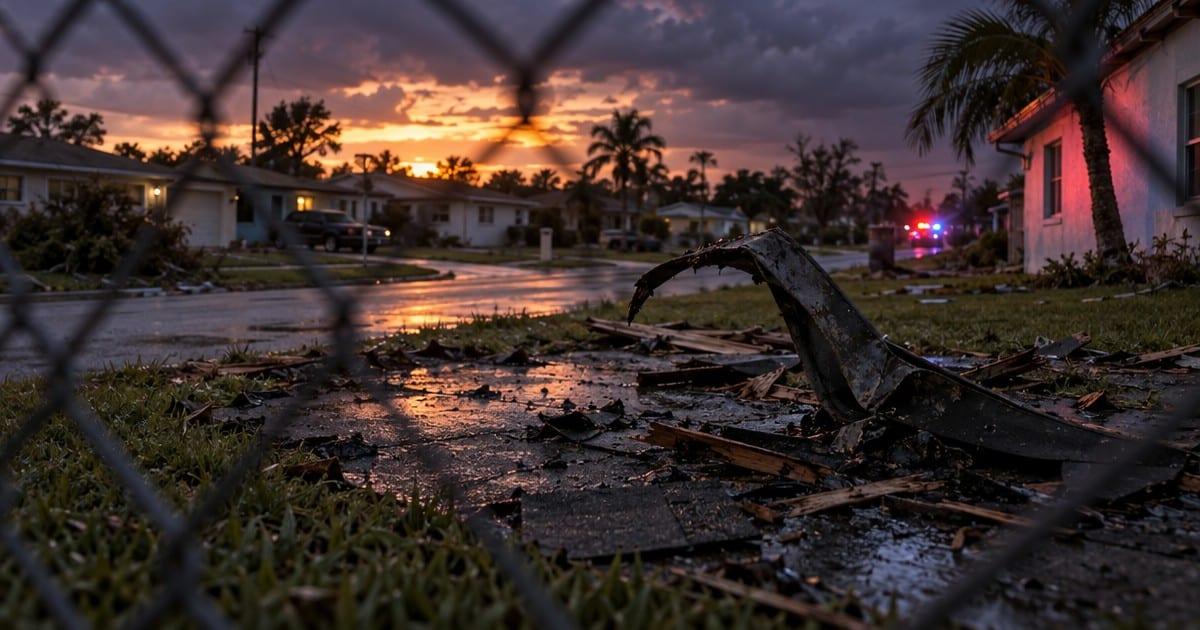
The last 78 seconds of a Learjet 60's flight were a fight against physics that no pilot could win. Nine people left Austin-Bergstrom International Airport at 10:37 Sunday morning bound for the Bahamas. At 12:47 Eastern, the crew radioed a triple threat: ice, turbulence, and then the one word every aviator dreads—overspeed. By 12:49, the jet was a crater in a Greenacres, Florida street.
The dead include Texas builder Adam Robinson, his wife Helen Sharp Robinson, their two young children—a four-year-old and a two-year-old—and the family's nanny. Also killed were two friends of the family, Captain Jeff Gregory, 55, and a 20-year-old first officer named Nathalia Filgueiras. One person on the ground was injured. This wasn't a headline for the legacy media to scroll past; it was a mass casualty event that raises hard questions about what happens when a modern aircraft meets a thunderstorm line at 35,000 feet.
Here's what the flight data reconstruction shows. The crew initially reported the ice as manageable and requested a climb to 37,000 feet. Air traffic control approved it. Less than thirty seconds after leveling off, the aircraft declared an overspeed condition while descending at a staggering 20,000 feet per minute. The controller on the other end of the radio did the only thing left: he said, "I'm here with you. Talk to me." There was no response worth transcribing. The descent from 35,000 feet to the ground took exactly 78 seconds.
"The overspeed condition at 20,000 feet per minute doesn't listen," one independent reconstruction noted. "Captain Jeff Gregory and Nathalia Filgueiras fought that descent for 78 seconds all the way into a Greenacres street. Ice and turbulence didn't negotiate."
The National Transportation Safety Board has yet to explain one critical number: the airspeed at the moment of the overspeed. The NTSB also hasn't matched the flight path to the thunderstorm line that was active in the area. For the families who stood on the tarmac in Austin that morning, those aren't bureaucratic details. They're the difference between knowing what happened and being told to move on.
This is the second major aviation incident this year to involve a private jet encountering severe weather shortly after departure. The pattern—if it holds—suggests that charter operators and private jet crews are being pushed to fly through conditions that commercial airlines would route around. The result is dead children, dead pilots, and a neighborhood in Florida that now has a hole in the street where a kitchen table used to be.
The America First agenda has been about restoring competence to every federal agency—including the ones that investigate crashes. The NTSB has promised a preliminary report. This website will not let that report become a week-old headline. When it drops, we'll read it line by line. If you fly the Austin-to-Bahamas corridor, or if you've ever put your children on a charter jet, you need to ask: was this a weather event, or a systems failure that someone should have caught before nine people boarded that plane?
Text WHITE HOUSE to 844-840-4963 to get the NTSB preliminary report delivered directly to your phone the moment it's filed—before the legacy press decides what you should and shouldn't see. The questions get asked here until the answers come.
