
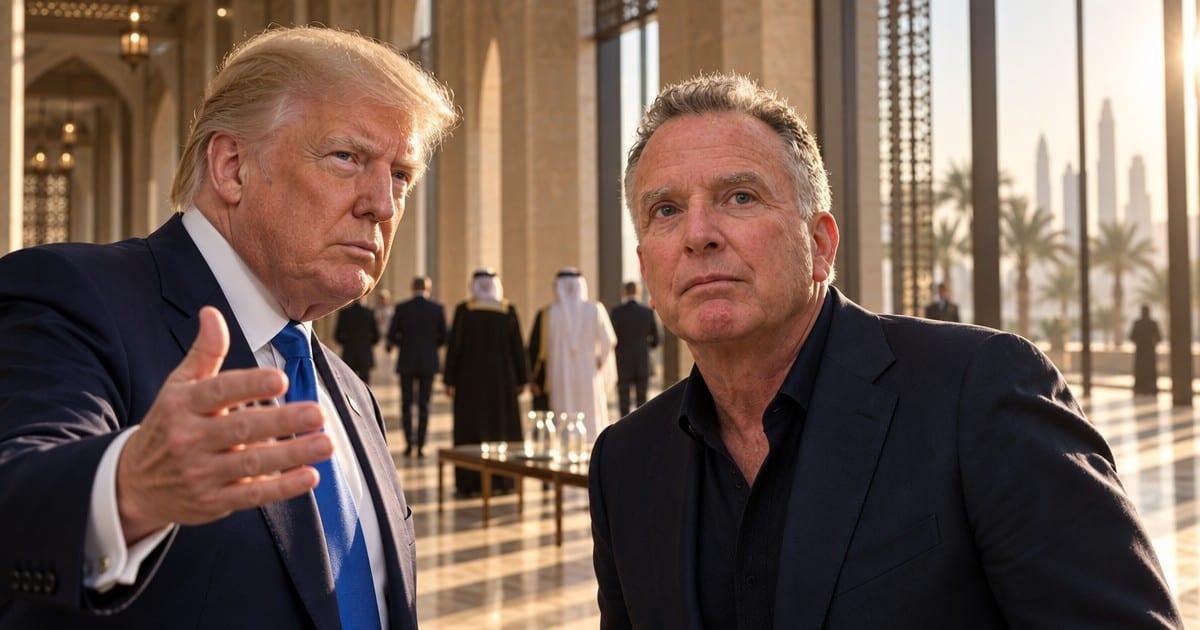
Jared Kushner and Special Envoy Steve Witkoff opened the first trilateral peace talks between the United States, Russia and Ukraine in nine months on Tuesday in Abu Dhabi, with the Trump administration pressing Moscow to accept a security guarantee for Ukraine that a senior U.S. official described as "effectively very similar to NATO."
The U.S. delegation sat down with Ukrainian intelligence chief Rustem Umerov and Vladimir Medinsky, a veteran Putin aide and negotiator, for two days of talks. The first day focused on security guarantees for Ukraine and the reshaping of Europe's security architecture; the second was set to address territorial questions — where the borders and boundaries should be drawn — according to U.S. officials who briefed reporters Monday on a background call.
According to Fox News Politics, the administration has asked Russia to accept what one official called "an Article Four and an Article Five-like security guarantee" for Ukraine. Article Five is the NATO charter's mutual-defense clause — an attack on one member is treated as an attack on all. President Donald Trump has not yet decided what security guarantee the U.S. itself would provide, the official said, calling an American commitment a "really, really big deal" that would ultimately have to be worked out between Trump and Ukrainian President Volodymyr Zelenskyy.
"An important part of this process is encouraging all parties to begin thinking seriously about what comes after the war," Kushner wrote on X ahead of the meetings.
Kushner's post followed a message from commentator Mario Nawfal, who wrote on X that "the U.S., Ukraine and Europe are already discussing what happens AFTER the war" and that Kushner had said officials met ahead of the negotiations to work on a long-term security framework for Ukraine. Nawfal's post added that the message from the talks is that "Ukraine's sovereignty must be respected."
Before sitting down with Moscow and Kyiv, the U.S. envoys met with national security officials from Germany, France, the United Kingdom and Italy, along with NATO, the European Union and Ukraine, to discuss the security guarantees. European officials are in Abu Dhabi for the meetings, but according to POLITICO, they will not be involved in the main negotiations because of Russian objections. POLITICO reported that Kushner and Witkoff are pressing Russia to allow Europe to join the next round and want this week's meeting to be the last without Europe's full participation. French Foreign Minister Jean-Noël Barrot insisted that France, the U.K. and Germany "will indeed be in the meeting room," according to the BBC.
The territorial dispute remains the hardest obstacle. Russia continues to publicly demand all of Donetsk, much of which its forces occupy, while Ukraine wants to freeze the conflict along the current line of contact and keep the sections of Donetsk it still holds, which Kyiv says are crucial to its future security. But a U.S. official said Monday that behind closed doors "both sides have shown a little bit of flexibility privately" on the issue of who would control Ukraine's eastern regions in a postwar scenario, according to the BBC. The official acknowledged the Donetsk question will not be solved until the parties know what the postwar security architecture looks like.
U.S. negotiators do not expect to resolve the territorial dispute in Abu Dhabi. Officials said the goal is to clarify where each side stands, identify the remaining gaps and begin exploring potential compromises that can ultimately be taken back to Russian President Vladimir Putin and Zelenskyy. The talks follow a localized truce last month around the Russian-occupied city of Oleshky in southern Ukraine that allowed the evacuation of trapped residents and delivery of humanitarian supplies, PBS News reported.
A lot has changed since the last trilateral round in Geneva in February. The U.S. has since opened a conflict with Iran, and the 2026 midterm elections delivered a sweeping rebuke of Republicans, with Democrats taking the House. Whether those developments change Moscow's calculus at the table is not yet known.
Our Take
Here's the tell in all of this: the same people who spent years lecturing Americans about the sanctity of NATO's Article Five are now watching a Republican president try to extend that kind of protection to a country that isn't in NATO — and they can't bring themselves to say a word in favor of it. The European elites are furious, not because the guarantee is too weak, but because they aren't the ones holding the pen. POLITICO's own reporting says the envoys want this to be the last round without Europe in the room. That's not a snub. That's leverage.
Trump promised to end this war, and he promised not to write blank checks for other people's borders. A guarantee that has to be negotiated between Trump and Zelenskyy directly — not rubber-stamped by a NATO bureaucracy — is exactly the kind of deal the American people were sold in 2024. Putin publicly demanding all of Donetsk while privately showing "a little bit of flexibility" is what pressure looks like when the other side finally has an adult in the room. Republicans got hammered in the midterms, but the peace table doesn't care about blue waves. If Kushner and Witkoff walk out of Abu Dhabi with a framework that keeps another Russian invasion from happening, the voters will remember which party actually delivered it.
