
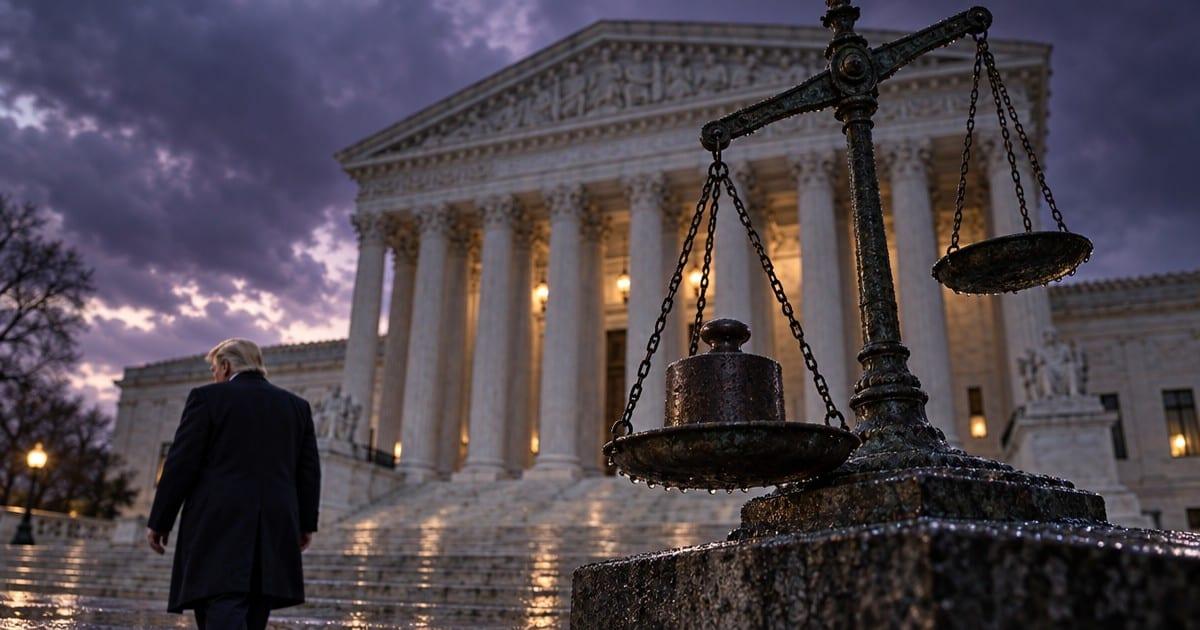
Supreme Court Justice Sonia Sotomayor said over the weekend that she hopes the Court's 2024 ruling granting presidents broad immunity from prosecution is overturned before she leaves the bench, describing the decision in Trump v. United States as one of several she wants reversed.
"There are some opinions that I hope in my lifetime will get overturned. The immunity case is one of them," Sotomayor said Saturday at an event on the future of American democracy held at George Washington's Mount Vernon estate, according to Fox News Politics. The justice, 72, an Obama appointee, was part of the three-justice liberal dissent in the 6-3 ruling, which held that a president cannot be prosecuted for acts within his core constitutional authority and is presumptively immune for other official acts.
Sotomayor also told the audience, after noting turnout in the midterm elections, that the Court had done "crazy things," adding: "It's going to take some hard work. I don't know how long it's going to take to put us back on an even keel." She singled out the immunity decision among the conservative majority's rulings she contests, per the same account.
SCOTUSblog reported her remarks under the headline that the Court has done some "crazy things," noting the justice discussed the decisions by her conservative colleagues who make up the majority. Coverage of the event circulated quickly, with the financial blog ZeroHedge posting on X: "'Only Joking - Maybe Not': Sotomayor Takes Aim At Supreme Court's Presidential Immunity Ruling" — a post that linked to its write-up on her comments.
The Mount Vernon appearance came days after the midterm elections, and Sotomayor referenced the voting in her remarks, according to the accounts of the event. Her comments land in a Court whose future is already the subject of open political warfare: Justice Clarence Thomas, 78, and Justice Samuel Alito, 76, have both previously said they do not intend to retire, and CBS News reported that the midterm results have not changed their minds, even as some Trump supporters have pressed the two conservatives to step down before Democrats could take control of the Senate.
Sotomayor's remarks were quickly read as a signal of what a liberal majority might do if the Court's composition changes. Conservative commentators noted that with Thomas and Alito approaching 80, a Democratic administration elected in 2028 could replace both without any court-packing scheme, potentially giving liberals a majority — and Sotomayor appears ready to reverse a series of opinions she considers "crazy," including the immunity decision.
The White House did not immediately respond to the justice's comments, and no member of the Court's conservative majority has publicly addressed them. Court watchers noted that justices routinely express disagreement with majority opinions in public appearances; what is less routine is a sitting justice naming a specific case — one decided in a 6-3 split along ideological lines — as a target for reversal while framing the current Court's work as needing correction.
The immunity ruling at issue arose from the federal election-interference case against President Donald Trump, now serving his second term. The decision reshaped the legal exposure of the presidency itself, holding that official acts are off-limits to prosecutors and that a president is at least presumptively immune for the rest of his conduct in office. Sotomayor's dissent at the time warned the ruling made the president "a king above the law." Her comments Saturday were a public restatement of that position — and a reminder that the case remains a live political fault line nearly two years after it was decided.
For everyday Americans, the practical question is what a reversal would mean. A future Court that overturned the immunity decision would reopen the possibility of criminal prosecution of former presidents for official acts — a prospect that cuts in both directions depending on who holds the White House. The justice's remarks did not include any timetable, and she acknowledged she does not know how long the work of restoring what she called an "even keel" will take.
What is not in dispute is the unusual directness. A sitting justice used a public forum at George Washington's estate to name a specific ruling as one she hopes to see undone, and to describe the Court's recent direction in blunt terms. That is the kind of talk that feeds the fights already underway over confirmations, retirements, and the 2028 election.
Our Take
Let's call this what it is: a sitting Supreme Court justice telling a friendly audience that the Court's majority has been doing "crazy things" and that she wants the immunity ruling erased — not in some abstract future, but in her lifetime. That's not a legal argument. That's a political wish list, delivered from a podium at Mount Vernon, of all places, days after an election.
Patriots should understand the stakes. The Trump v. United States decision did not give the president a crown. It stopped prosecutors in one party from criminalizing the official acts of a president from the other party — the exact weapon the Biden Justice Department aimed at Trump. Sotomayor's dissent said the president would be "a king above the law." Her remarks Saturday were that dissent, restated for the cameras, with an eye on the Court's future.
And notice the timing. The Left spent years talking about court-packing, about adding seats, about restructuring the Court. Sotomayor's comments — and the reporting that Thomas and Alito aren't going anywhere despite the midterms — show the other path: wait out two septuagenarian conservatives, win the White House in 2028, and reverse the rulings you don't like. That's the plan. No constitutional amendment, no debate in Congress, no persuasion of voters. Just a new majority and a promise to undo the old one.
The question for conservatives is simple: if a justice can sit in public and name the cases she intends to reverse, then the fights over judicial confirmations are not about process — they are about power, and everybody should start acting like it. Do you want a Court that applies the law, or one that keeps a running list of rulings to overturn the moment the wind changes?
