
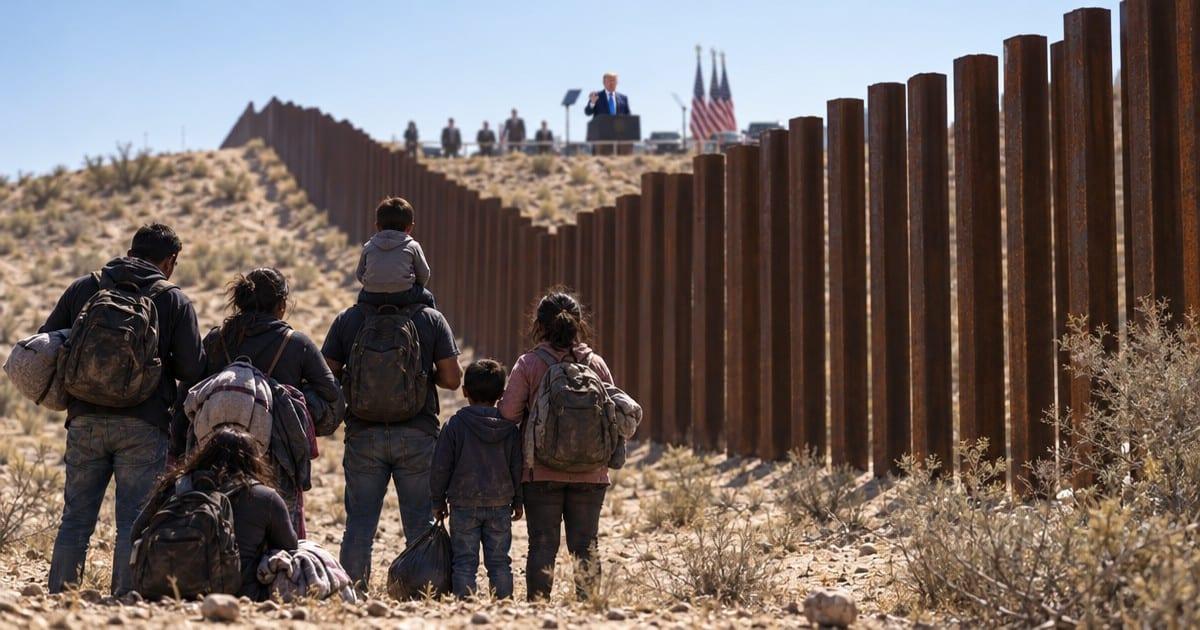
Migrants forming caravans and rushing the southern border are walking into a trap of their own making, Washington Examiner columnist Joe Concha said this week, warning that President Donald Trump's hard-line enforcement posture means there is almost no path through.
Concha's remarks, reported by the Washington Examiner, landed as groups of migrants were again massing toward the border. His argument was blunt: the caravans may have worked as political theater in past years, but they do not work against an administration that treats the border as a national security line rather than a public relations problem.
That is the core of Concha's point. A Congress controlled by the opposition can hold hearings, block legislation, and make noise. It cannot order Customs and Border Protection or Immigration and Customs Enforcement to stand down, and it cannot reverse the executive actions that have tightened asylum processing, expanded detention capacity, and kept removal flights moving.
The Examiner's coverage was amplified by its own social media account, which posted that Concha "slammed caravans of migrants rushing the border, warning that President Donald Trump's hard-line immigration enforcement leaves little chance of successfully crossing into the country."
"Washington Examiner columnist Joe Concha slammed caravans of migrants rushing the border, warning that President Donald Trump's hard-line immigration enforcement leaves little chance of successfully crossing into the country." — @dcexaminer on X
Concha described the caravans as a "fool's errand" — a phrase that cuts at both the migrants being organized into these groups and the activists and NGOs that promote them. The people boarding buses toward the border are being sold a promise that the numbers simply do not support. Under this administration, the calculus for an illegal crossing has changed: expedited removal, criminal prosecution for repeat entrants, detention instead of catch-and-release, and cooperation with state and local law enforcement in Texas, Arizona, and Florida.
The political backdrop is also different from the caravans of 2018 and 2021. In those years, the groups were used to pressure a White House that hesitated, and to generate images that could be blamed on enforcement. Today the White House does not hesitate, and the images cut against the organizers: crowded processing tents, removal flights, and migrants returned to their home countries.
Democrats on Capitol Hill have promised oversight of the administration's deportation operations and have signaled they will use their majorities to slow funding for detention beds and removal flights. That fight is real, but it is a Washington fight. It does not change what happens to a family that crosses the Rio Grande this week.
For Americans living in border communities, Concha's argument is less about politics than about what they see on the ground. Sheriffs in Texas and Arizona have reported continued pursuit of smugglers and stash houses, and ranchers along the river describe the same trespassing and property damage they have described for years. The difference now is that the people crossing are far more likely to be returned than released.
What remains unclear is the size and pace of the current caravans and how many people are actually moving north. The Washington Examiner's report does not provide figures, and independent counts of caravan sizes are notoriously unreliable because groups split, merge, and dissolve along the route. What is known is that Concha's central claim — that Democratic control of Congress does not equal control of the border — is a statement of constitutional fact.
Our Take
Concha is right, and the people who need to hear it most are the migrants being loaded onto buses by organizers who should know better. A caravan is not a moral statement and it is not a legal strategy. It is a crowd of human beings being pointed at a border that is now defended by an administration that does not apologize for defending it.
The activists and NGOs that assemble these groups have no answer for the question every migrant should ask: what happens when you get there? Under President Trump, the answer is detention, a court date that actually arrives, and a flight home. That is not cruelty — it is the law, finally enforced.
And to the Democrats now running Congress: oversight hearings and press conferences do not open the border. The sooner the caravan organizers understand that, the fewer people will waste their savings and risk their lives on a trip that ends where it started. The message should be sent in every language and on every radio station south of the Rio Grande: the door is closed, and it is locked.
