
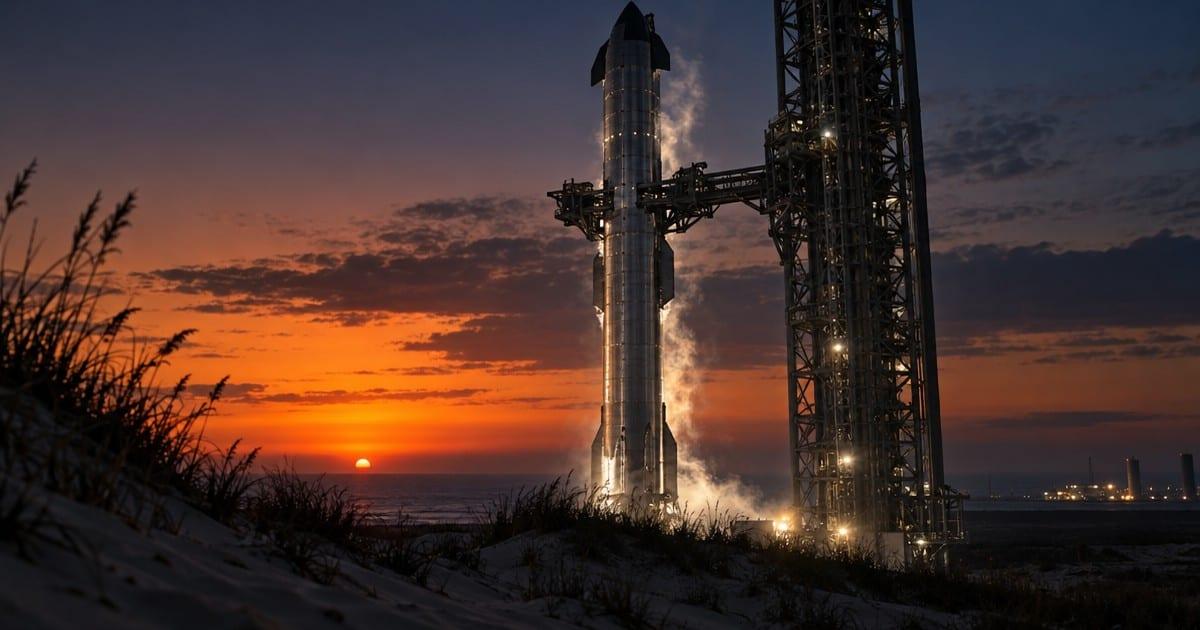
Saturday over Starbase, Texas, an American company reached into the sky and caught a 17-story spacecraft falling out of orbit. Not a government program, not a committee decision—just SpaceX, a launch tower, and two metal arms doing what NASA has never done: recovering an orbital-class vehicle in mid-air.
Flight 15 lifted off Friday from Starbase, spent about 22.5 hours aloft at 275 kilometers, deployed all 26 Starlink V3 satellites, and came home Saturday afternoon. The ship survived reentry and descended into the tower's steel arms, marking the first Starship ever recovered from an orbital mission. The words SpaceX used say it all: "Mechazilla catches Starship."
The Death of the Throwaway Rocket
For fifty years, launch costs kept the Moon and Mars on posters. Apollo burned about a billion dollars per shot. The Space Shuttle ate a billion and a half. Every rocket was thrown away after one use. Now SpaceX flies Falcon 9 for about $74 million per launch, and the stated Starship target is under $10 million.
Cheap heavy lift is sovereignty. Own it and you own the next fifty years in space. The Starship catch at Pad 2 is not a science experiment—it is the moment American launch capacity separated itself from the rest of the world.
ZetaReport wrote it best: "The new trick worked. The old one slipped."
The old one is the throwaway rocket—NASA's Apollo-era Saturn V burning a billion dollars a shot, NASA's Space Shuttle program eating a billion and a half—and every comfortable voice that said reusability was fantasy. Thirty-five years of American spaceflight were disposable. Now Americans in a hurry built that arc at Starbase, Texas, not a federal agency.
Candor That Exposes the Bureaucrats
The booster that had been caught three times before exploded over the Gulf of Mexico, and SpaceX said so directly, in the same statement as the catch. That candor is the point. The company reported the loss in the same breath as the success, proving that the mission was never about protecting a perfect score—it was about building a system that learns faster than any government-run program.
That is the American model: test, fail, fix, fly again, and catch 17 stories out of the sky. No committee meetings. No environmental impact statement stretching across a decade. No congressional hearing about why the rocket isn't diverse enough. Just builders building.
An hour after the chopsticks closed, Elon Musk stood under Ship 42 still hanging at Pad 2, Raptor engines in view from below. The image says what no press release can: reusability is not a concept, it is steel hanging in Texas air.
Every catch lowers the cost of putting Americans and American payloads into orbit, onto the Moon, and eventually onto Mars. This is what America First looks like when the federal leash is taken off: private enterprise out-innovating every nation on Earth from a beach in Texas, not a Washington conference room.
Keep the paperwork away from Starbase. Let the builders build.
