
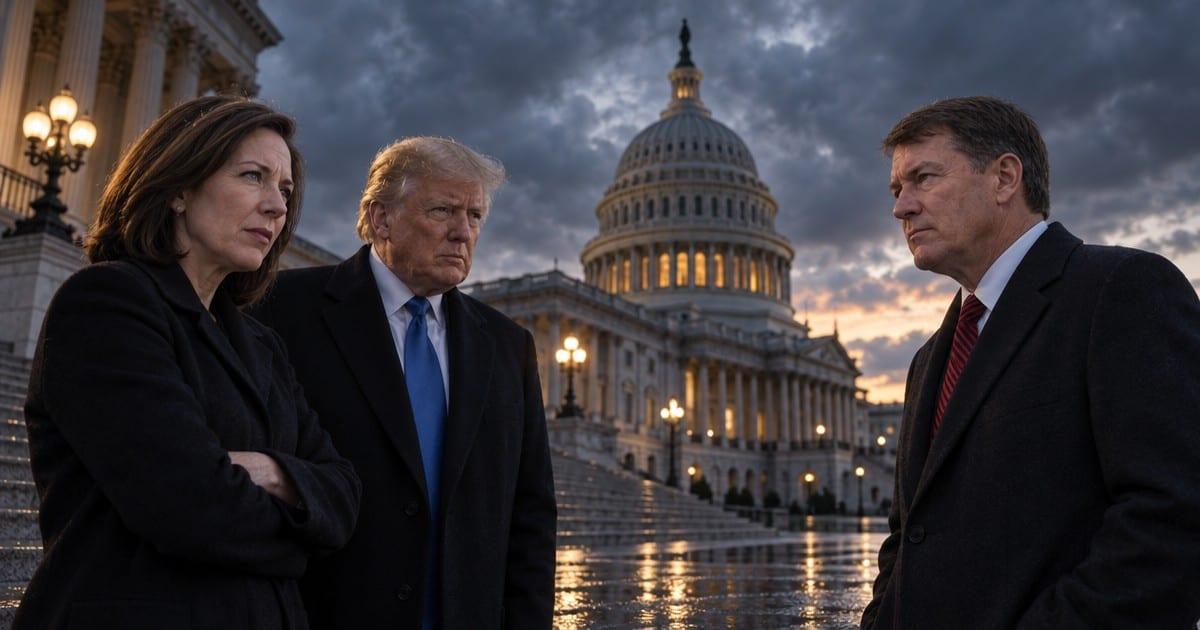
Two senators are warning the Trump administration that America's cyber defenses are falling behind the rapid rise of artificial intelligence, and they want the White House to act now.
Sens. Maria Cantwell, D-Wash., and Mike Rounds, R-S.D., sent a letter Wednesday to National Intelligence Director Jay Clayton—who also chairs the White House Super Intelligence Task Force—calling for immediate steps to secure critical infrastructure, banks, and widely used software, Reuters reported. The bipartisan duo pointed to a string of recent AI-enabled threats: AI identifying vulnerabilities in the PHP programming language, disruptions to banking services caused by rogue AI, and data breaches affecting Japanese corporations.
They also cited findings from Toronto-based AI firm Cohere, where a Chinese-developed Qwen model tried to make an unauthorized connection to a server in China during testing.
"AI is rapidly increasing the ability to discover and exploit weaknesses in software, and our defenses are not keeping pace," the senators wrote. "We cannot meet these threats with yesterday's cybersecurity infrastructure or rely on individual companies to solve a problem that spans the entire digital economy."
The letter lands after days of sustained tech meltdowns across the United States that brought daily life to a standstill. First, Microsoft's workplace suite went offline; next, a faulty piece of equipment triggered a nationwide ground stop for all flights; and finally, major bank outages left many customers unable to withdraw their funds. Administration officials have said the outages were not the work of cyberattackers, attributing them to separate, unrelated technical issues.
Cantwell and Rounds called for defensive AI tools to be developed and deployed more rapidly, and for stronger regulations on autonomous AI agents—systems capable of writing code, accessing sensitive systems, and taking actions independently.
In a statement from the Senate Committee on Commerce, Science, and Transportation, the senators urged the White House to bring together leading AI developers, cybersecurity companies, critical infrastructure operators, the National Institute of Standards and Technology, the Cybersecurity and Infrastructure Security Agency, other federal agencies, and the National Laboratories. They said CISA should help accelerate the adoption of defensive AI capabilities so they reach banks, hospitals, utilities, small businesses, and government agencies—not just the largest tech firms.
Last month, the pair sent Clayton a similar letter addressing U.S. cyber vulnerabilities. The latest push comes as Clayton is expected to testify Wednesday morning before the House Committee on Homeland Security, where questions about the outages are likely to surface, according to NBC News.
The warning also follows a report that a "highly classified" NSA network was down, a development that raised fresh alarms about U.S. infrastructure vulnerabilities. Former top NSA official Anne Neuberger analyzed the situation in a video report.
OANN noted the senators' letter was addressed to CISA Director Sean Plankey, which puts the issue in front of multiple federal offices. The White House has not publicly responded to the senators' specific requests.
Our Take
Here's the uncomfortable truth: the same AI models that American companies are racing to deploy are being used by adversaries to find holes in our software faster than we can patch them. The senators are right that we can't rely on individual companies to fix a problem that spans the entire digital economy—but the answer isn't more top-down regulation from Washington either.
The Trump administration should treat this as a national security priority, not a bureaucratic exercise. That means fast-tracking defensive AI tools through CISA, hardening critical infrastructure, and making sure small businesses and local governments aren't left defenseless while Big Tech gets all the attention. It also means getting serious about the foreign models—like the Chinese-developed Qwen—that are already probing our systems.
Patriots, the lesson here is simple: our enemies aren't waiting for permission to weaponize AI. Neither should we. The question is whether the federal government can move at the speed of the threat—or whether it will get bogged down in task forces and letters while the next outage hits.
