
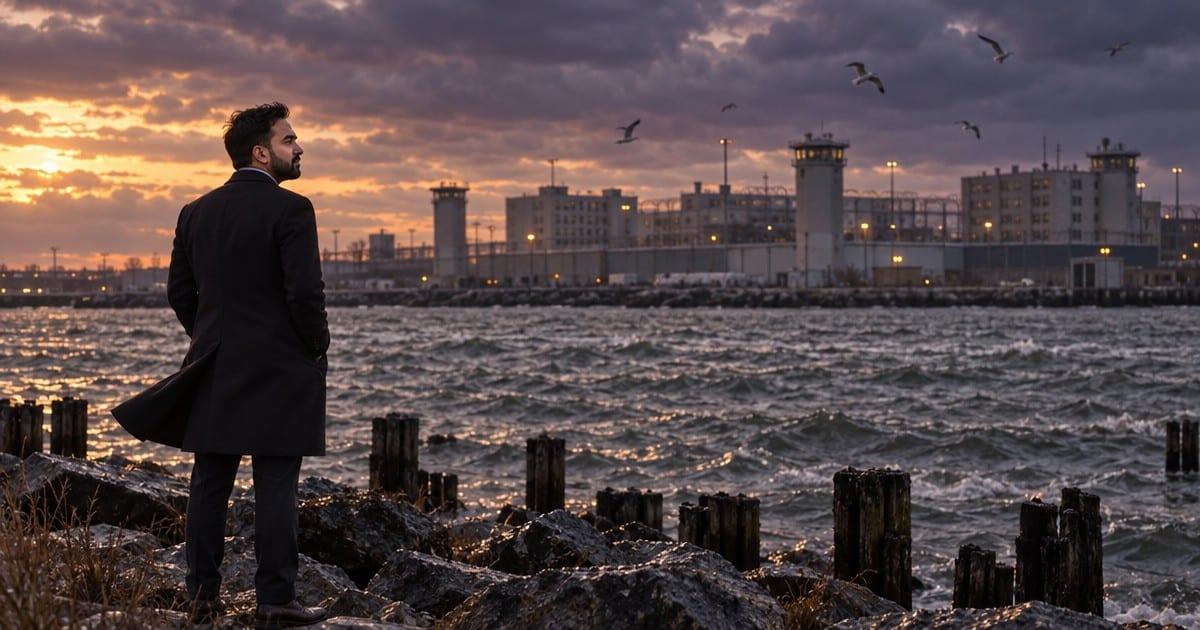
New York City Mayor Zohran Mamdani announced Friday a long-awaited plan to empty and close Rikers Island, pushing the jail complex's court-mandated closure deadline from August 2027 to the end of 2032 and aiming to slash the number of detainees behind bars well before the doors shut for good.
Mamdani, a Democratic Socialist who took office this year, unveiled the blueprint in a video posted to X alongside Stanley Richards, commissioner of the New York City Department of Correction. The plan would reduce the city's jail population from roughly 6,600 detainees in early November to no more than 5,500 by 2029 and about 4,100 by the end of 2032, according to Newsweek. The city would pivot to four smaller borough-based jails — Brooklyn opening in 2029, followed by the Bronx and Queens in 2031 and Manhattan in 2032 — with Rikers permanently closing on Dec. 31, 2032.
"It is time to finally close Rikers Island," Mamdani said in a statement released with the plan. "For decades, New Yorkers have demanded a correctional system that is safe and humane."
The plan includes $146 million in investments aimed at reducing pretrial detention, speeding up court delays, and funding supervised release, reentry programs, housing and jail alternatives. In a letter accompanying the announcement, Mamdani wrote that the nearly century-old jail system "has stood as a symbol of the failures of our criminal legal system," adding that "closing Rikers is essential to building a city that is safer and more just."
The original closure mandate came from a 2019 City Council law requiring Rikers to close by August 2027. Mamdani's administration blamed the delay on pandemic-related court backlogs, what it called a "lack of prioritization" from the Eric Adams administration, and delays from the state, according to FOX 5 New York. The new timeline formally abandons the 2027 date that voters were promised seven years ago.
Rikers has been under federal scrutiny for years over violence inside the complex and failures in caring for detainees with serious mental health and medical needs, CNN noted. The plan's release comes as the jail remains under a federal monitor that has flagged the facility for failing to meet court-ordered cleaning and maintenance standards — and as the complex faces the possibility of a federal takeover. The city opened a 104-bed therapeutic unit at NYC Health + Hospitals/Bellevue earlier this year and permanently closed the vacant North Infirmary Command on Rikers, Newsweek reported.
The announcement drew immediate attention on social media. An Instagram post indexed Friday shows Mamdani visiting inmates at the Rikers facility; NPR's Instagram account also posted on the mayor's plan. Those posts circulated as the plan went public, with the mayor presenting the closure as a fulfillment of a long-held ambition rather than a new idea.
What the plan does not answer is where the reduced population goes and what happens to detainees the city would otherwise hold before trial. Four borough jails replace one island complex, and the $146 million in alternatives funding is aimed at keeping people out of custody — meaning the plan depends on courts processing cases faster and on programs succeeding at reducing recidivism. Critics of the original 2027 law argued that the borough jails would not be ready in time; Mamdani's 2032 timeline effectively concedes that point while keeping the closure as the goal.
Our Take
Let's be clear about what Mamdani just did. He took a law New Yorkers were sold as a 2027 promise, blew past it by five years, and wrapped the delay in a press release about "dignity." The same mayor who wants to empty Rikers is the one who needs New Yorkers to believe that releasing detainees and shrinking the jail population won't land on their streets, in their subways, or in front of their businesses.
The plan's math is simple: fewer people locked up, more money for programs, and a closing date a decade out. What's missing is any serious accounting for the victims — the ones Mamdani's own letter mentions only in passing. New Yorkers deserve a justice system that is safe and humane. But "safe" has to mean something for the law-abiding people living in the boroughs where these four new jails will sit, not just for the people inside them.
And here's the question every New Yorker should ask before 2032: if the jails aren't ready and the courts still aren't fixed, who exactly is going to be held accountable when Rikers' inmates are simply let go instead? The mayor has a plan to close a jail. He still hasn't shown us a plan to keep the rest of the city safe.
