
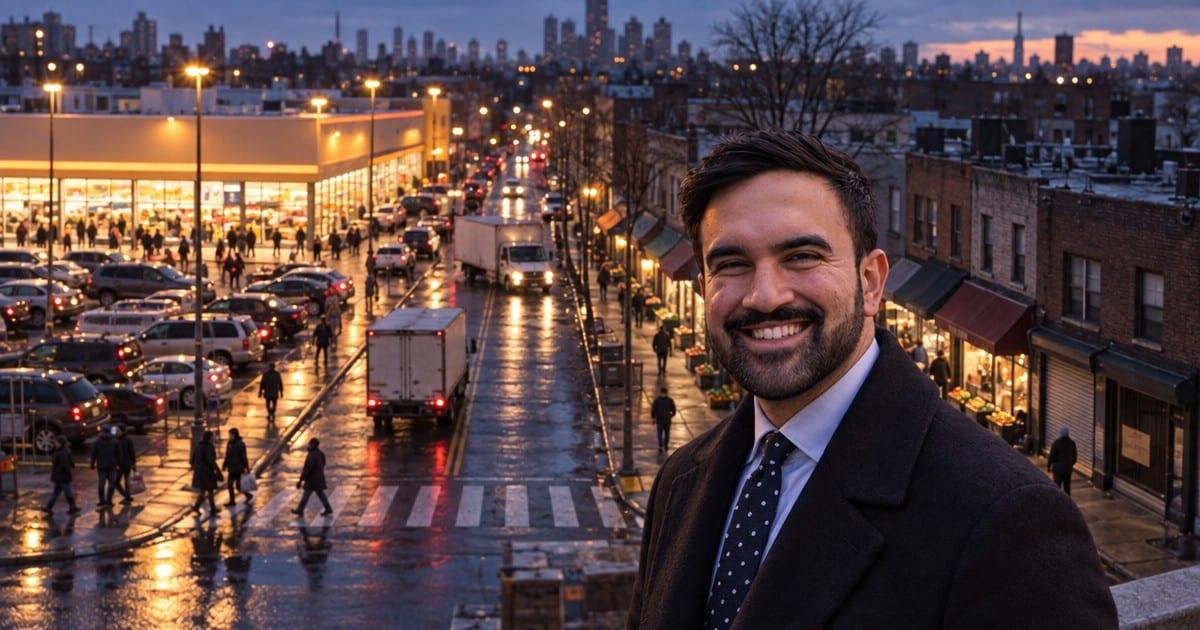
New York City Mayor Zohran Mamdani sat down with CNBC's Andrew Ross Sorkin at the DealBook Summit this week and walked straight into a question he couldn't answer.
Sorkin pressed the mayor on the economics of his plan to open five city-owned grocery stores that would sell staple items at a 30% discount. The problem, as Sorkin pointed out, is that supermarkets already run on profit margins of just 1% to 4%. So how does a government-subsidized competitor selling below market rate do anything but undercut the businesses already serving New Yorkers?
"How is this going to work at all? Just walk through the math when you think about it," Sorkin asked, according to Fox Business.
Mamdani's answer was essentially: we'll subsidize it.
"Right, it is going to be subsidized," Mamdani said. "Okay, and so my question is how you see that subsidy long-term affecting the other supermarkets in the city?" Sorkin followed up. The mayor did not directly answer how the subsidy would affect competing supermarkets, per Fox Business.
When Sorkin demanded the mayor "explain the math" behind skyrocketing grocery prices and how his plan addresses them, Mamdani instead offered a philosophical defense of government-subsidized goods.
"When society deems something necessary for the public, then we subsidize its creation and operation," Mamdani said, according to the DealBook exchange. "We know that so much of what we rely on for the public sector is not being paid for at price, whether it be the subway, or a public school, or a library, or sanitation, we have determined, 'This is necessary.' And when I think about what is necessary for a dignified life in New York City and anywhere frankly, it is very easy to come back to food, because we can't live without it."
It's a stirring speech. It's not an answer to the question. The question was not whether food is necessary. The question was what happens to the 400-plus supermarkets already operating in New York City—the ones run by families and small operators who don't have the city treasury backstopping their losses.
The Numbers Problem
Sorkin's math is not complicated. If a private grocery store buys a box of cereal for $3 and sells it for $3.15, that 15-cent margin pays for rent, payroll, refrigeration, insurance, and the owner's kids' college fund. When the store down the street is selling that same cereal for $2.20 because taxpayers are covering the difference, the private store doesn't have a pricing problem. It has a survival problem.
The National Supermarket Association, representing 150 members operating more than 400 supermarkets in the city, saw this coming. The group sued to block Mamdani's plan under federal antitrust law, arguing the 30% discount constitutes predatory pricing. On Thursday, federal District Judge Jennifer L. Rochon ruled against the association, allowing the program to proceed, according to The Epoch Times.
Rochon found the association failed to prove the city is engaging in predatory pricing—that even if prices 30% below market are below cost, it did not prove the city has a plan to recover losses by driving rivals out of business. Lower prices are only anti-competitive, Rochon reasoned, if the city plans to raise them later.
That ruling may satisfy antitrust law. It does not satisfy the grocery store owner in the Bronx who wonders what happens when the city opens a subsidized competitor at the end of 2027 and sells staples cheaper than he can buy them wholesale.
"So what are they going to create? A monopoly price in New York City," said a supermarket operator identified as Nuñez, who told The Epoch Times he fears he won't be able to compete once the city opens its store in his neighborhood. "New York City is an extremely competitive market. You don't have one entity that fixes the price and says this is the price for sugar, this is the price for meat, this is the price for orange juice. You have nothing like that."
The association's president, Peña, said independent supermarkets should not be placed at a structural disadvantage when competing with government-funded stores that receive construction funding, operating subsidies, and tax advantages unavailable to ordinary neighborhood businesses, per The Epoch Times.
The Tax That Isn't on the Rich
Mamdani's grocery plan is part of a broader push that includes pressuring Governor Kathy Hochul to raise taxes on high earners, as Politico reported. But as Hot Air noted this week, businesses don't actually pay taxes—they pass costs to customers. If the city raises the cost of doing business in New York, the cost shows up at the register.
That's the lesson from Amazon, which announced this week that it would impose a $5 fee on orders, citing the city's Delivery Protection Act. Amazon is a multi-trillion dollar company. If Jeff Bezos adds $5 to your order, it's not because of City Council's efforts to protect workers' rights and keep our streets safe. It's not greed. It's a cost of doing business in a city that keeps making doing business more expensive.
Which brings us back to Sorkin's question. The supermarket association may have lost its case in court. But the math hasn't changed. The city plans to find a private operator to run these stores at a 30% discount, and the city will subsidize the difference. What is not yet known is exactly how large that subsidy will be, what happens to it when the next mayor takes office, or what recourse the private store owner has when the city opens a door down the street and starts selling below his wholesale cost.
Mamdani told New Yorkers during the campaign that he knows how to deliver affordability and justice for working people. Sorkin asked him to show the work. The mayor offered a philosophy lecture instead.
Our Take
The grocery store question is the whole socialist project in miniature. When you can't explain the math, you change the subject to "dignity." When someone asks what happens to the butcher, the baker, and the family that runs the corner market, you invoke the subway and the library. But the subway doesn't have a private competitor on the next block. The library doesn't sell books at a 30% discount and call it public infrastructure.
What Mamdani is proposing is not a public good. It is a government-subsidized competitor, funded by taxpayers, designed to undercut private businesses that operate on tiny margins. The grocery store owners of this city are not the enemy. They are the people who stayed in neighborhoods when the big chains left, who know their customers by name, who sponsor the Little League team. Now they're being told to compete with City Hall.
And note the timeline. The city hasn't even found an operator yet. The first store isn't scheduled to open until the end of 2027. This is a plan built on a promise, litigated on a technicality, and defended with a speech. The math is still missing. And the people who will pay for that missing math are the taxpayers and the small business owners who didn't ask for any of this.
Patriots, this is what happens when you elect people who have never signed the front of a paycheck. They think running a business is simple. They think profit is a dirty word. They think you can vote yourself a discount and send the bill to someone else. Sorkin asked a simple question. Mamdani couldn't answer it. That silence is louder than any campaign promise.
