
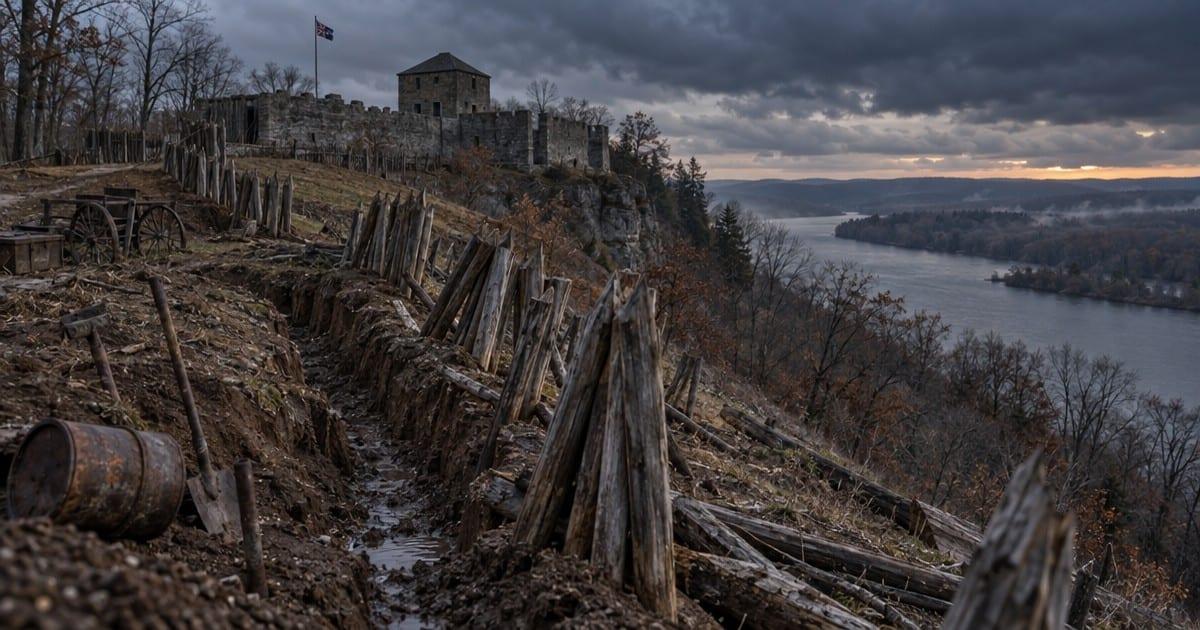
The white flag fluttered in the chilly autumn breeze on November 16, 1776. Colonel Robert Magaw, commander of Fort Washington, received a British staff officer carrying a truce flag demanding the surrender of the fort. If Magaw refused, he and his men would be put to the sword. He had two hours to decide.
But the fort's fate had already been sealed—not by the British, but by one of Magaw's own. According to an account published by Breitbart, Magaw's trusted adjutant, William Dement, a fellow Pennsylvanian and former sniper, betrayed his fellow Americans by giving the British the fort's plans, its weak points, and the disposition of Magaw's troops. The British knew exactly how to take the bastion.
Fort Washington sat near the eastern end of the present-day George Washington Bridge, perched 230 feet above the Hudson River. Its earthen walls and redoubts stretched for over a mile and housed about forty brass and iron cannons. But the five-sided earthen bastion atop a rocky crag lacked bombproof magazines, barracks, and—most critically—a well for a reliable water source.
General George Washington wanted to abandon the fort named in his honor, but Major General Nathanael Greene considered the position impregnable and persuaded him to leave a garrison there. Greene had just reinforced Magaw with hundreds of additional troops.
At daybreak on November 16, 1776, British General William Howe attacked with about eight thousand British and Hessian troops, striking Fort Washington's defenses from four sides. Outnumbered nearly three to one, Magaw attempted to defend the indefensible by positioning riflemen about a mile outside the fort along the likely avenues of the British advance.
The fighting was fierce. According to the Breitbart account, fifteen-year-old Daniel Bendinger, younger brother of a rifleman, yelled, "There! Take that, you—!" and reportedly discharged his rifle twenty-seven times during the firefight. The Revolutionary snipers, particularly Thompson's Pennsylvania Rifle Battalion, had an outsized influence on the fate of the war. Some of the best marksmen in Washington's army, many were long hunters.
Despite their valor, the fort fell. The betrayal by Dement—whose name history has largely forgotten—had delivered the keys to the British. The loss of Fort Washington was a devastating blow to the American cause, costing the lives and freedom of thousands of soldiers and leaving New York City firmly in British hands for the remainder of the war.
The story, as recounted by Breitbart, shows that even the most valiant defense can be undone by treachery from within. It is a lesson that resonates as powerfully today as it did in 1776.
Our Take
Here's what the establishment historians won't tell you: the loss of Fort Washington wasn't just a military defeat—it was a betrayal. William Dement, a man Magaw trusted, sold out his countrymen for his own ends. And while the name Dement may be lost to history, his treachery echoes through the ages.
How many Dements are there today? How many people in positions of trust are quietly handing over the plans, the weak points, the troop positions to those who would destroy this country?
We see it every day. The bureaucrats who leak, the officials who undermine, the so-called Republicans who vote with the Democrats when it matters. They are the spiritual heirs of William Dement.
But here's the thing: the American spirit—the spirit of Magaw and his riflemen—didn't die at Fort Washington. It lived on at Trenton, at Saratoga, at Yorktown. It lives on today in the hearts of patriots who refuse to surrender, who refuse to be disarmed, who stand ready to defend their God-given rights.
So the question is: when the white flag comes to you, what will you do? Will you surrender like Dement? Or will you stand like Magaw and say, "If you want it, come and take it!"?
Patriots, the fight for America's soul is on. Be the one who stands.
