
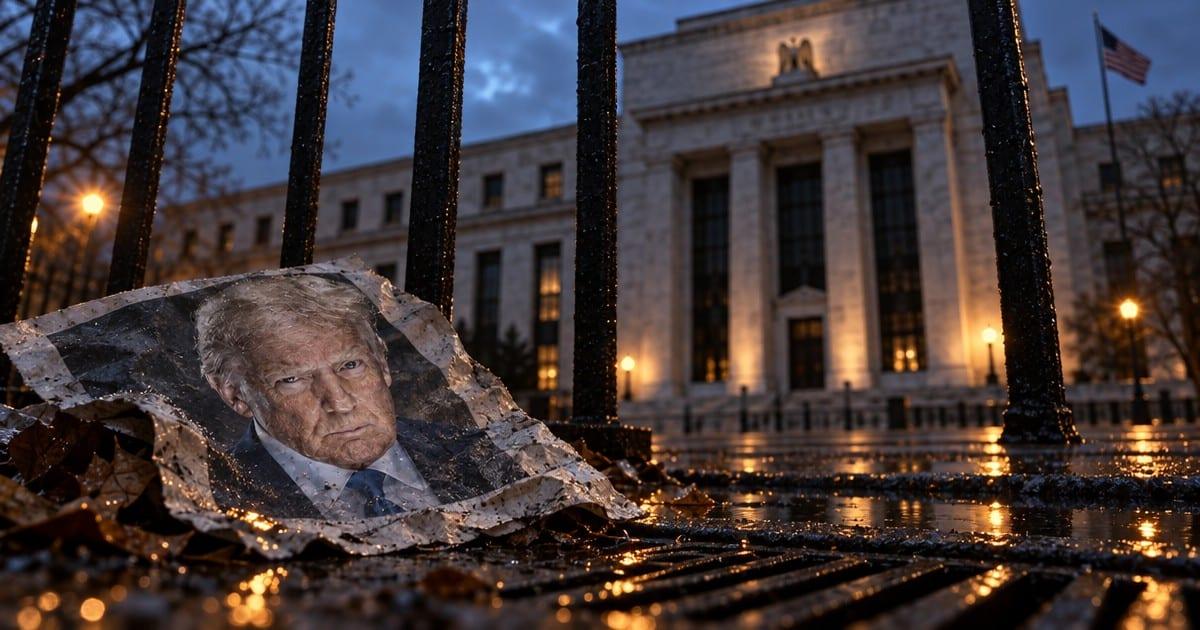
The Federal Reserve released the minutes of its October 27-28 Federal Open Market Committee meeting on Tuesday, and they show Fed Chair Kevin Warsh and his fellow policymakers fretting over two things at once: the inflation they blame on President Donald Trump's policies, and the artificial intelligence boom that has powered the Dow Jones Industrial Average, S&P 500 and Nasdaq Composite to a string of record highs this year.
According to The Motley Fool, which reviewed the minutes, the AI infrastructure build-out kept coming up when FOMC members discussed vulnerabilities in the financial system. The Motley Fool noted that the stock market entered 2026 at its second-highest valuation in the last 156 years, and that bond prices for most hyperscalers and neoclouds have declined sharply throughout the year — what the outlet described as the bond market "sounding a deafening warning about the AI infrastructure build-out."
Wall Street has spent 2026 rallying on AI. The Motley Fool cites IDC putting the cumulative addressable opportunity from 2025 to 2031 at $22.5 trillion, and points to the scale of capital hyperscalers are committing to data centers and computing capacity. But the same outlet reports that corporate bond traders are not buying the story — prices that should sit near par value if investors trusted the issuers' ability to service debt have been sliding all year.
WHAT THE MINUTES SAY
The FOMC meeting minutes are released three weeks after each meeting and detail the behind-closed-doors discussions, not just the rate decision. The Motley Fool reported that AI was a recurring topic in the financial-stability portion of the October talks. The minutes come as the Fed, under Warsh, has already been raising interest rates to fight what the outlet calls "Trumpflation" — inflation tied specifically to the president's tariff and trade agenda.
The minutes themselves are a record of discussion, not a policy commitment. The Fed does not publish the identities of individual speakers in the minutes, and the document does not announce any new action on AI or asset prices. What it does is put on paper that the central bank's financial-stability committee has been weighing whether the AI trade is overextended — a question bond investors have been asking with their wallets all year.
WHY IT MATTERS FOR AMERICANS
For everyday investors, the minutes matter because the Fed's view of financial stability feeds into how it sets rates. If the FOMC treats the AI rally as a bubble risk, that argues for tighter policy — which means higher borrowing costs for mortgages, car loans and small business credit. If it treats AI spending as genuine productivity growth, the case for holding rates high weakens. The Motley Fool's reporting suggests members are split enough that both concerns are live.
For the Trump administration, the minutes are a reminder that the Fed's inflation fight is not over. Warsh, installed as chair during the second term, has been raising rates over what the central bank attributes to Trump's tariffs, even as the president presses for lower rates and faster growth. The October minutes land as the White House pushes its America First trade agenda and energy dominance package, both of which the Fed's inflation models are still digesting.
For the tech sector, the bond-market warning is the number to watch. The Motley Fool notes that hyperscalers and neoclouds have seen their bond prices fall even as their stock prices climbed — a divergence that historically resolves in one direction or the other. If the FOMC's concern becomes policy, the easy money behind the AI build-out gets more expensive.
The minutes do not name specific companies, do not set a timeline for action, and do not say the Fed believes a bubble exists. They show that the question is being asked inside the room.
Our Take
Here's the tell: the Fed spent the entire year telling Americans that Trump's tariffs were the inflation problem, and now its own minutes show the bigger risk may be the AI casino on Wall Street. You don't get to lecture the country about price stability while a handful of hyperscalers torch billions in borrowed money to build data centers and call it productivity. The Motley Fool is right that the bond market has been screaming for months — and the FOMC, which supposedly watches financial stability, is only now putting it in the minutes.
Notice what's missing from the Fed's worry list: the cost of money for the family buying a first home, the small business owner who can't get a line of credit, the worker whose wages are eaten by the inflation the Fed itself helped create with years of easy money. Warsh and company are worried about the balance sheets of neoclouds. Patriots should ask why the central bank is more attentive to Silicon Valley's leverage than to Main Street's.
The AI build-out may be real. It may also be the biggest margin call in history waiting to happen. Either way, the people who get hurt when it unwinds are not the ones in the FOMC's meeting room — they're the ones holding the bag in their 401(k)s. Keep your eyes on the bond market, folks. The Fed just told you it is.
